Driving licence · Theory practice

Practice test 3

70 questions · Pick an answer to see whether you are right. Your answers are saved in this browser.

0of 70 correct
Not started

0 of 70 answered

0Correct
0Incorrect
70Unanswered
14Mistakes allowed

The real test has 70 questions in 50 minutes. You need 56 correct (80%) to pass.

Question 1

When should you turn your full beam headlights back on after meeting another car in the dark?

Explanation

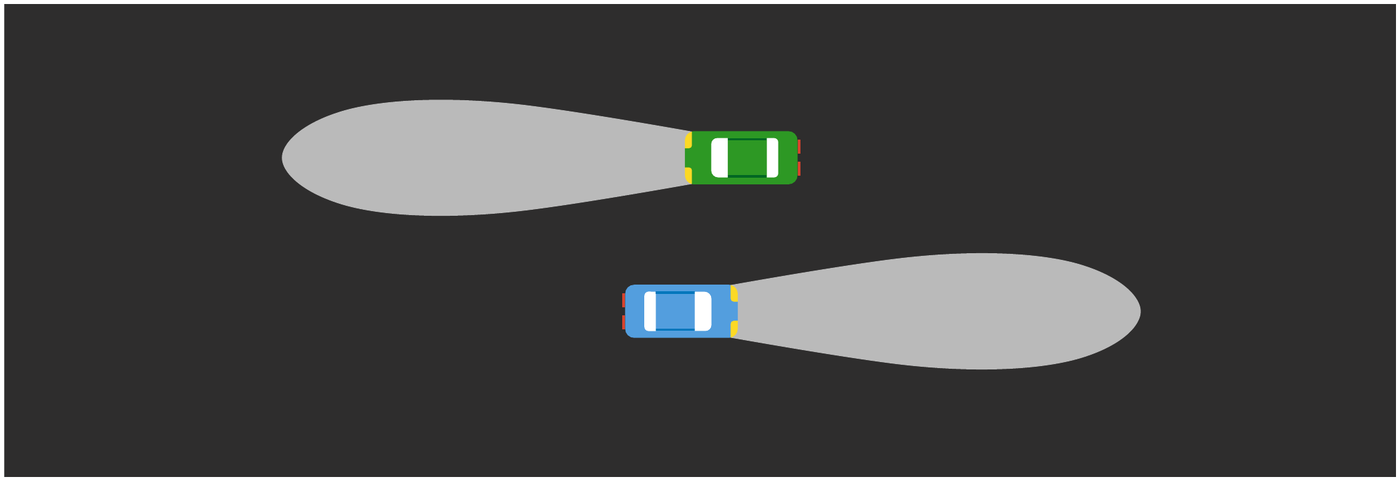
You should turn your full beam headlights back on as you are meeting. The aim is to regain a longer line of sight as soon as possible.
Du och jag i trafiken [You and me in traffic], 28th Edition, page 275
Illustration

Study the picture. The harshest part of the light is focused far ahead of you, so you will not dazzle the oncoming driver to the side when you turn your full beam headlights on.
Question 2

Which alternative is something that contributes to the acidification and eutrophication of water, while also having an effect on our breathing?

Explanation

Nitric oxide “acidifies land and water. Contributes to the eutrophication of lakes [...] effects of [...] our airways.” (Driving Licence Book, 19th Edition, page 228)

Question 3

You are washing your car in an automatic car wash. What should you do afterwards?

Explanation

Test the brakes [...] after washing the car [...] When you test the brakes, they heat up and dry out any moisture.
Driving Licence Book, 19th Edition, page 130

The brakes are not water protected in the same way as the electric system. Water can therefore lower the effectiveness of the brakes.

Question 4

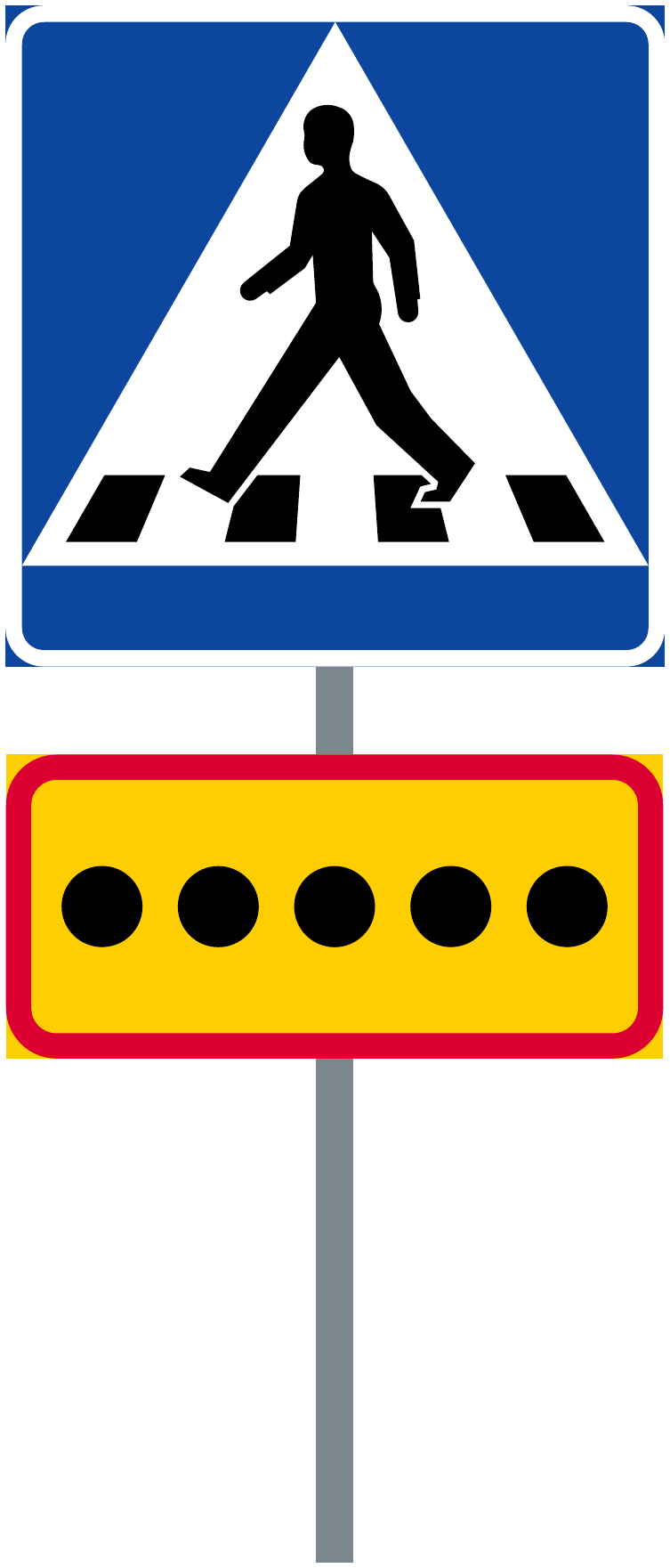
What does this sign combination mean?

Picture for the question

Explanation

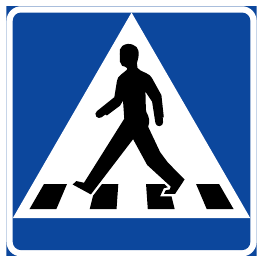
Pedestrian crossing
Pedestrian crossingB3
Visual impairment
Visual impairmentT9

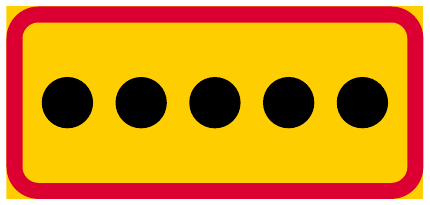
The panel indicates that people with visual impairments often use the crossing. This panel always has a yellow background.

Question 5

The car has stopped to wait for the road to clear. What do you think about its positioning?

Picture for the question

Explanation

Stop line
Stop lineM13

The marking indicates where a vehicle should be stopped according to a road sign or traffic signal.

The vehicle shall stop right before the stop line, not over it. The placement of the stop line has been chosen to provide good visibility if you stop right before it.

Question 6

What is true regarding a type-approved towbar retrofitted to a type-approved private car?

Explanation

The Swedish Transport Agency is easing the regulations for registration inspection of towbars. […] The new rules stipulate that a type-approved private car or light truck, that has a type-approved coupling device retrofitted, no longer needs to undergo a registration inspection.
Swedish Transport Agency

Previously it was the case that a registration inspection was required.

Question 7

What does the term perception mean?

Explanation

Nationalencyklopedin: “perception, the fundamental function used by all living beings to become aware of relevant aspects of the world around them and to put themselves in relation to it.”

Question 8

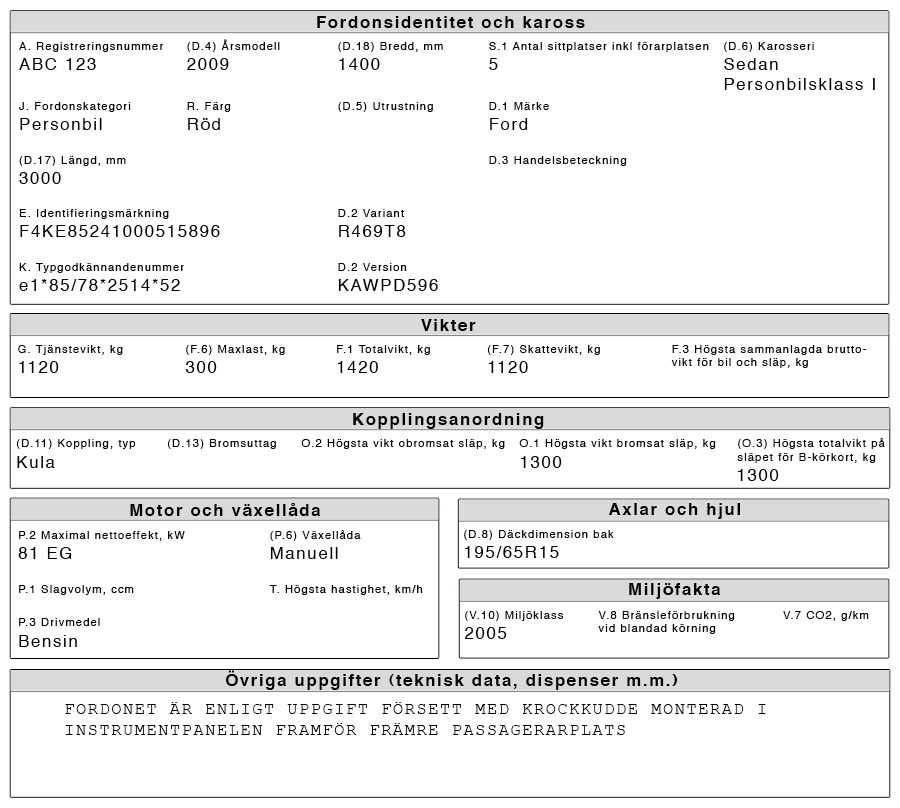
You intend to tow a braked trailer with a total weight of 1,290 kg using the car with this registration certificate. Which of the following is true?

Picture for the question

Explanation

(O.3) The maximum total trailer weight with a category B licence, kg that is stated on the registration certificate is 1,300 kg, which means that towing 1,290 kg is permitted.

Question 9

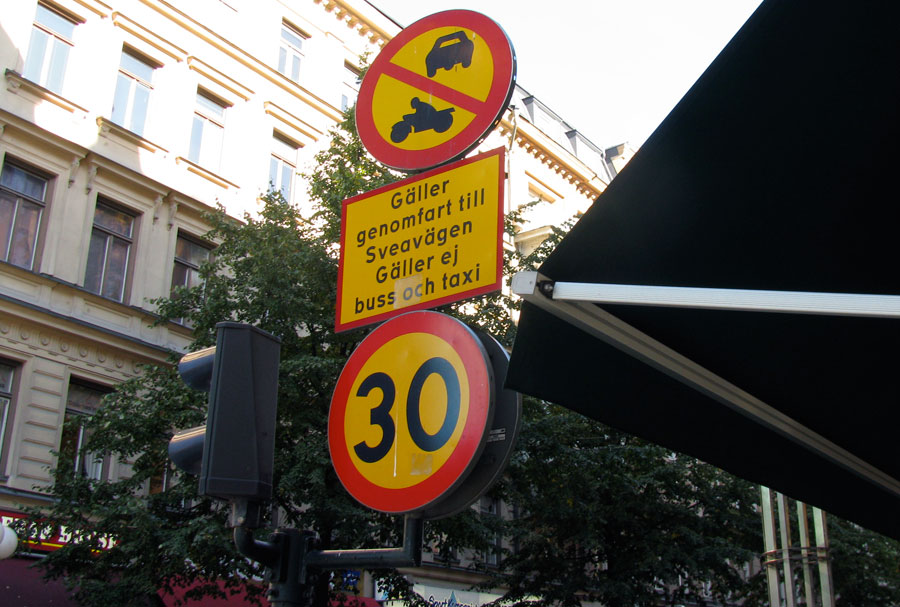
You are collecting a friend who lives a bit in on the street where this sign is erected. Are you allowed to drive in with the car?

Picture for the question

Explanation

”Genomfart” = through traffic

The additional panel indicates that the prohibition on motor vehicle traffic only applies to “through traffic to Sveavägen”.

There is no clear and general definition of what “through traffic” actually is. Picking up a person is in all likelihood not classed as through traffic. It is not even certain that you will continue through to Sveavägen; maybe you will turn around and drive back the same way.

Question 10

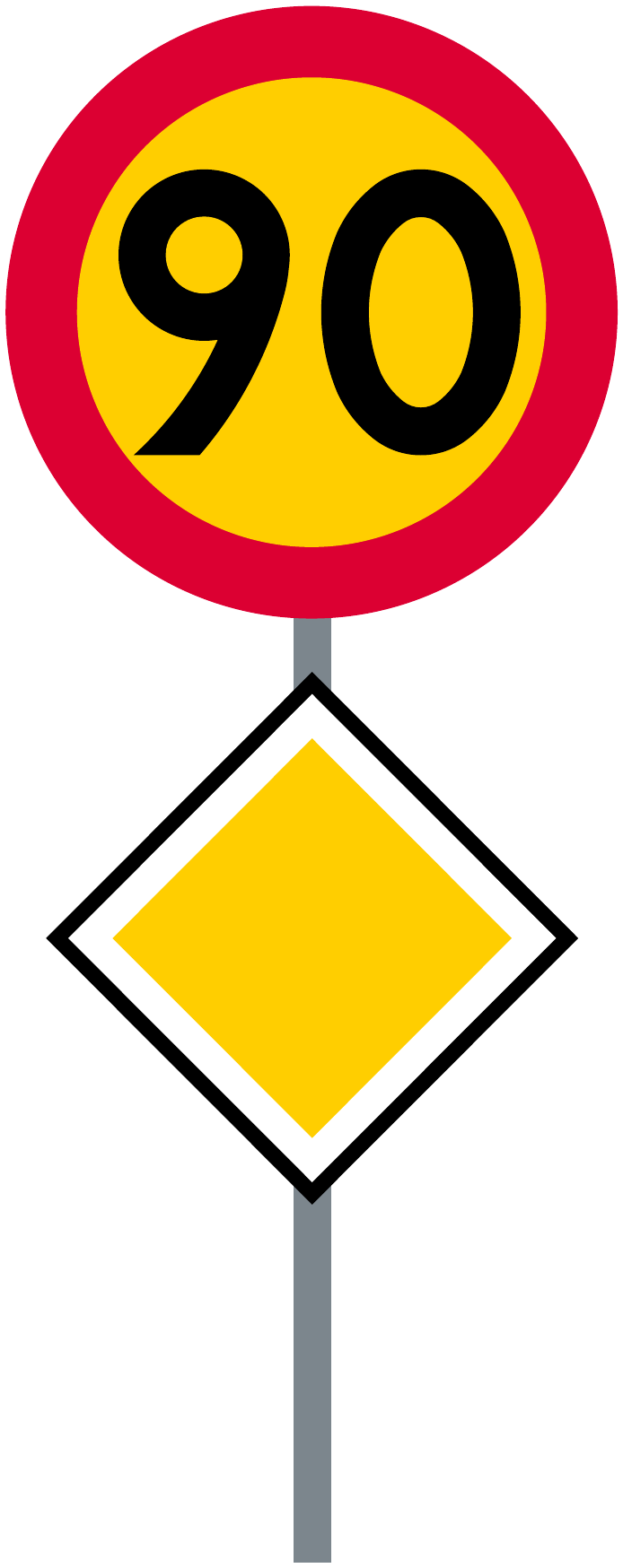
What is the maximum speed for a heavy lorry on a road with this combination of signs?

Picture for the question

Explanation

A heavy lorry is permitted to drive at a maximum speed of 90 km/h on motorways and clearways and a maximum 80 km/h on all other roads.

Since the sign does not indicate that this is a motorway or clearway, the applicable speed is 80 km/h.

Question 11

Is it true that fuel consumption is reduced by around 10% if you lower your speed from 110 km/h to 100 km/h?

Explanation

If you lower your speed from 110 to 100 km/h, you reduce your fuel consumption by 10 per cent.
Swedish Transport Administration

Why is this relevant?
– This has to do with the environmental objectives in the driving licence training. The lawmakers have an interest in you being aware of tips and tricks to lower fuel consumption.

Question 12

Which type of tyre entails the greatest risk of aquaplaning?

Explanation

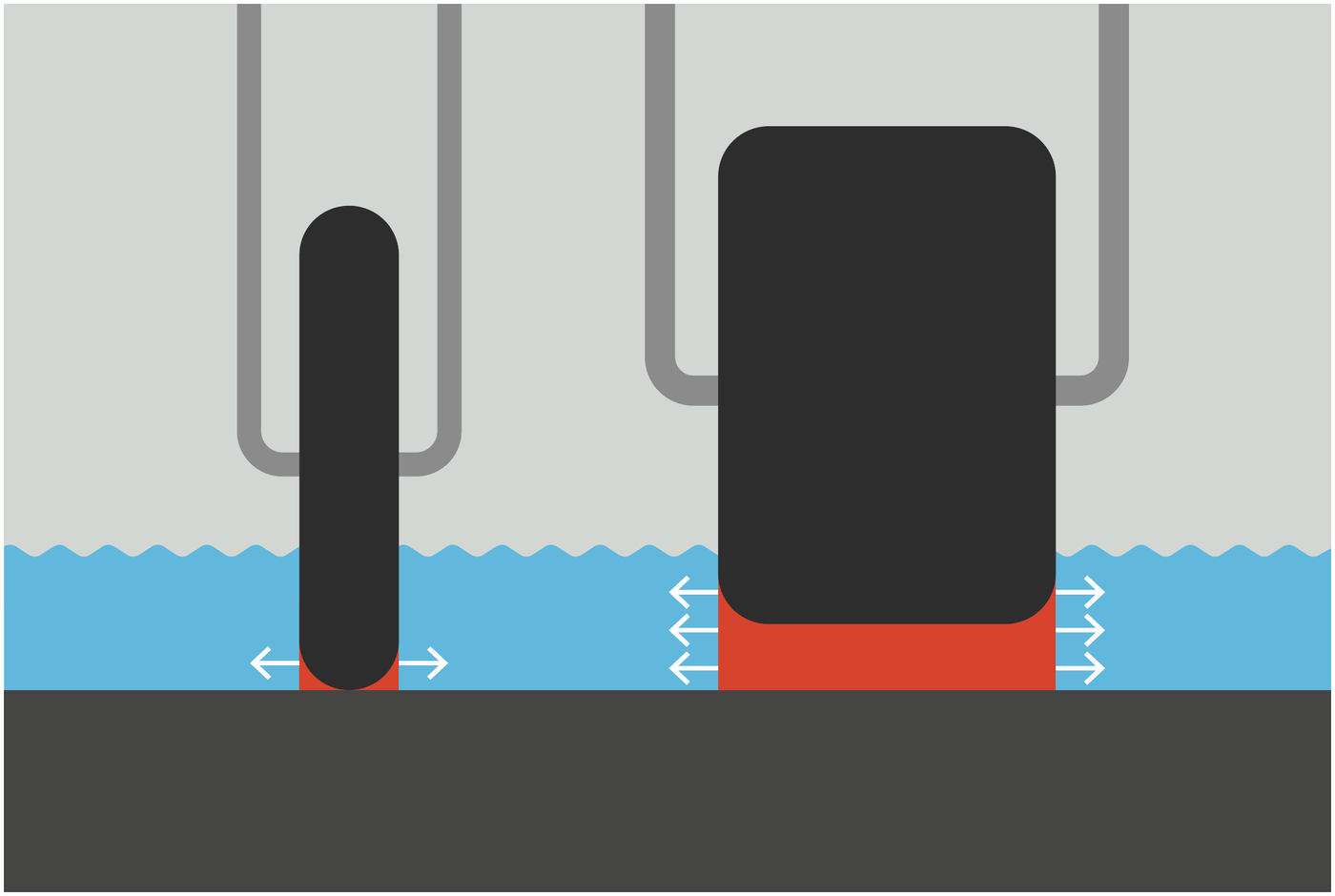
Illustration

Red = the amount of water that has to be dispersed for the tyres to have contact with the road.

Wider tyres mean that more water needs to be pushed aside, which leads to a greater risk of aquaplaning. The narrow tyre cuts through the water like a knife. The wide tyre instead becomes an uncontrollable boat.

Question 13

What is the basic speed limit in a densely populated area?

Explanation

The basic speed limit on Swedish roads is 50 km/h in densely populated areas
Swedish Transport Administration
Question 14

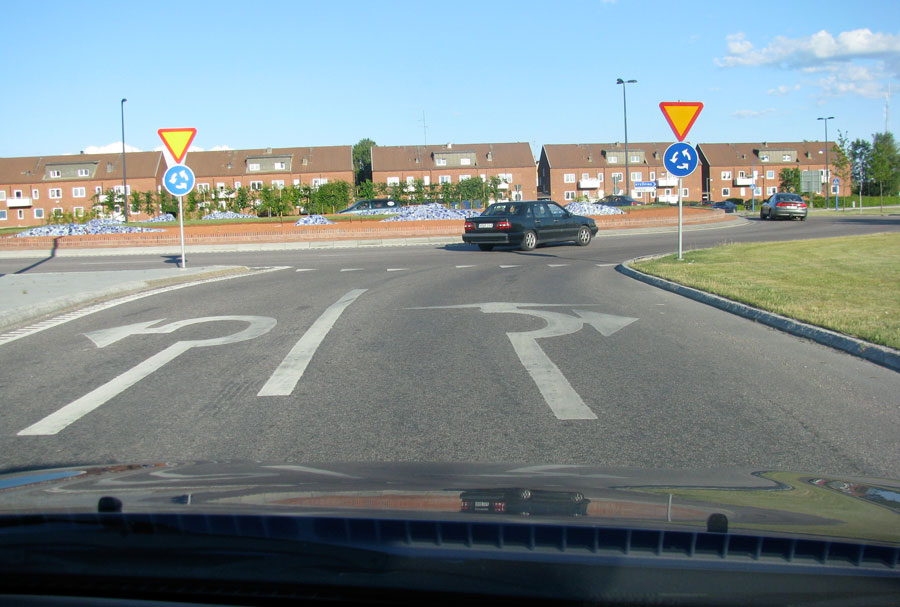
You position your car in the right lane and when you enter the roundabout you intend to turn off at the first exit road on the right. Do you have to indicate when exiting the roundabout?

Picture for the question

Explanation

When a driver intends to pull away from a curb or turn around, turn off, change lanes or move the car sideways in any way not considered insignificant, the driver shall use their indicator to show their intention.
Swedish Road Traffic Ordinance

The fact that there are arrows on the ground has no significance. Other road users further on do not see these arrows, right?

Question 15

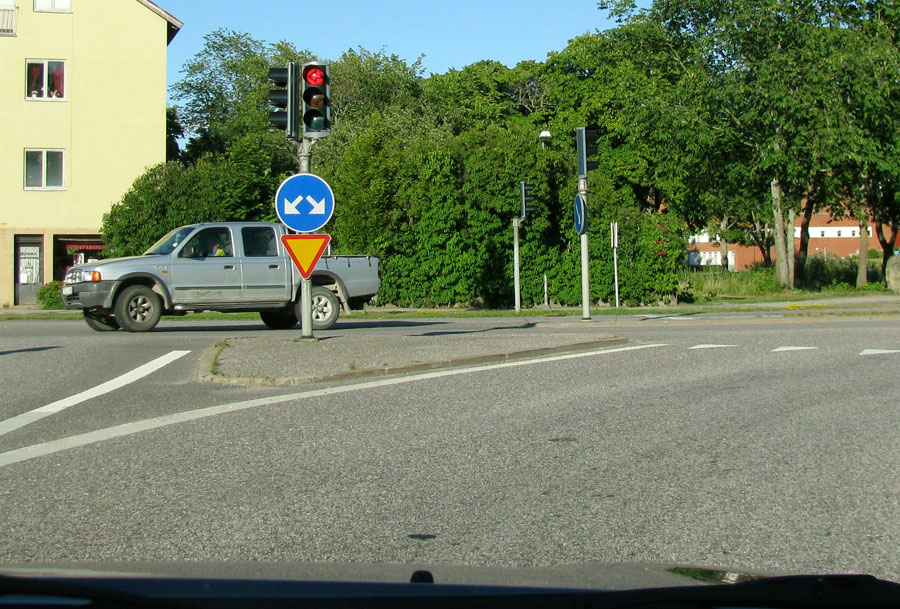
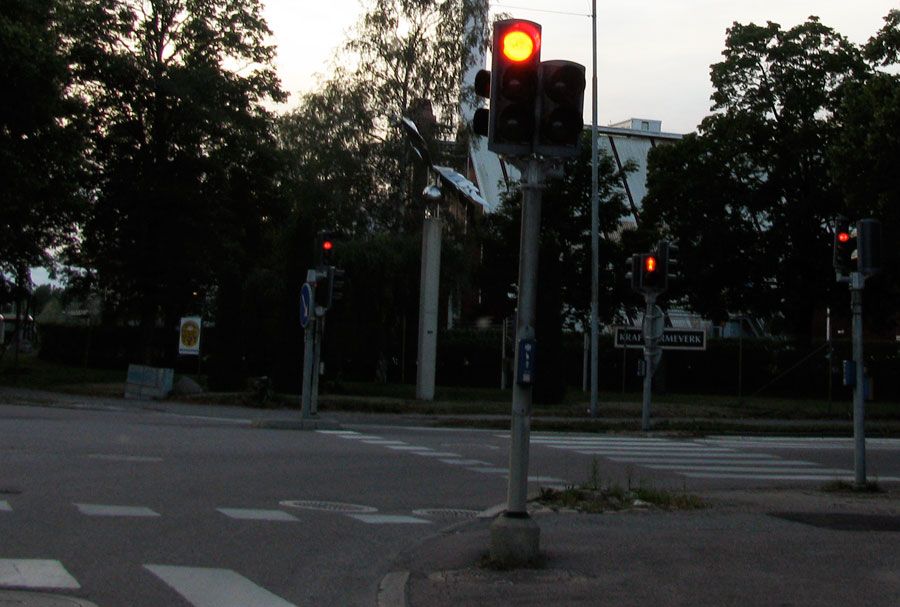
You are driving the car from which the picture is taken. After the grey car, the intersecting road is free of traffic. Are you allowed to turn right directly without stopping?

Picture for the question

Explanation

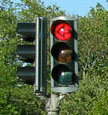
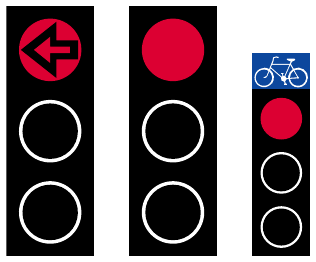
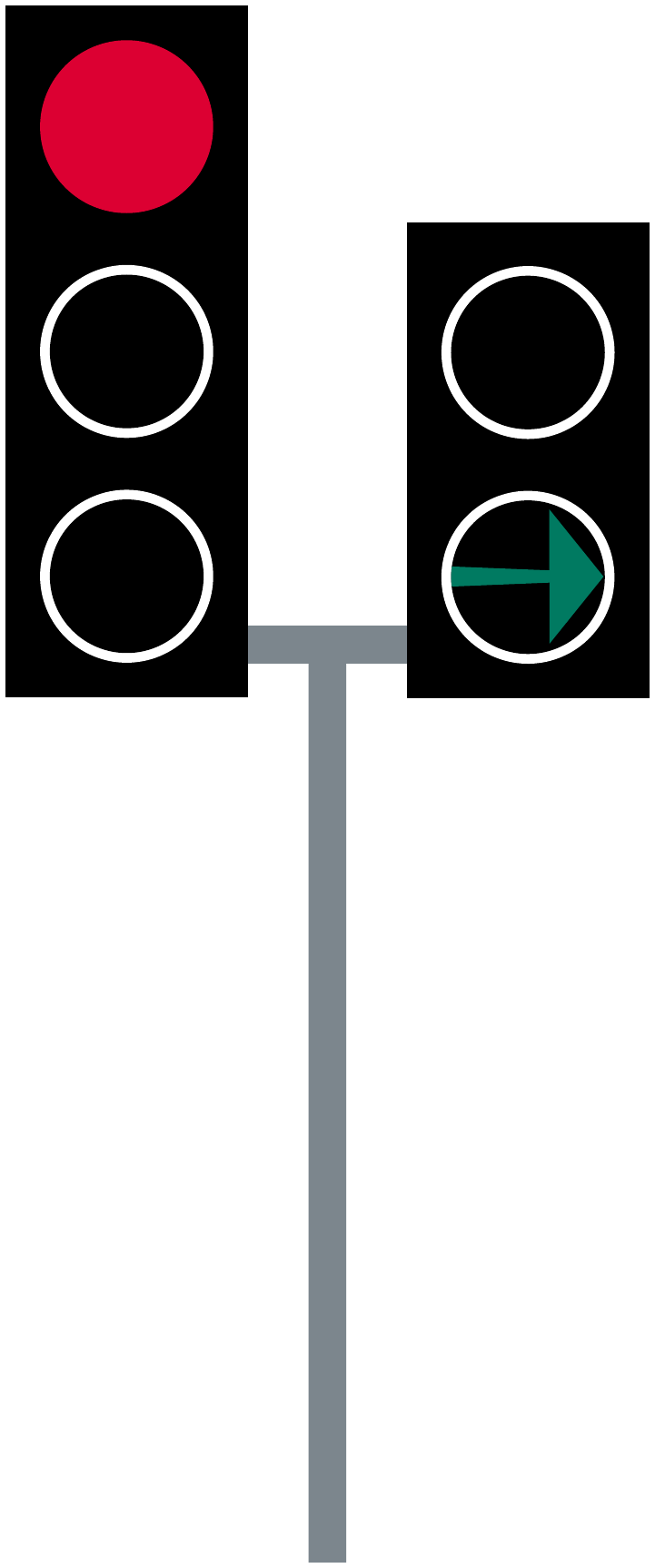
Enlarge the first picture by clicking on it. Then it is fairly clear that there is an arrow on the red light:

Illustration
Red
RedSIG1

Stop. A vehicle may not pass the stop line or, in the absence of such, the signal. A signal with an arrow outline only applies to the direction or directions indicated by the arrow.

You are turning right, which means that you do not have to obey the red signal since it only applies to those turning left.

The picture is unclear!
– Yes, that is intentional. Reports from the real test indicate that small details in pictures that are hard to see can determine a whole question.

Question 16

Is traffic the main cause of air pollution in many densely populated areas?

Explanation

Emissions from road traffic is the primary cause of air pollution in densely populated areas.
Driving Licence Book, 19th Edition, page 228
Question 17

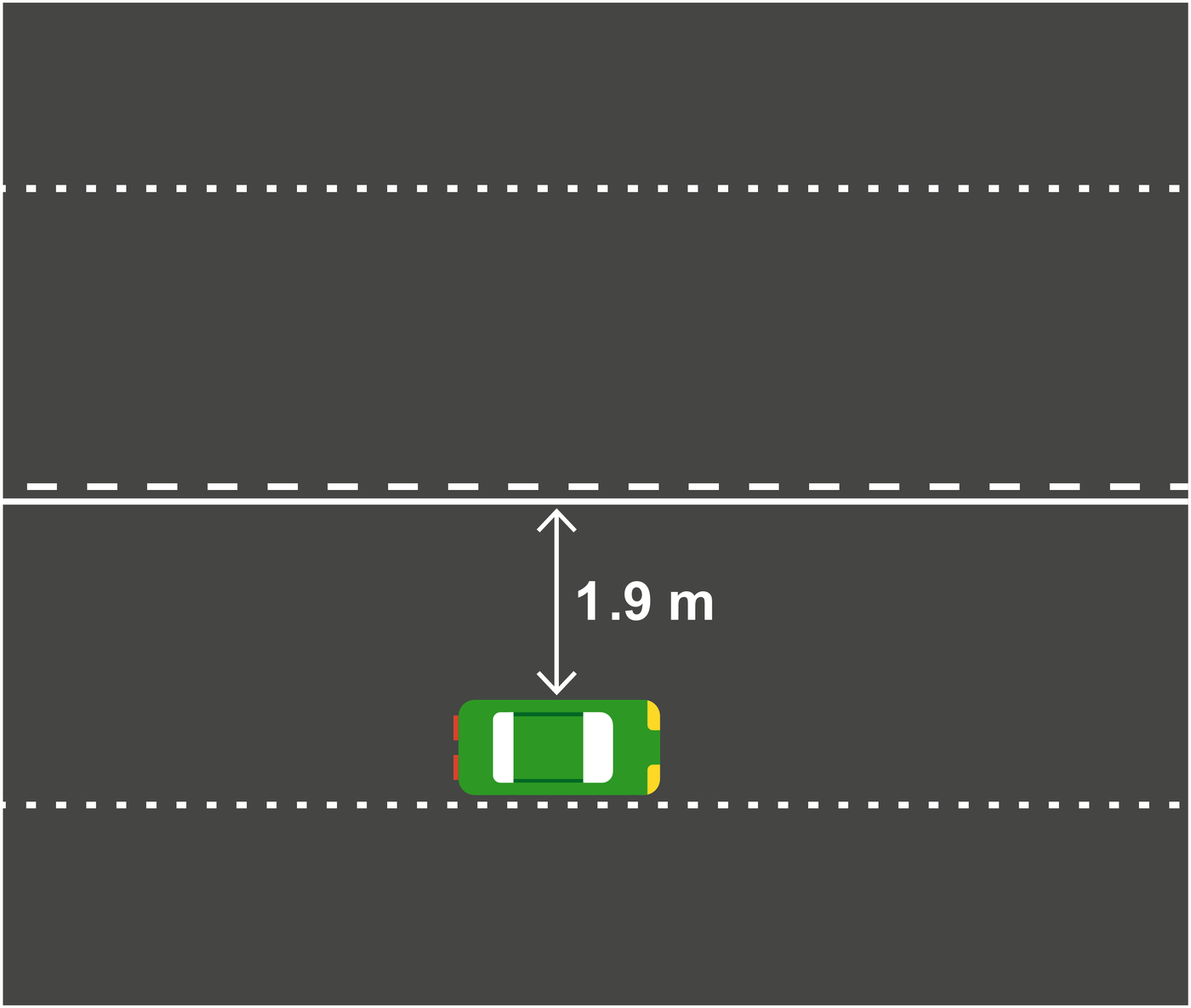
The green car has stopped. Which alternative is true?

Picture for the question

Explanation

A vehicle may not be stopped or parked [...] along a roadside where a solid line indicates the boundary between lanes, if the distance between the vehicle and the line is less than three metres, unless a broken line is running between the vehicle and the solid line
Swedish Road Traffic Ordinance

In this case, the broken line is on the left side of the obstruction line, which means that parking is prohibited.

However, it would have been permissible to stop on the other side, as the cars behind you on that side are not subject to the obstruction line and can therefore pass easily.

Question 18

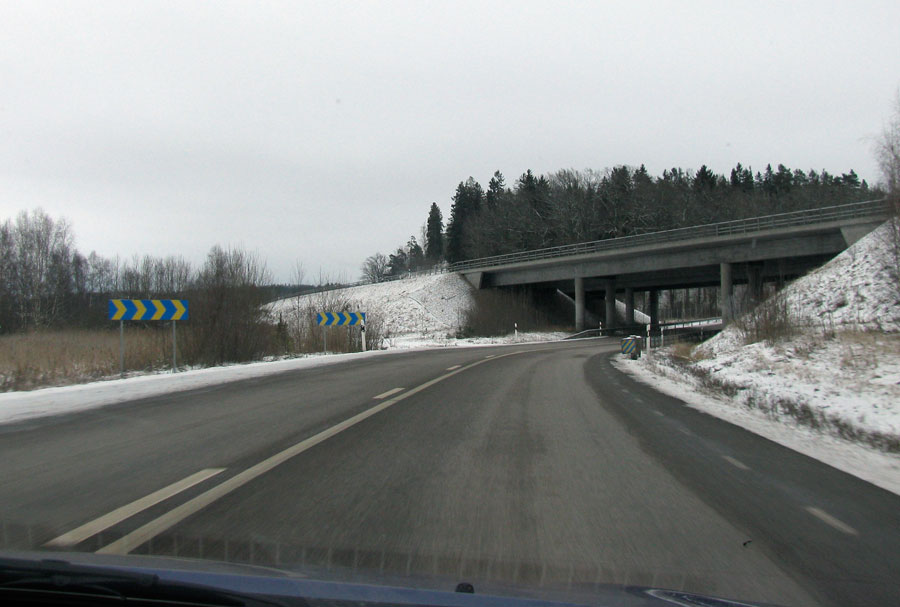
What is indicated by the two arrow signs to the left of the picture?

Picture for the question

Explanation

Arrow marker
Arrow markerX1

The device indicates that motorists must make a sharp turn in the arrows direction because of, for example, a bend. If the device is used during roadworks or similar work, the background is red.

Question 19

What does the traffic signal mean?

Picture for the question

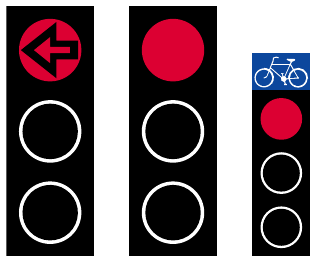
Explanation

Red
RedSIG1

Stop. A vehicle may not pass the stop line or, in the absence of such, the signal. A signal with an arrow outline only applies to the direction or directions indicated by the arrow.

You should only concern yourself with signals that are lit. The right signals are not lit. This means that you are not allowed drive in any direction.

Question 20

Is it true that train crossing signs do not necessarily have to be posted on private roads with limited traffic?

Picture for the question

Explanation

Train crossing
Train crossingA39

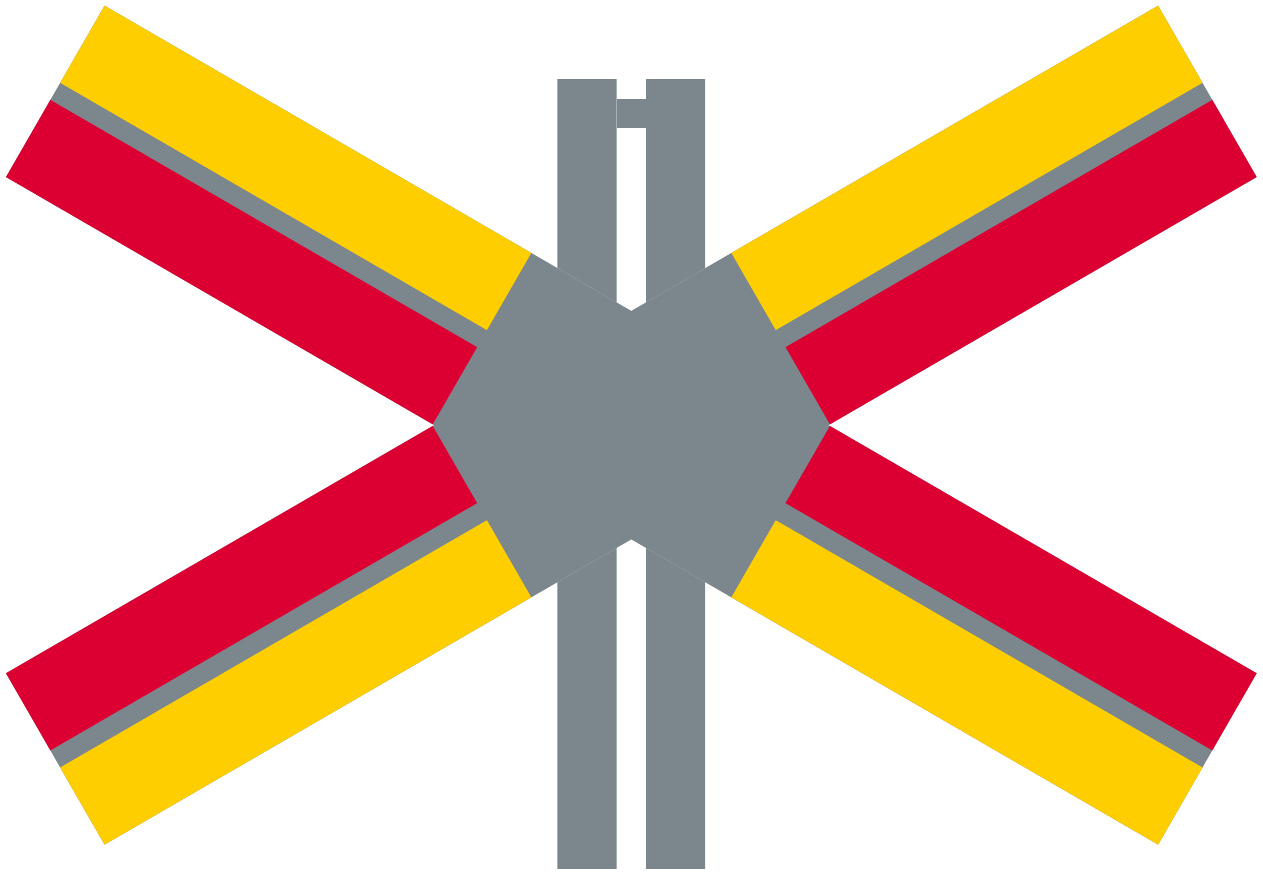
The sign indicates a crossing railway or tramway with one or more tracks. The sign is posted immediately prior to a level crossing. It does not have to be posted on a private road with limited traffic where it can be omitted without threatening traffic safety. The sign can also be posted at unlevel railway or tramway crossings. The post holding the sign can be fitted with a red/yellow post marking device.

Question 21

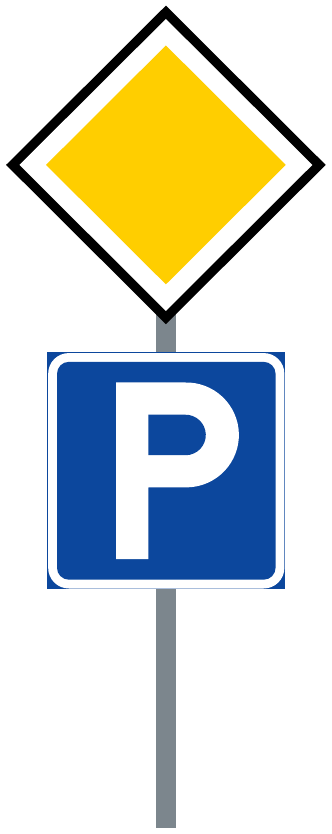
Is there something wrong with this combination of signs?

Picture for the question

Explanation

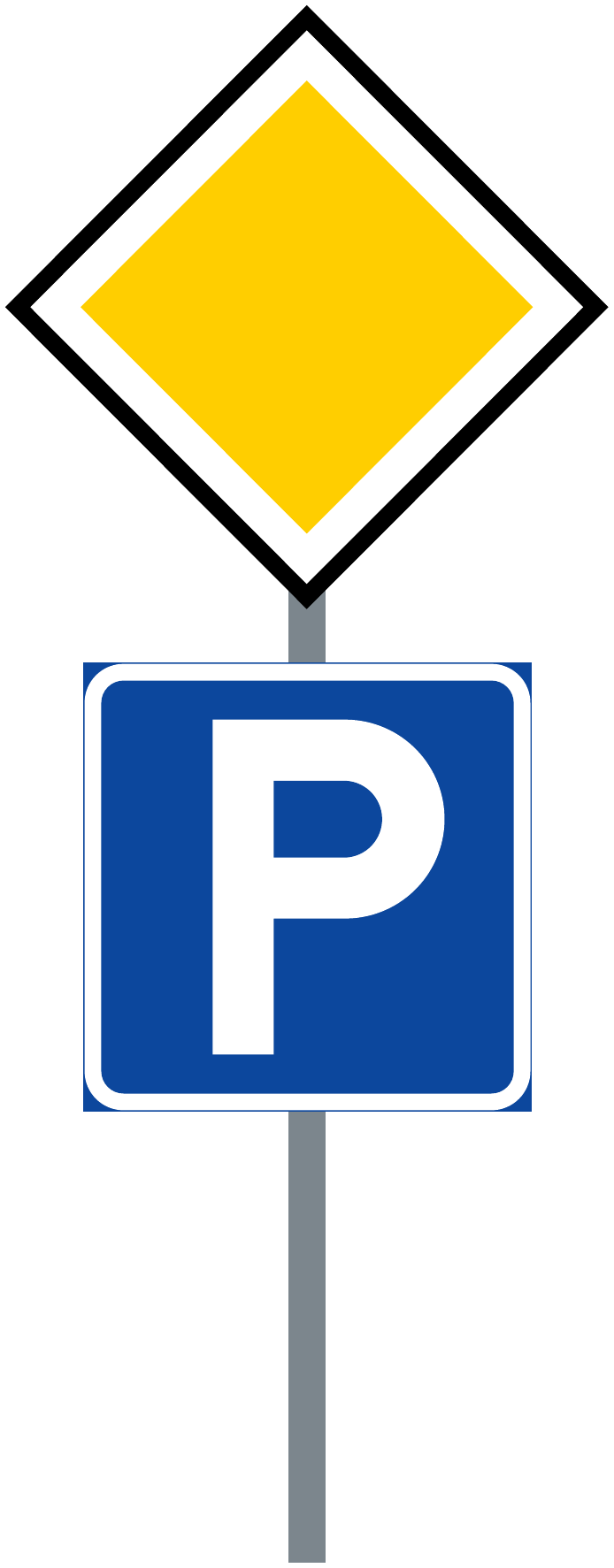
There is generally a parking prohibition on priority roads. If there is a parking sign, however, it overrides this rule since signs take priority over rules (think of a junction; if a stop sign has been posted, it takes priority over the right-hand rule).

Question 22

What should you do to conserve fuel in this situation?

Picture for the question

Explanation

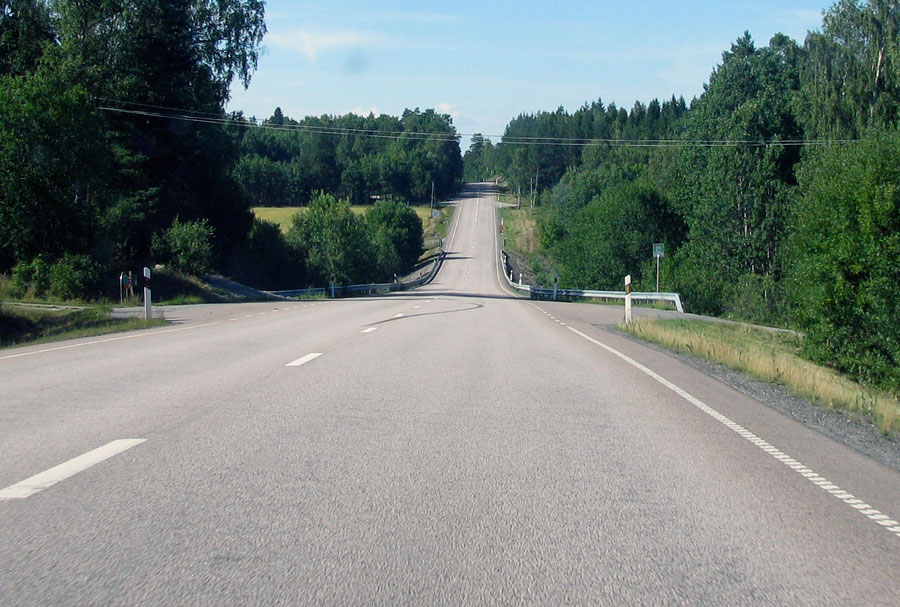
When going downhill, you can let up on the accelerator if the slope is steep enough. [...] If there is an uphill slope after the dip, you can utilise the higher speed from going downhill by staying in a high gear while going up it. This will conserve fuel. Do not accelerate going uphill; instead, maintain an even pressure on the accelerator to save as much as possible.
Swedish Transport Administration
Question 23

What percentage of those killed in traffic are men?

Explanation

Year Men killed Women killed Percentage of men

2017 196 58 77%

2018 249 75 77%

2019 169 52 76%

(Swedish Transport Agency)

Question 24

When does the warning cease to apply?

Picture for the question

Explanation

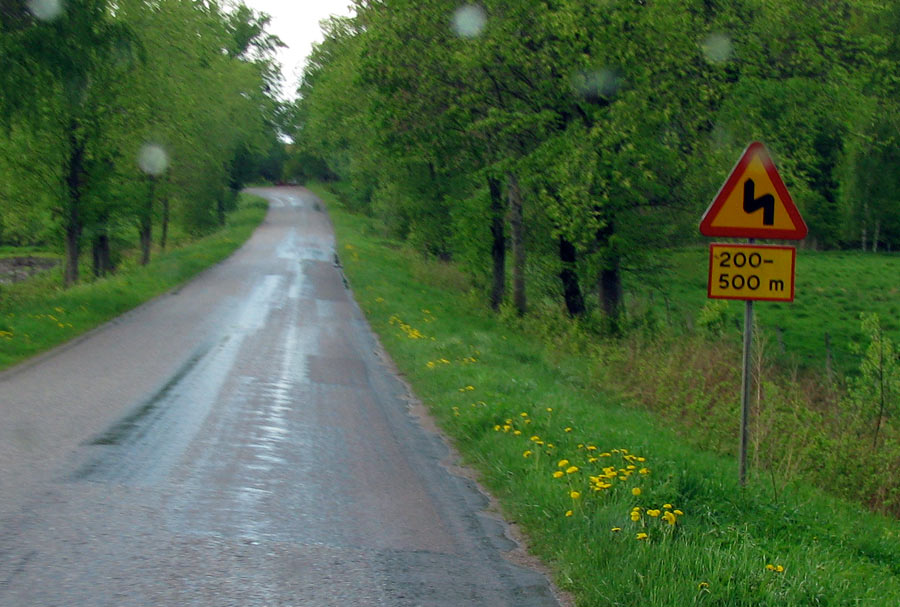
Explanation for the numbers on the additional panel: Starts to apply 200 metres after the sign and ceases to apply 500 metres from the location of the sign. You can also think of it as the sign being applicable for 300 metres starting at the 200-metre mark, since 200 + 300 = 500.

The question is when the sign ceases to apply. The correct answer is 500 metres after the sign. The numbers at the bottom are always the furthest limit and you should never end up with a number greater than that.

200 + 500 is therefore incorrect. “300 metres after the sign” is also incorrect (it would have been right if it had said “300 metres after the 200-metre mark”).

Question 25

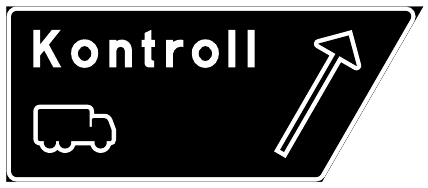
You are driving a private car and see this sign. What should you do?

Picture for the question

Explanation

Checkpoint
CheckpointP6

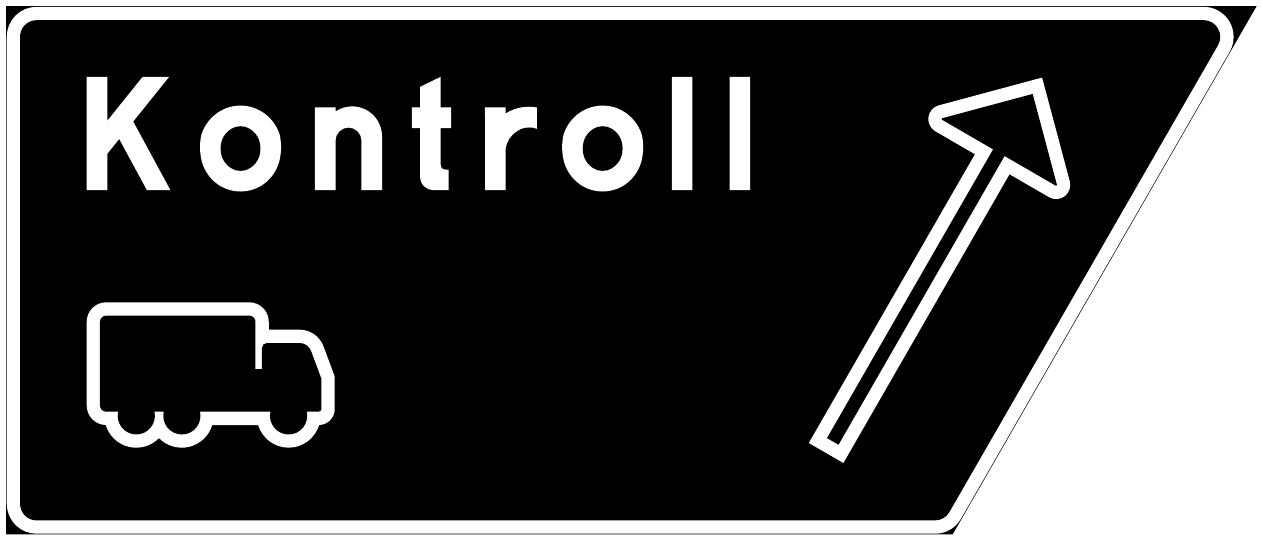
When these symbols and this text are displayed, vehicle drivers are to turn into the checkpoint for control. If symbols for a certain type or types of vehicle are shown, the obligation to go into the checkpoint only applies to these vehicles. The directions are specific to the conditions at the location.

The sign is showing the symbol for lorries and you are driving a car, which means the sign does not apply to you.

Question 26

Are you allowed turn right?

Picture for the question

Explanation

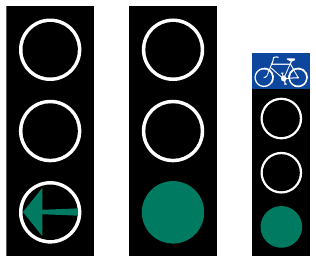
Green
GreenSIG3

Vehicles may continue on straight. A green arrow indicates that the signal applies to the direction in which the arrow points. Vehicles may be driven in the arrow’s direction even if another signal is showing at the same time.

Therefore, regardless of what other signals are showing, you may always turn right.

Question 27

What is true when it comes to the parking prohibition on priority roads?

Picture for the question

Explanation

The prohibition to park on a priority road is a traffic rule. A road sign is a direction. When a direction is in conflict with a traffic rule, the direction always wins.
Du och jag i trafiken [You and me in traffic], 28th Edition, page 313

If a parking sign has been posted on a priority road, it is thus permitted to park.

Question 28

What is a towed vehicle?

Explanation

Towed vehicle: “A vehicle connected to a car, a tractor, a piece of heavy equipment or a terrain vehicle, and which is not a trailer.” (Act on road traffic definitions)

Question 29

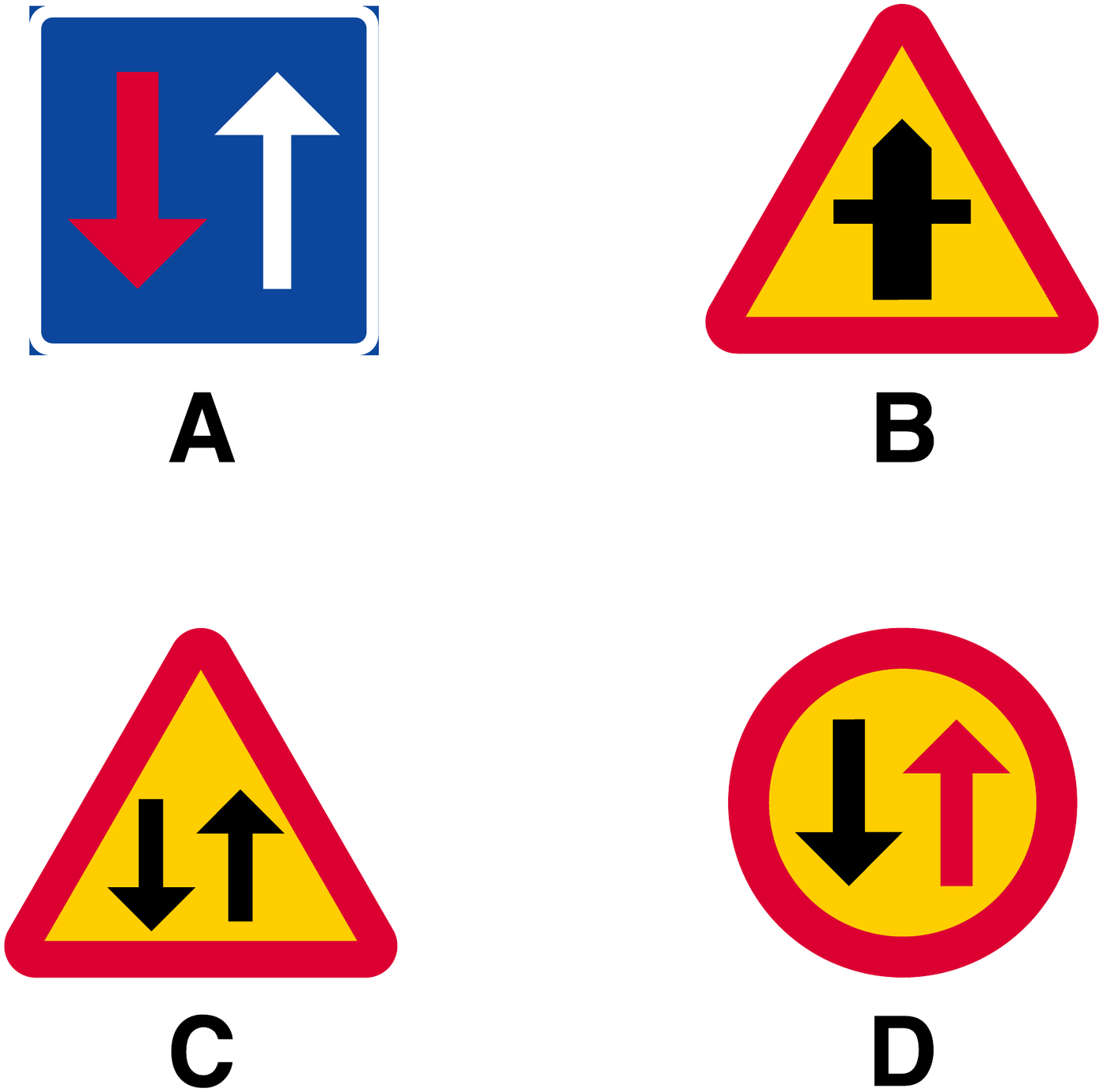
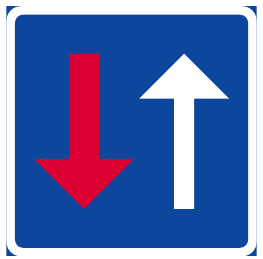
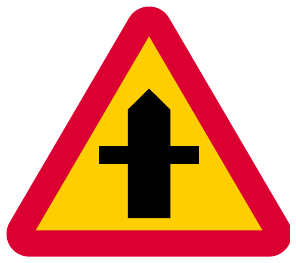
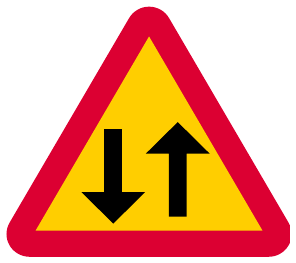
Which sign indicates that oncoming traffic must give way?

Picture for the question

Explanation

Priority over oncoming vehicles
APriority over oncoming vehiclesB7
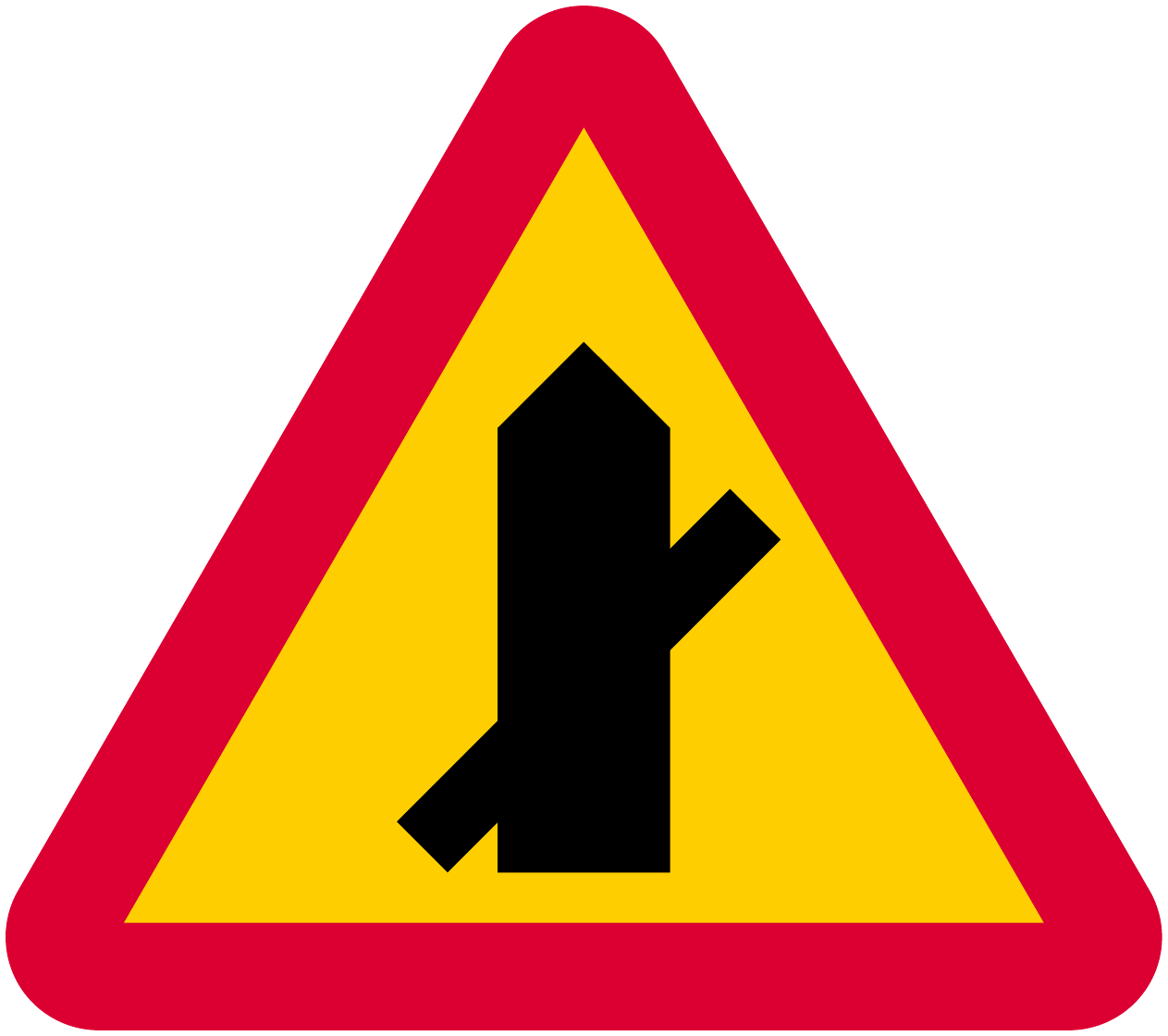
Warning for a junction where road users on a connecting road are obliged to give way or stop
BWarning for a junction where road users on a connecting road are obliged to give way or stopA29

The sign indicates a junction where drivers of vehicles on connecting roads are obliged to give way or stop. The symbol is adapted to the conditions of the location.

Beware of two-way traffic ahead
CBeware of two-way traffic aheadA25

This sign indicates that a one-way road is turning into a road with traffic in both directions.

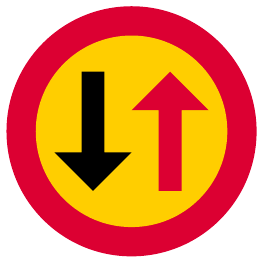
Priority for oncoming vehicles
DPriority for oncoming vehiclesB6
Question 30

Should the airbag on the front passenger seat be activated if a rear-facing child seat is installed there?

Explanation

A child safety seat installed in the front seat may not be used without disconnecting the airbag.
Driving Licence Book, 19th Edition, page 117

If the airbag triggers, this will push the child safety seat against the front seat with great force. The child will be exposed to a great impact, while at the same time the child may be trapped against the front seat.

Note that the question says activated (i.e. connected).

Question 31

Do special rules apply when you are being overtaken?

Explanation

When a driver who is driving on a road observes that someone intends to overtake them [...] The driver may not increase their speed or in any way hinder the overtaking manoeuvre.
Swedish Road Traffic Ordinance
Question 32

What does this road sign mean?

Picture for the question

Explanation

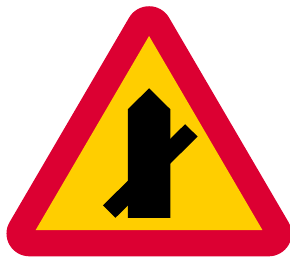
Warning for a junction where road users on a connecting road are obliged to give way or stop

The sign indicates a junction where drivers of vehicles on connecting roads are obliged to give way or stop. The symbol is specific to the conditions at the location.

Question 33

What happens if you do not have your vehicle inspected within the prescribed time?

Explanation

If you do not have your vehicle inspected in time, you automatically have a driving ban imposed.
Swedish Transport Agency
Question 34

What does the road sign indicate?

Picture for the question

Explanation

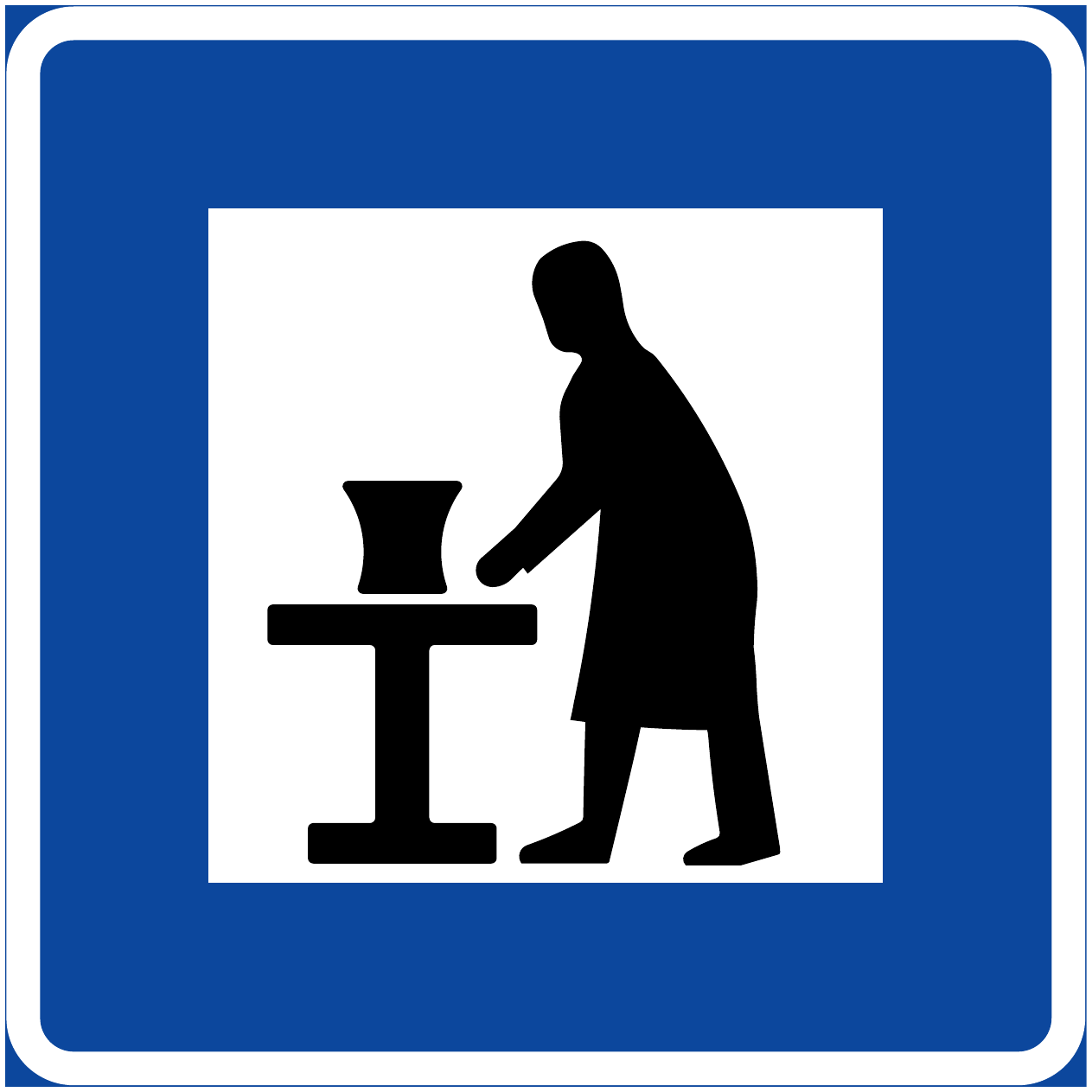
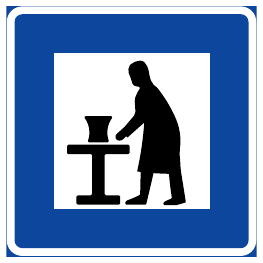
Handicrafts
HandicraftsH26

The sign indicates a facility where handicraft products are manufactured and sold.

Question 35

You have parked your car by the kerb on the right side of the road on a downhill slope. Which option is true?

Explanation

Downhill slope = if the car starts to move, it will do so forwards, i.e. bonnet first. If the wheels are turned to the right, they will simply roll into the kerb and then the car will stop.

Question 36

Which colours do most warning signs have?

Explanation

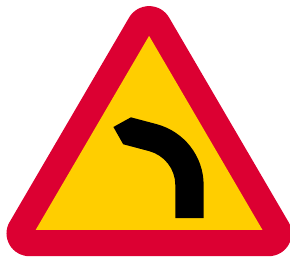
Dangerous curve ahead
Dangerous curve aheadA1

The sign indicates a dangerous curve and its direction.

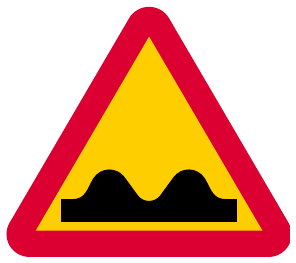
Uneven road ahead
Uneven road aheadA8

The sign indicates bumps or damage to the road which make it appropriate to travel at a lower speed than what would otherwise be the case.

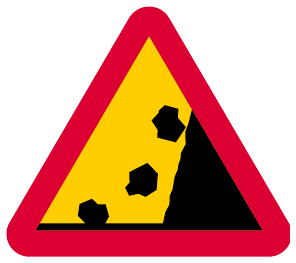
Falling rocks or debris ahead
Falling rocks or debris aheadA12

The sign indicates a risk of falling rocks and that there may be fallen rocks on the road. The symbol is adapted to the conditions of the location.

Question 37

What is true regarding the emissions of sulphur dioxide?

Explanation

The sulphur emissions from road traffic have gone down a great deal in the last 15 years and is now only 1 per cent of what they were in 1990. Road traffic sulphur dioxide emissions is therefore a problem we can consider solved, as today’s fuels contain very small amounts of sulphur.
Swedish Transport Administration
Question 38

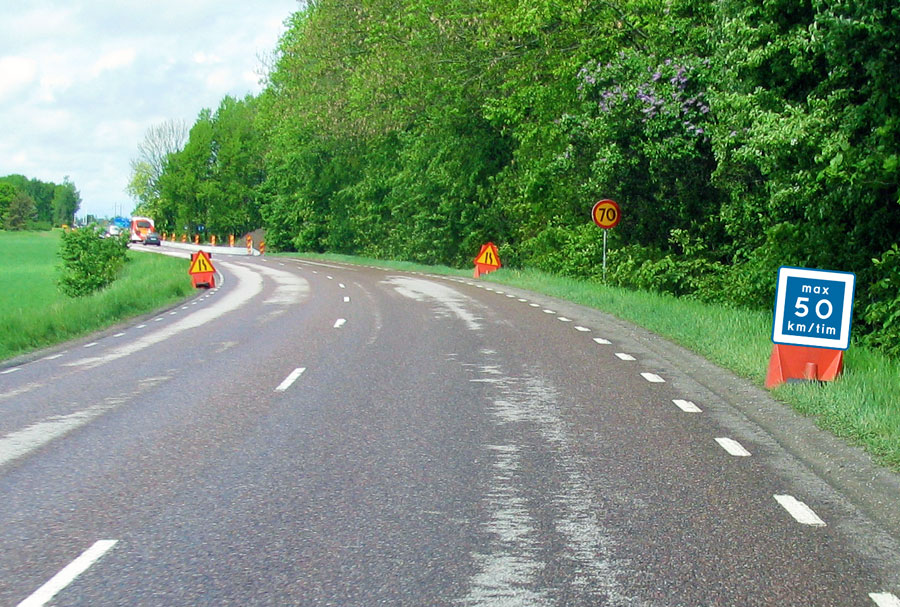
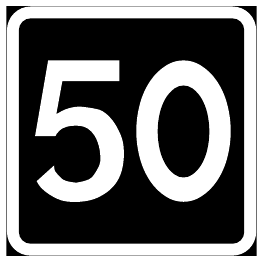
When does the blue and white 50 sign cease to apply?

Picture for the question

Explanation

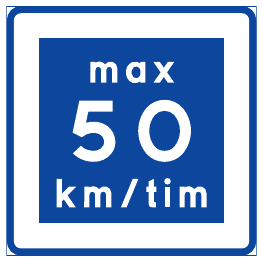
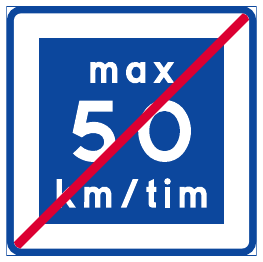
Generally, you should go by the last posted road sign, i.e. by the 50 sign for a few metres and then by the 70 sign. However, this is a special case. The blue and white sign Recommended lower speed applies until a posted end sign or until it is “otherwise clear that the stretch has ended.” (Swedish Transport Agency)

Recommended lower speed
Recommended lower speedE11

The sign indicates a stretch of road or an area where specific measures have been taken or where conditions are such that it is advisable to drive at a lower speed than the maximum permitted speed. The recommended lower speed is indicated on the sign.

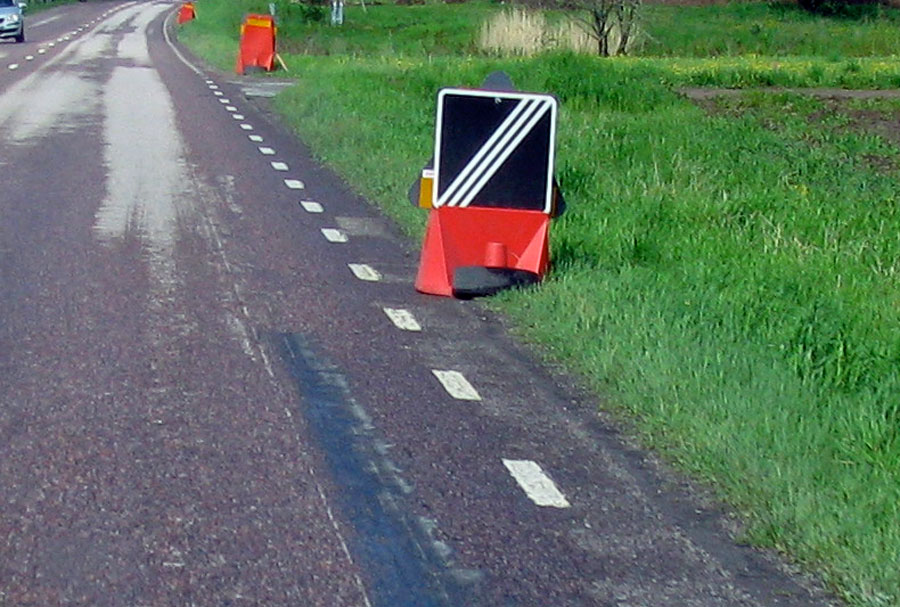
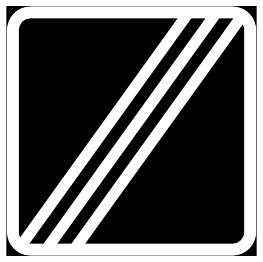
Illustration

Recommended lower speed ends (E12) (end sign) ”The sign does not need to be posted if it is otherwise clear that the stretch comes to an end.”

In the situation depicted, it is obvious that the 50 sign applies even after the 70 sign, as it is evident that there are roadworks ahead and that the stretch does not come to an end at the 70 sign.

But would not the alternative “Only when you pass an end sign informing you that the recommended lower speed ends.” also be correct?
– No, since it says “only”. An end sign does not have to be posted, which means that the sign can cease to apply in one of several ways and not “only” at an end sign.

Question 39

How does the human brain process impressions in traffic?

Explanation

You constantly collect information through your eyes. This information goes to the brain to be interpreted. It is impossible to make profound assessments about everything you see in traffic; the brain would be overloaded.

Instead of assessing everything, the brain quickly selects relevant things to focus on. This selection is made with the help of a number of factors, including your:
  • Experience
  • Knowledge
  • Expectations
  • Interests
  • Needs
  • Impressions

If your knowledge tells you that parked cars can be dangerous, and you have experience of children running out in front of you in that spot, your brain will momentarily devote the most attention to that aspect and completely ignore the fact that there are some birds in a tree above the road.

Question 40

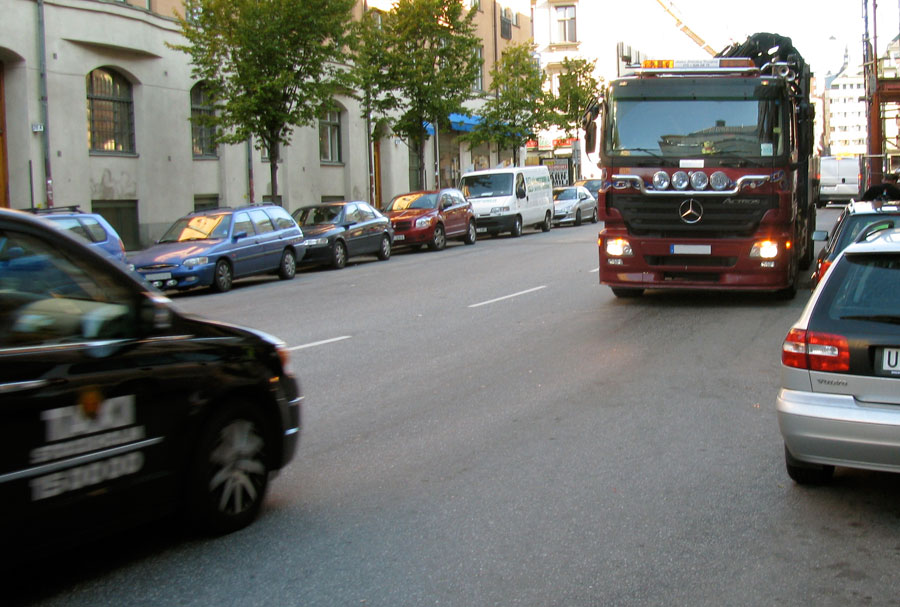
How should the black taxi to the left act in the situation in the picture where the truck is stationary and being loaded?

Picture for the question

Explanation

The first option does not feel safe since it may cause a dangerous situation if there is oncoming traffic.

The last two options involve exaggeration and do more harm than good (stopping and waiting may create irritation and disrupt the traffic flow, and making a U-turn is at least equally as risky as driving past the truck).

Question 41

May a car with a total weight of 1,975 kg pull a trailer whose total weight is 1,550 kg if the driver has a category B licence?

Explanation

You can only pull a light trailer if you have a category B licence. The following counts as a light trailer:

  • Trailer with a maximum total weight of 750 kg.
  • or
  • Trailer where the maximum total weight for car + trailer is 3.5 tonnes.

Does the combined total weight exceed 3.5 tonnes? 1,975 kg + 1,550 kg = 3,525 kg = NOT OK

Question 42

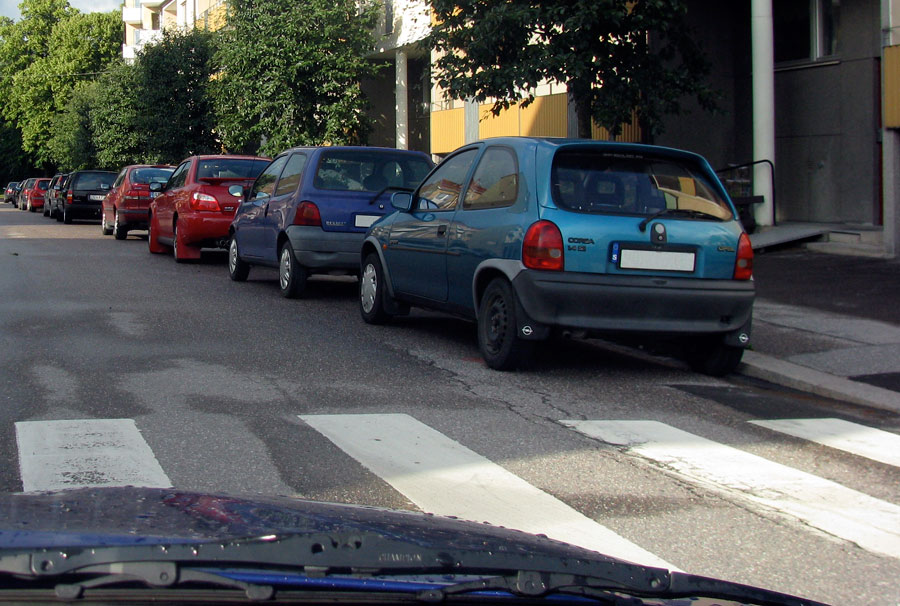
Why is it advisable to drive with a sideways safety clearance of 1 metre to cars parked along the road?

Picture for the question

Explanation

Review of the options

  • A car door may open suddenly.This seems reasonable.
  • It makes it easier if the parked car wants to drive out in front of you.Sideways safety clearance does not feel relevant. How does it help? Are you going to drive two cars side by side in the same line?
  • You have a good margin if a car in the oncoming lane would force you out.Sounds strange, what does “force you out” mean?
Question 43

Are you always obligated to stop when clearing the way for an emergency response vehicle?

Explanation

Drivers who are clearing a passage shall stop if necessary.
Swedish Road Traffic Ordinance

This means that if it is not necessary to stop, you do not have to.

Question 44

When are studded tyres forbidden, other than in existing or expected winter road conditions?

Question 45

Where should the best tyres be placed, from a traffic safety perspective?

Explanation

When changing the tyres on your car, you should put the best ones on the rear axle.
Driving Licence Book, 19th Edition, page 125
Question 46

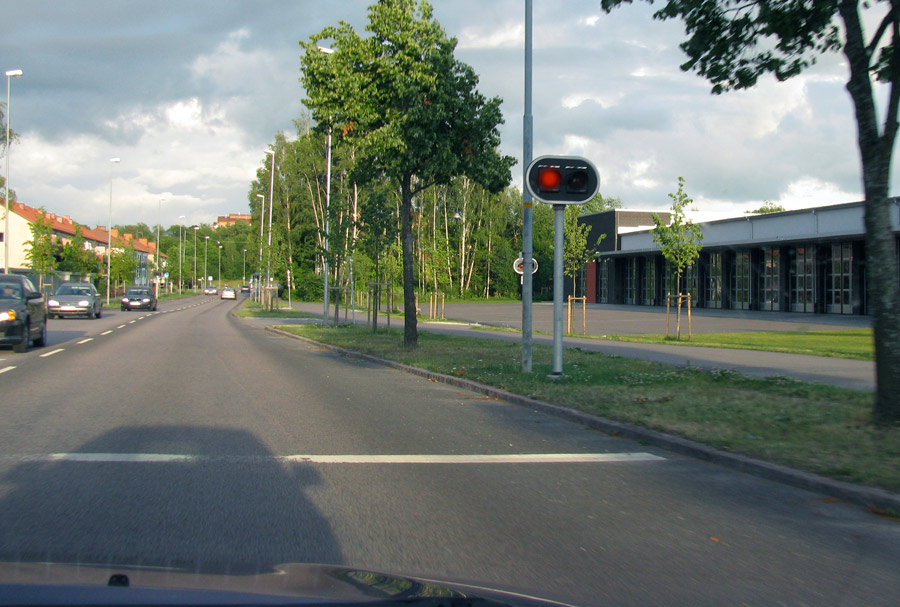
You are driving at a crawling speed. How should you act in the situation in the picture?

Picture for the question

Explanation

The lights signal that the fire engines are about to turn out. They are flashing (right, left, right, left...), which means that only one light is lit at a time. This means that you must stop at the line and are allowed to start moving again when the lights go out (there is no green light on this type of signal).

Red flashing light
Red flashing lightSIG16

Stop. A vehicle may not pass the stop line or, in the absence of such, the signal.

Question 47

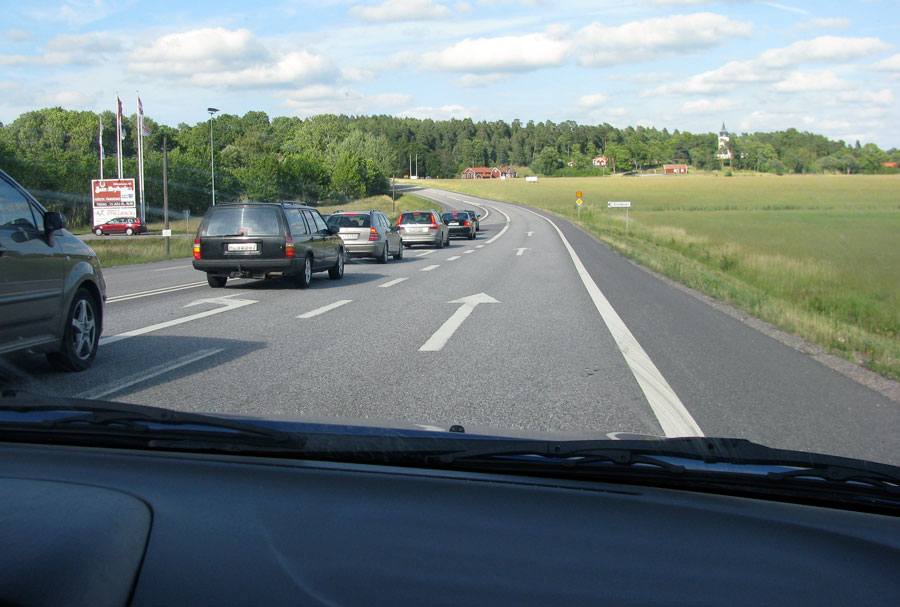
You are driving the car from which the picture is taken. Are you allowed pass the queue of cars?

Picture for the question

Explanation

It is permitted to pass on the right “if the vehicles are in separate lanes in conjunction with a junction”. (Swedish Road Traffic Ordinance)

Question 48

Do special rules apply when you are coming from a private road and intend to drive out onto a public road?

Explanation

A junction between a private road and a public road is considered under law to be a regular junction, i.e.:

  • Is the public road a priority road? – I must give way.
  • Is the public road not a priority road (and no other road signs)? – The right hand rule applies.

However, remember to be extra careful since private roads are sometimes not viewed as “roads” by all road users. It is better to yield one time too many that one too few!

Question 49

Which of the following is applicable to four-wheel drive and fuel consumption?

Explanation

Four-wheel drive increases fuel consumption by up to ten per cent.
The Keep Sweden Tidy Foundation

More energy is required to drive 4 wheels than for 2 wheels.

Question 50

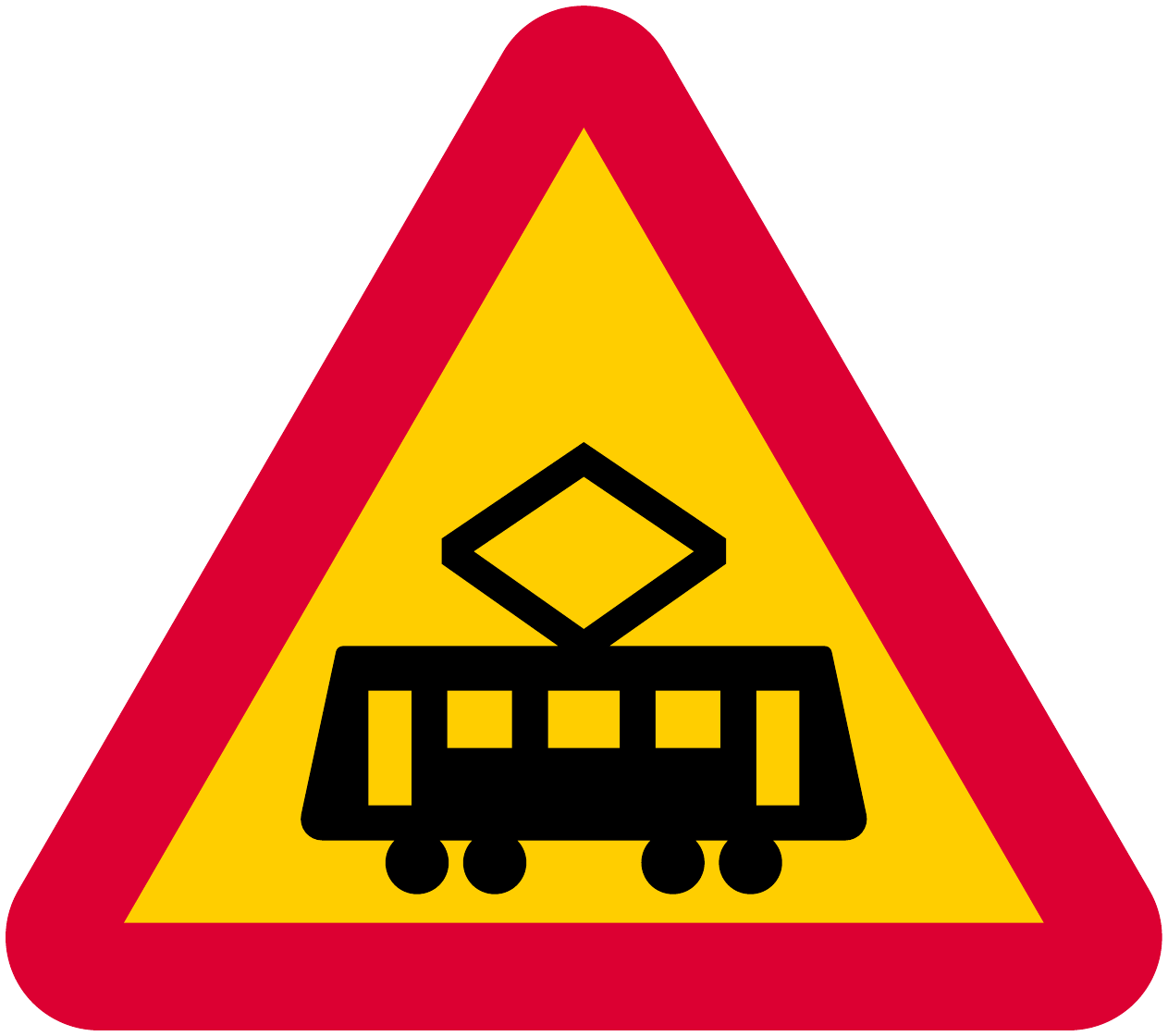
What does this road sign mean?

Picture for the question

Explanation

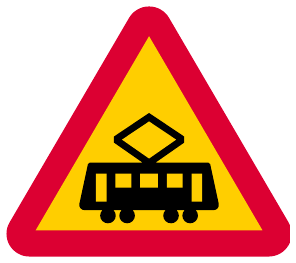
Junction with tramway line

The sign indicates a junction with a tramway line without gates.

Question 51

Is it common for people who use a pedestrian crossing in the dark to be hit by a car?

Explanation

Unfortunately, it happens all too often that pedestrians are run over on pedestrian crossings.
Driving Licence Book, 19st Edition, page 153
Question 52

What does the black sign mean?

Picture for the question

Explanation

Recommended maximum speed
Recommended maximum speedE13

The sign is only used as an adjustable road sign and indicates that the conditions are such that, for a limited period, it is not advisable to travel at a higher speed than the one indicated on the sign. The indicated speed is therefore lower than the maximum permitted speed.

End of recommended maximum speed
End of recommended maximum speedE14

The sign does not need to be posted if it is otherwise clear that the temporary circumstance comes to an end.

Question 53

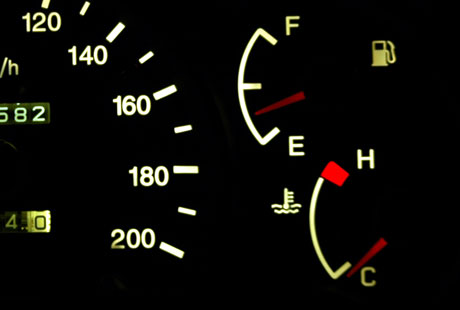
It is winter and you have just started your car. Should you be concerned about the temperature of the engine?

Picture for the question

Explanation

When you have just started the car, the temperature is always low, so there is no cause for concern.

Question 54

Is it permitted to move a dead animal from the carriageway after a wildlife accident?

Explanation

If the animal has died in the collision, you are to move it from the carriageway.
Driving Licence Book, 19th Edition, page 103

Wildlife accidents are not investigated in the same way as accidents where people have died. You should therefore try to move the animal.

Question 55

You are driving at 90 km/h on a country road when you spot a warning sign. At approximately what distance can you expect the danger to be?

Explanation

Warning signs […] 90 km/h […] Distance to the danger […] 150–250 metres
STR’s Vägmärken & vägmarkeringar [Road Signs & Markings], 6th Edition, page 4
Question 56

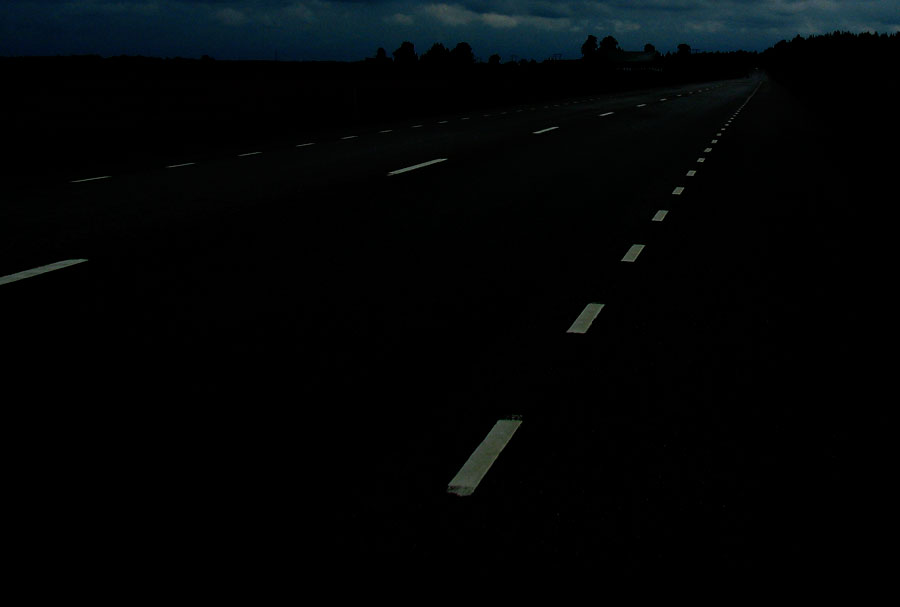
You have stopped temporarily on a road at dusk. Which lights are you obligated to keep turned on?

Picture for the question

Explanation

When a vehicle has stopped or parked on a road, the vehicle’s parking and rear lights are to be turned on at night, at dusk or dawn and at other times when the weather or other circumstances require it in order for other road users to become aware of the vehicle.
Swedish Road Traffic Ordinance
Question 57

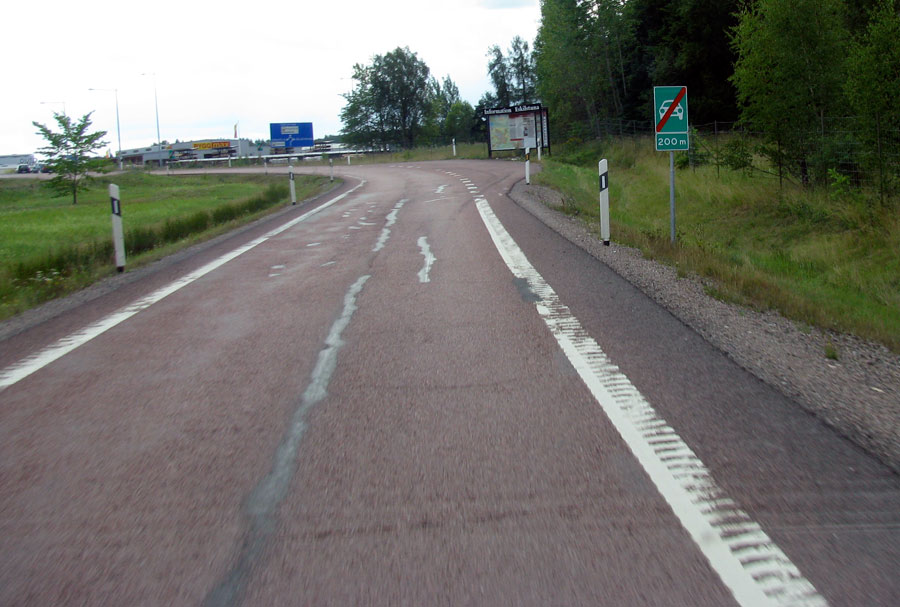
What is the greatest risk when you have driven onto this exit ramp?

Picture for the question

Explanation

This is a classic situation. With questions concerning exit ramps from motorways and clearways, it is almost always speed blindness that is the issue.
When you have driven a long distance on the motorway [or clearway] and slow down at the exit ramp, you may, due to speed blindness brake, brake far too late and, for example, swerve off the road as a result.
Driving Licence Book, 19th Edition, page 83

The distance you have driven is admittedly not given. You must then think about how long you normally drive on a clearway. It is more than 1 minute in any case. This, in combination with the fact that the other options are not so reasonable, means that you can assume that you have driven a long distance and therefore risk speed blindness.
Question 58

Is it possible for the road to be slippery even if the temperature is +4°C?

Explanation

If the temperature is +4°C or lower, there is always a risk of the road being slippery.
Driving Licence Book, 19th Edition, page 167

If the weather has been very cold over several weeks, and the road is covered in a thick layer of ice, it will still be slippery even if the temperature rises significantly for a short period of time.

Question 59

What are the chances of a pedestrian surviving getting hit by a car at 90 km/h?

Explanation

At a speed of 80 km/h, there is a close to 100% probability of the pedestrian being killed.
NTF
Question 60

Is it true that noise is only a problem for people who live close to major country roads?

Explanation

Noise is also generated in the cities. Cars constantly buzzing past at 50 km/h also cause noise.

Question 61

You are driving the car from which the picture is taken and intend to turn right. Are you allowed to pass the white car?

Picture for the question

Explanation

This situation is very common. The traffic would be significantly slower in urban areas if it was not permitted to overtake.

Overtaking shall [...] be done on the right when the driver of car in front is turning left or is clearly preparing for such a turn. […] Overtaking may not be done just before or at a junction, except when [...] overtaking on the right hand side
Swedish Road Traffic Ordinance
Question 62

What shape is the most common for prohibitory signs?

Explanation

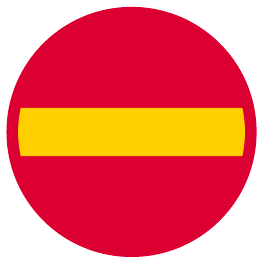
No entry
No entryC1
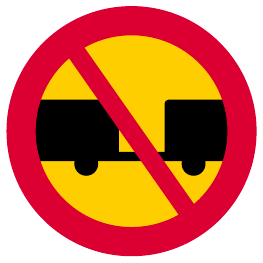
No motor vehicles with a connected trailer
No motor vehicles with a connected trailerC6

The sign indicates a prohibition against motor vehicles with a connected trailer of a type other than semi-trailer or centre axle trailer. If the prohibition also applies to motor vehicles with a connected semi-trailer or centre axle trailer, this will be indicated on an additional panel. If the prohibition only refers to vehicle combinations with a trailer whose total weight exceeds a certain tonnage, this will be indicated on additional panel T5, total weight.

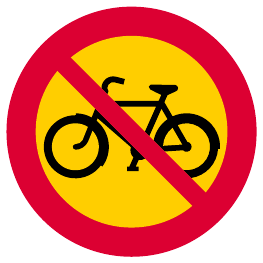
No bicycles or class II mopeds
No bicycles or class II mopedsC10

If the prohibition also applies to class I mopeds, this is indicated on an additional panel.

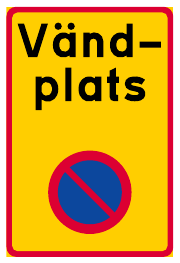
There are also a few square ones, such as:

Turning area
Turning areaC42

The sign indicates an area intended for turning a vehicle and that parking is prohibited here. If sign C39, no stopping or parking, is added to the sign, it indicates that both stopping and parking are prohibited.

Question 63

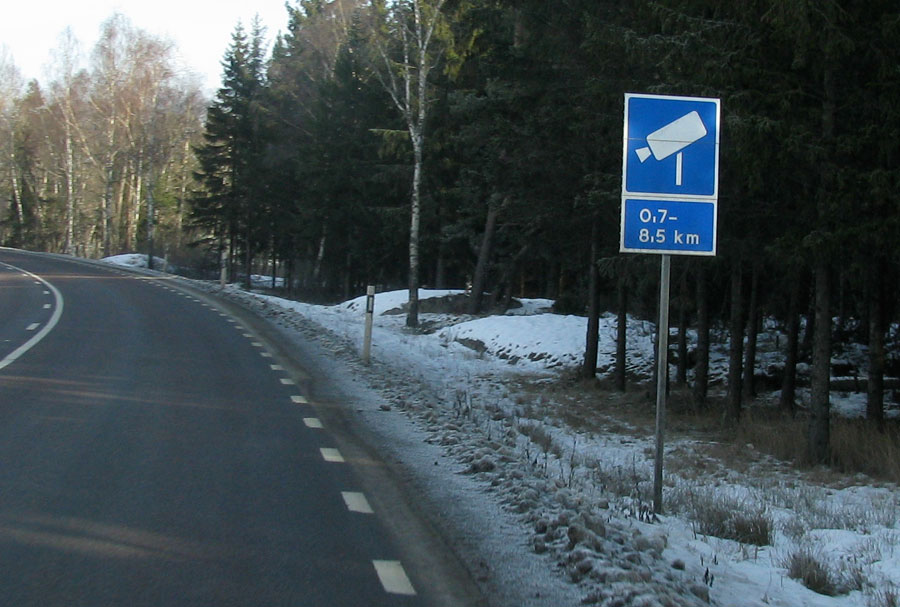
According to this sign, could there be a speed camera 550 metres after the sign?

Picture for the question

Explanation

The additional panel indicates that the sign above it becomes applicable in 0.7 km, i.e. in 700 metres. This means that the sign is not applicable in 550 metres.

Note that there is a similar question using different numbers.

Question 64

Is it true that there is less risk of skidding on bridges and flyovers?

Explanation

On bridges and flyovers, there is a greater risk of skidding. This is because the cold air cools the carriageway, both from above and below.
Driving Licence Book, 19th Edition, page 167
Question 65

Which statement is true regarding military police officers directing traffic?

Explanation

Motorists don’t understand signals from military police officers
Sveriges Radio
Question 66

What is a parking disc?

Explanation

Parking disc [...] becoming increasingly common for a parking disc to be used to limit parking time. An advantage is that you do not have to pay for parking.
Driving Licence Book, 19th Edition, page 67
Question 67

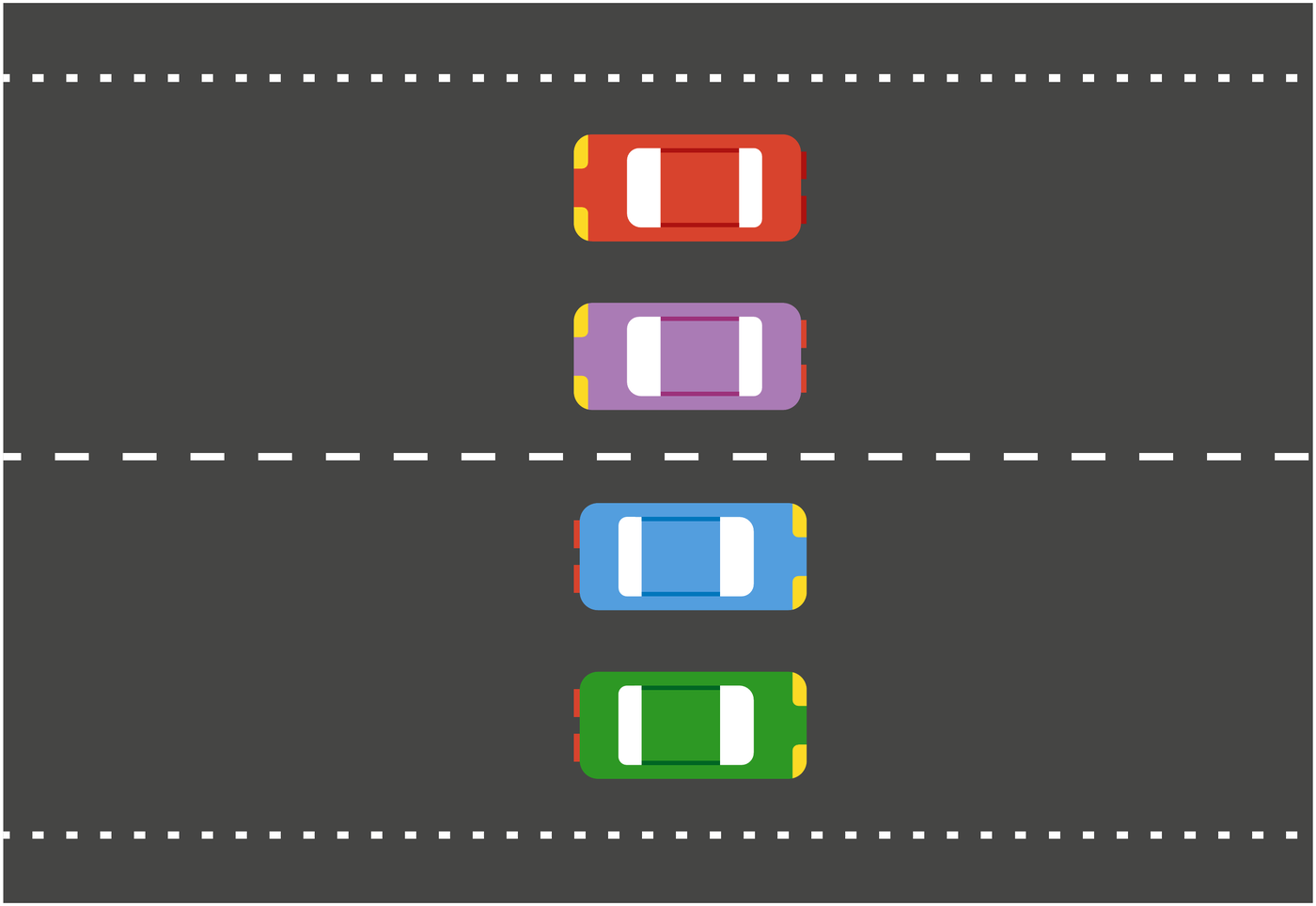
How many lanes does this road have?

Picture for the question

Explanation

Lane […] The lateral space required for the passage of a four-wheel vehicle. Lanes are often marked out with lines, but they do not have to be.
Du och jag i trafiken [You and me in traffic], 28th Edition, page 114

It is clear that two cars can fit side by side in each direction. The road thus has 4 lanes.

Question 68

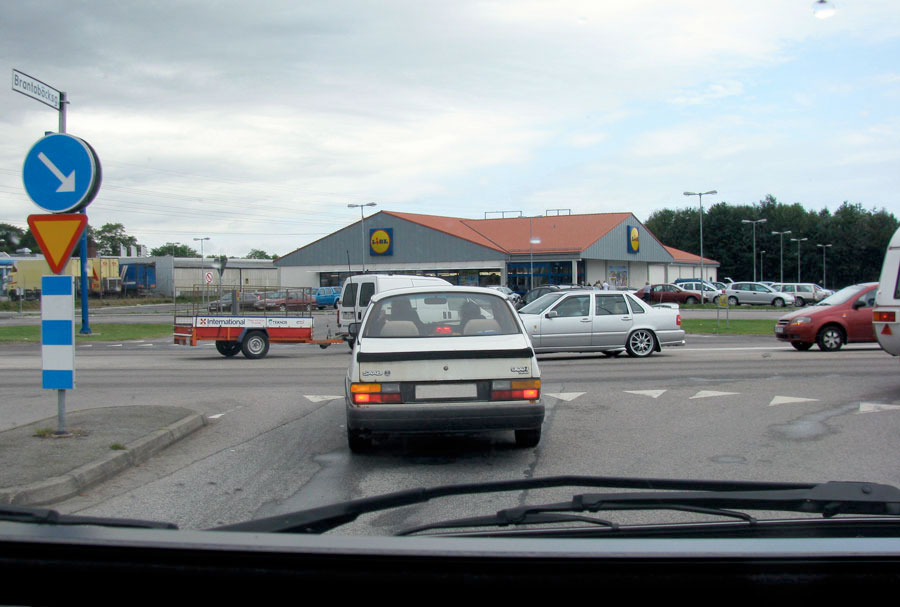
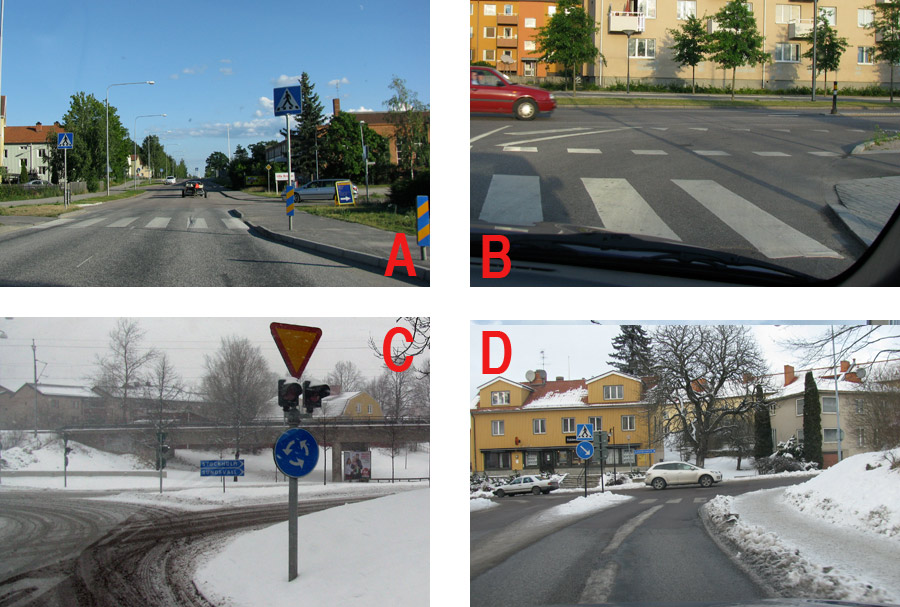
You are driving the vehicle from which the pictures are taken. In which situations do you have to give way to all intersecting cars?

Picture for the question

Explanation

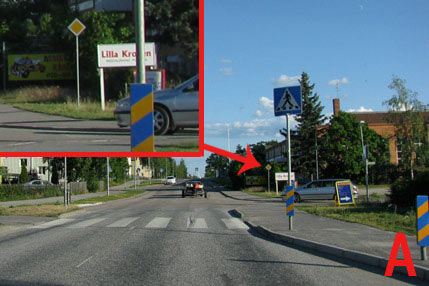
  • A: Priority road = you do not have to give way (priority road sign, see image below).
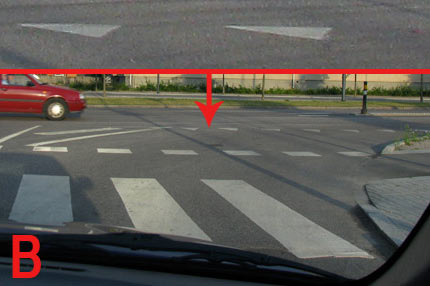
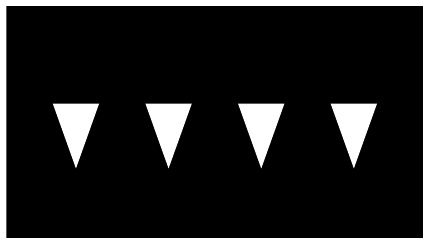
  • B: You have an obligation to give way to all traffic on the road (triangular markings on the road, see image below).
  • C: Roundabout = you have to give way to everyone in the roundabout.
  • D: Right-hand rule junction = you have to give way to the right, but not to the left. This is a right-hand rule junction, as there are no road signs indicating otherwise.

Clarification of A :

Illustration

The priority road sign is difficult to see, but if you enlarge the original image it becomes more clear.

Clarification of B:

Illustration

The triangular road markings are only used where there is an obligation to give way.

Give way line
Give way lineM14

This marking indicates the line that a vehicle should not pass when the driver is observing the obligation to give way.

Question 69

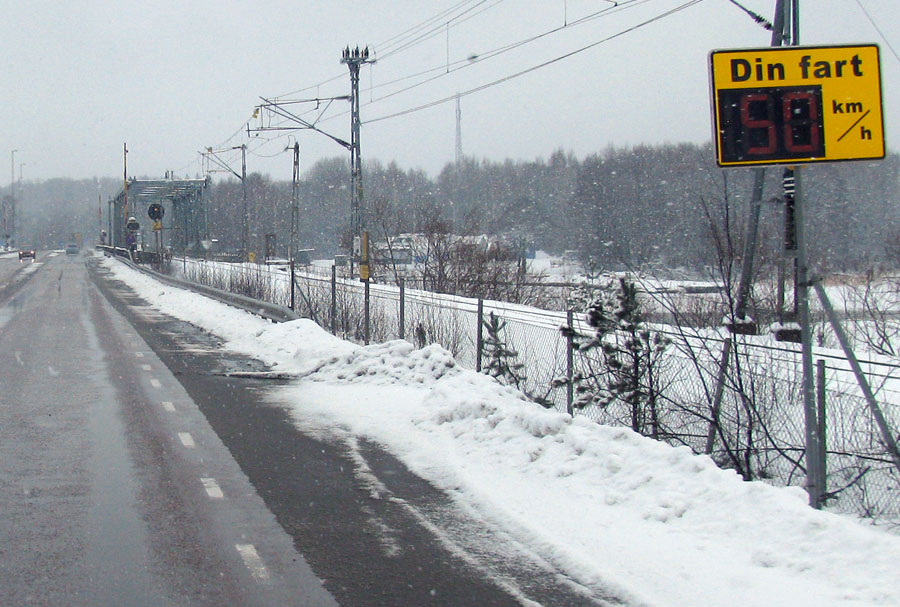
Which statement is true regarding the sign on the right?

Picture for the question

Explanation

”Din fart” = your speed.

This is not an official road sign, but a board that measures and shows you how fast you are going.

Question 70

Is it true that the cargo is included in the car’s unladen weight?

Explanation

Unladen weight of a car [...] The overall weight of the vehicle in normal, fully operational condition with the heaviest body belonging to the vehicle, tools and spare wheel belonging to the vehicle, fuel, lubricating oil and water, along with the driver.
Act on road traffic definitions

No questions to show here.