Driving licence · Theory practice

Practice test 5

70 questions · Pick an answer to see whether you are right. Your answers are saved in this browser.

0of 70 correct
Not started

0 of 70 answered

0Correct
0Incorrect
70Unanswered
14Mistakes allowed

The real test has 70 questions in 50 minutes. You need 56 correct (80%) to pass.

Question 1

Which statement applies to the stretch 15 metres after this crossing?
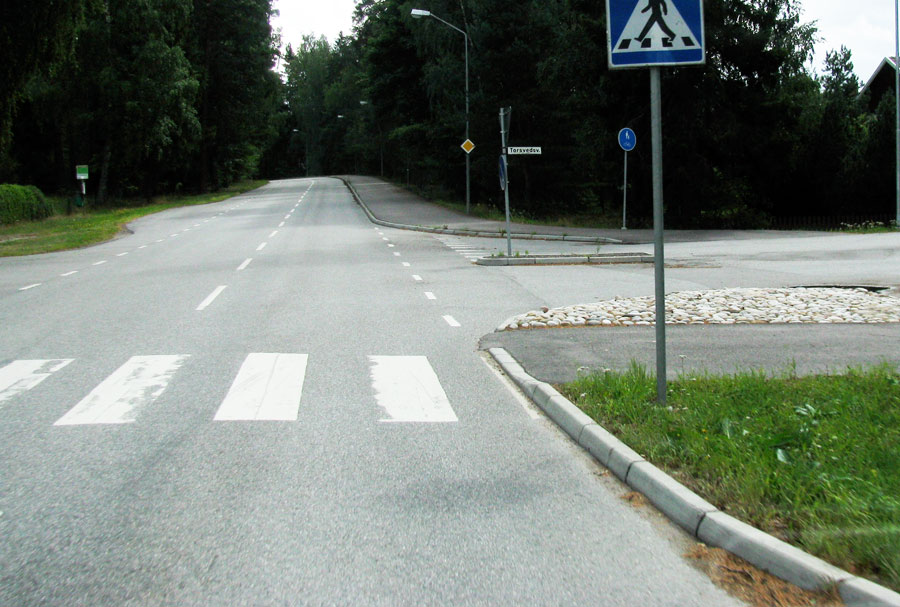
Picture for the question

Explanation

Review of the options

  • I may park on the carriageway.Wrong, it is prohibited to park on a priority road.
  • I may stop on the carriageway to drop off a passenger.Correct, there is no prohibition against stopping on a priority road.
  • I am not allowed to stop on the carriageway, as it is a priority road.Wrong, it is permitted to stop on a priority road.
  • I am not allowed to stop on the carriageway 15 metres after a crossing.Wrong, it is prohibited to stop within 10 metres of a crossing. 15 metres is permitted.
Question 2

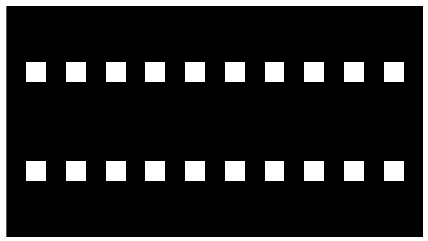
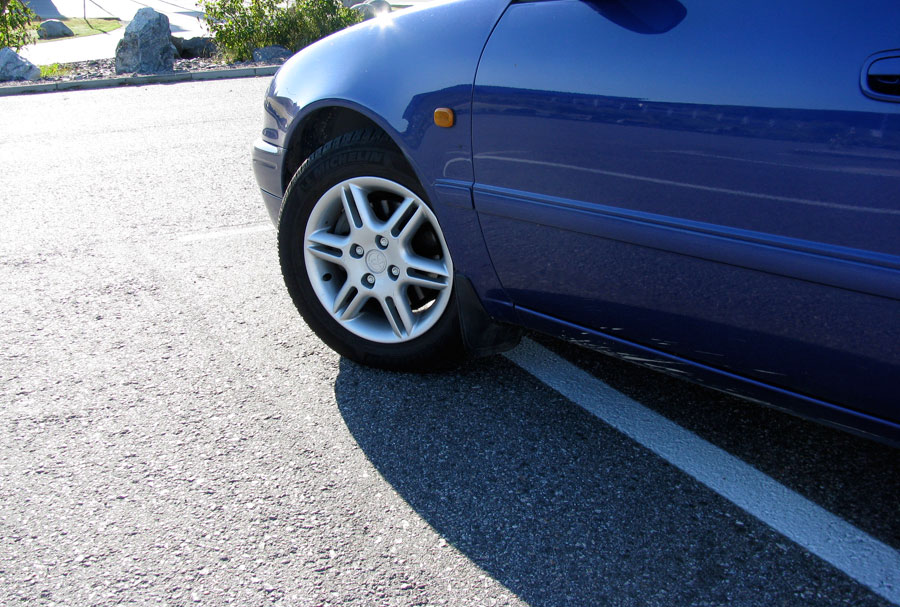
Why is it not permitted to park like the car in the picture?

Picture for the question

Explanation

A vehicle may not be parked so that [...] the vehicle has a wheel outside a parking space or other marking that indicates where you may park.
Swedish Road Traffic Ordinance
Question 3

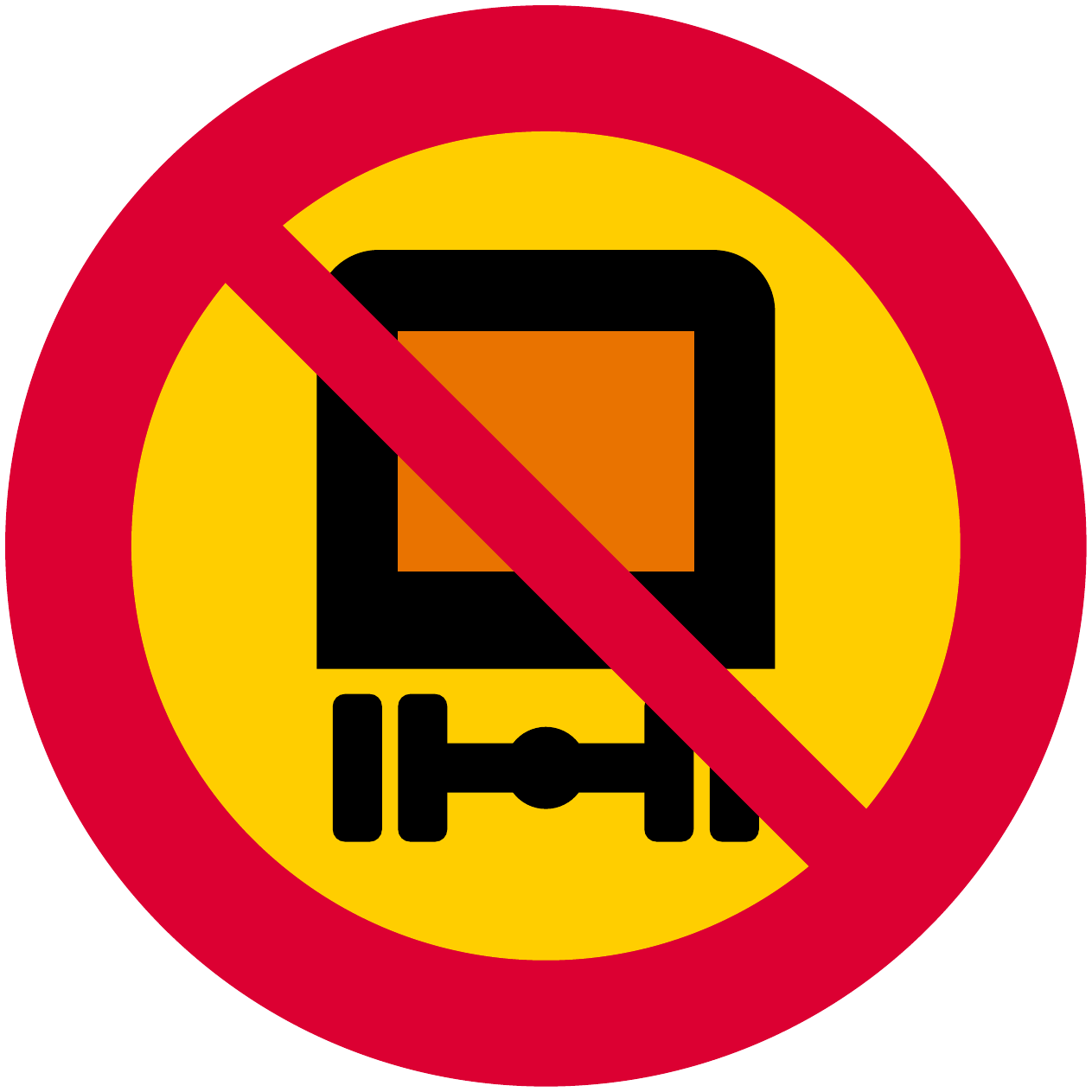
What does this road sign mean?

Picture for the question

Explanation

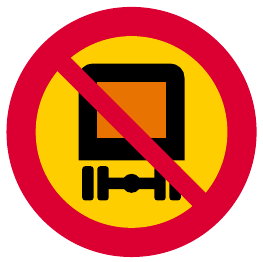
No vehicles carrying dangerous goods
No vehicles carrying dangerous goodsC9

The sign indicates a prohibition against traffic with vehicles carrying loads that are subject to the labelling requirement of an orange sign according to provisions stipulated pursuant to Act on the Transport of Dangerous Goods (2006:263).

Question 4

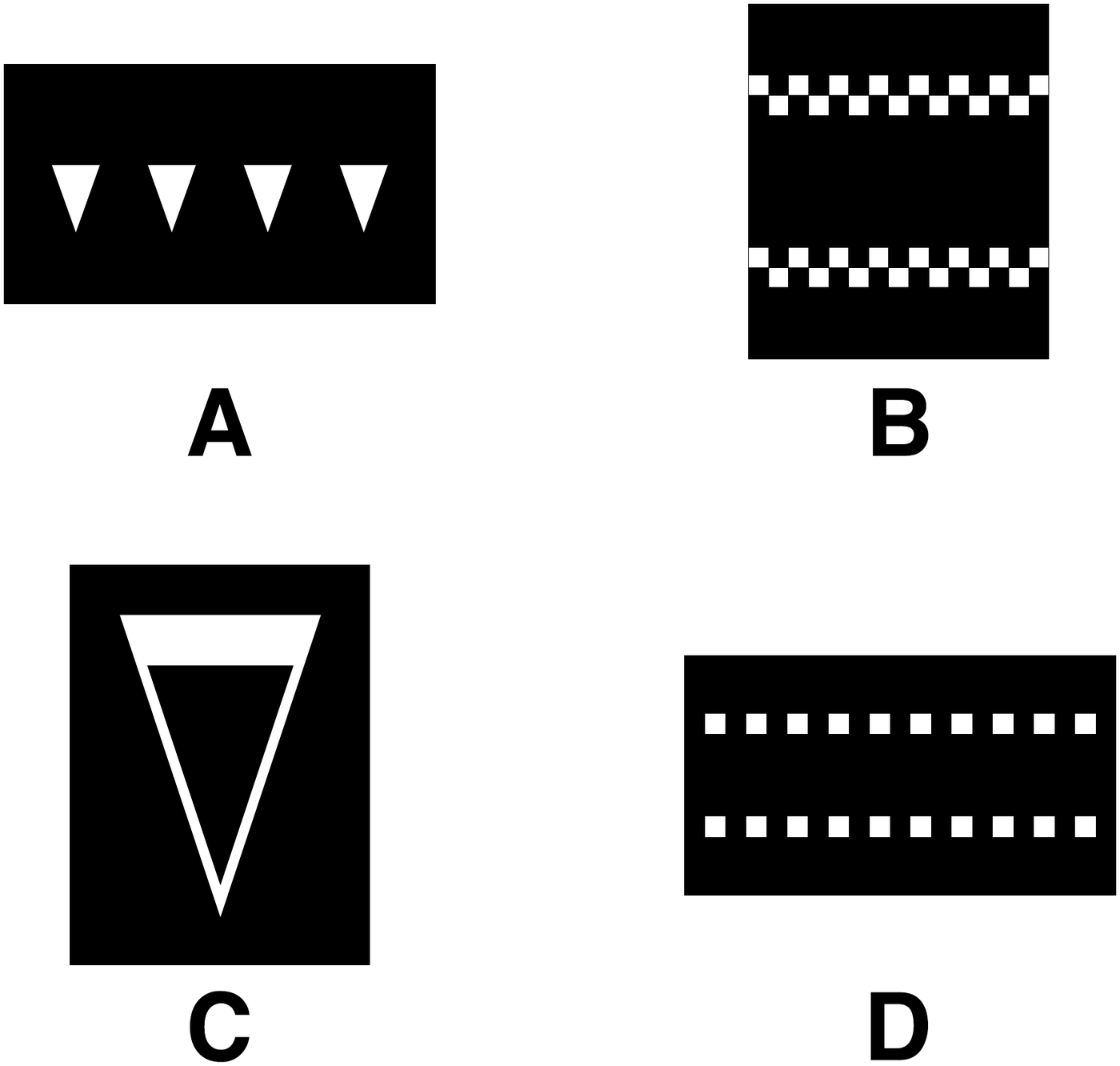
Which road marking indicates an obligation to give way or to stop further down the road?

Picture for the question

Explanation

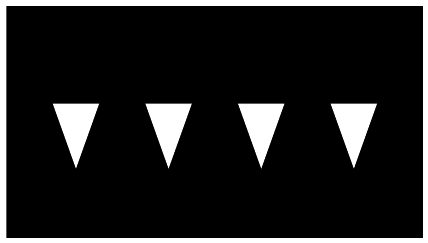
Give way line
AGive way lineM14

This marking indicates the line that a vehicle should not pass when the driver is observing the obligation to give way.

Speed bump
BSpeed bumpM17

This marking indicates a speed bump, gutter or similar obstacle.

Preparatory information regarding the obligation to give way or to stop
CPreparatory information regarding the obligation to give way or to stopM18

This marking indicates that there is an obligation to give way or to stop further down the road.

Bicycle passage or bicycle crossing
DBicycle passage or bicycle crossingM16
Question 5

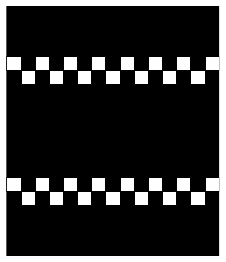
Does this marking constitute an obstacle due to roadworks?

Picture for the question

Explanation

Marking for obstacle on the side, speed bumps, etc.
Marking for obstacle on the side, speed bumps, etc.X3

This device indicates a change in conditions entailing a need to adapt your speed. It is used to mark the edge of the carriageway or lane, or to separate traffic directions on complex passages. The device is placed so that the panels lean downwards on the side where traffic must travel. If the device is used for roadworks or similar work, it is red and yellow. In that case, the panels can also be horizontal.

Question 6

You are driving on a road with a solid line and see an abandoned car further down on your side of the road. How should you act?

Explanation

A vehicle may not with any wheel drive on an obstruction marking or across a solid line. If particular caution is observed, however, exceptions can be made from this rule if [...] it is required for the vehicle to be able to pass an obstruction on the road.
Swedish Road Traffic Ordinance

An abandoned car = an obstruction.

Question 7

What is true regarding vehicle inspection?

Explanation

It is the inspection companies, not The Swedish Transport Agency, that send offers about roadwordiness tests, but they do not have to do so. You are always responsible for making sure that your vehicle is inspected on time. If you do not get any offers from any inspection company, you must contact one yourself.
The Swedish Transport Agency
Question 8

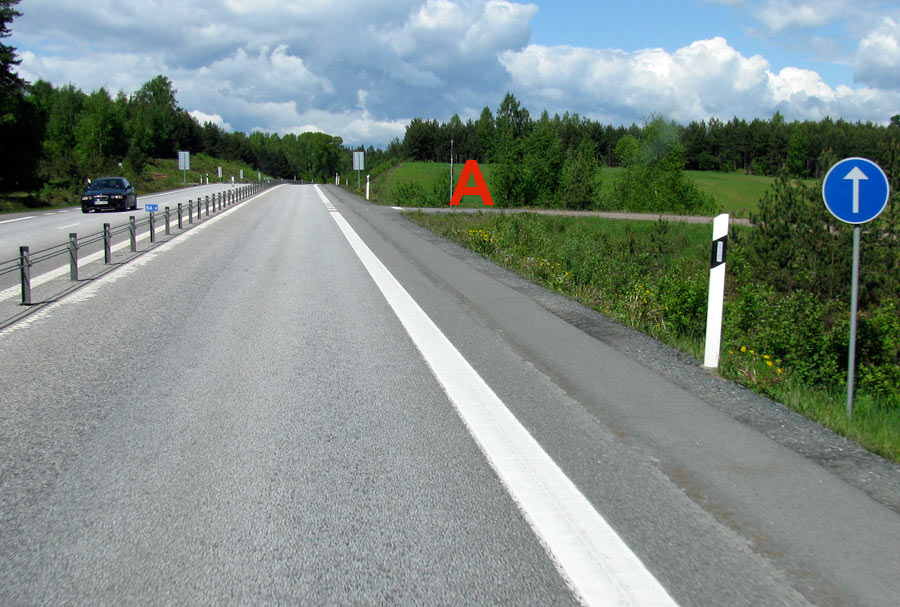
You are driving the car from which the picture is taken. Are you allowed to turn right at A?

Picture for the question

Explanation

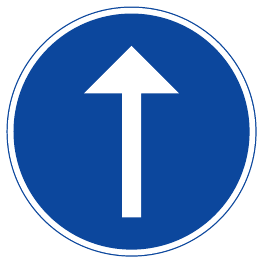
Direction to be followed
Direction to be followedD1

The signs indicate that the vehicle may only be driven in the direction of the arrow or, in the case of two arrows, in either arrow’s direction. The symbol is adapted to the conditions of the location.

The mandatory sign is the only clear alternative. The other alternatives refer to more general matters and rules. Road signs take priority over rules.

Question 9

What is true when it comes to the development of the air quality in built-up areas since the early 1990s?

Explanation

The levels of soot have been reduced by approximately 60 per cent since 1990. [...] Nitric oxide emissions have been reduced by approximately 60 per cent since the base year of 1990. [...] Hydrocarbon emissions have been reduced by approximately 80 per cent since 1990.
Swedish Transport Administration
The air quality has been significantly improved in built-up areas since the 1990s.
The Swedish Environmental Protection Agency
Question 10

What is true when it comes to taking after your role models in traffic?

Explanation

If the role model is a risk taker and an aggressive person, it is not good to take after them in traffic.

Question 11

What does this road sign mean?

Picture for the question

Explanation

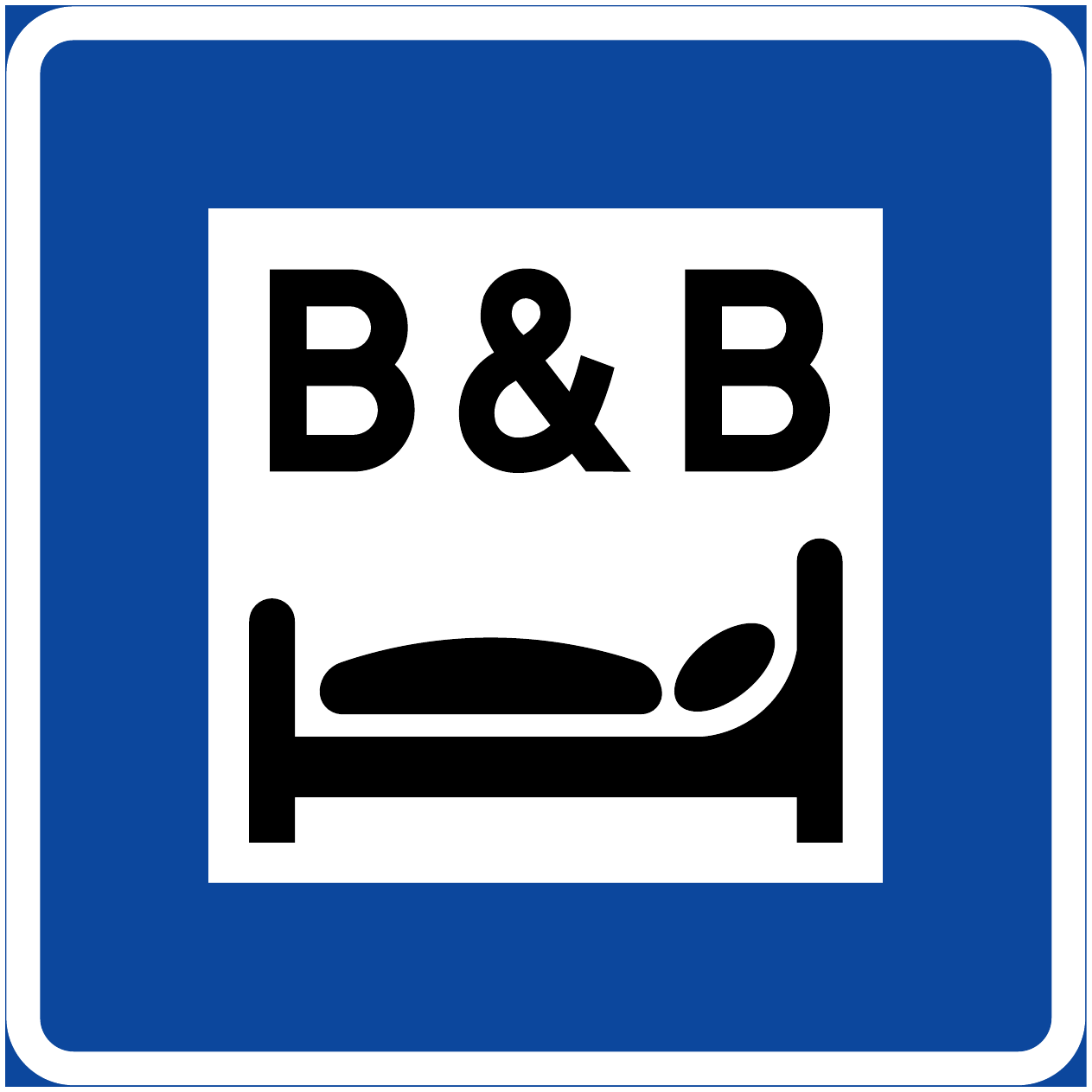
Bed and breakfast
Bed and breakfastH24

The sign indicates an establishment that provides overnight lodging and breakfast.

Question 12

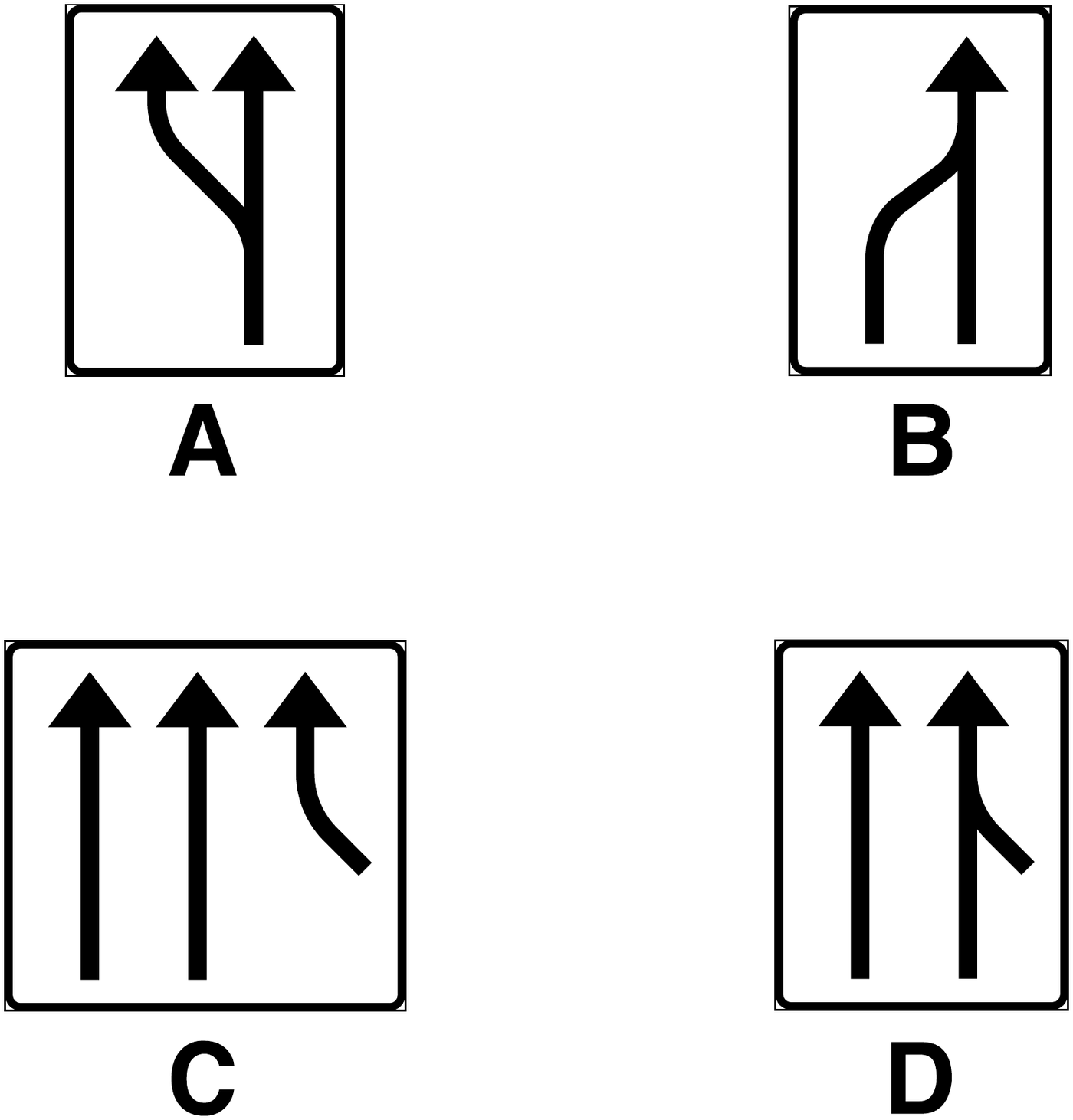
Which sign indicates a connecting road with an acceleration lane?

Picture for the question

Explanation

Additional lane
AAdditional laneF16

This sign indicates an increase in the number of lanes. The sign is specific to the conditions at the location. Symbols for types of vehicles or road numbers may be included in the sign. The sign is also used as a preparatory notice that the number of lanes will increase. The distance is then stated on an additional panel. In case of a temporary re-routing of traffic, the sign may have an orange base. Otherwise, no deviating colour may be used.

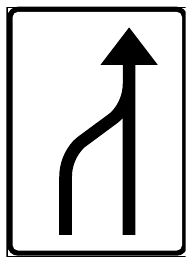
Lane ends
BLane endsF17

This sign indicates a reduction in the number of lanes. The sign is specific to the conditions at the location. The sign is also used as a preparatory notice that a lane is ending. The distance is then stated on an additional panel. In case of a temporary re-routing of traffic, the sign may have an orange base. Otherwise, no deviating colour may be used.

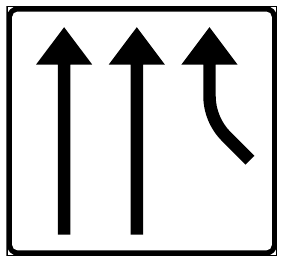
Connecting road in a separate lane
CConnecting road in a separate laneF20

The sign is specific to the conditions at the location. In case of a temporary re-routing of traffic, the sign may have an orange base. Otherwise, no deviating colour may be used.

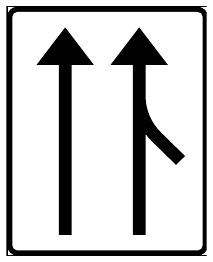
Connecting road with acceleration lane
DConnecting road with acceleration laneF19

The sign is specific to the conditions at the location. In case of a temporary re-routing of traffic, the sign may have an orange base. Otherwise, no deviating colour may be used.

Question 13

Why should you not keep your rear fog lights lit at all times?

Explanation

The rear fog lights “are sharp and dazzling, and you shall therefore turn them off as soon as you know that traffic behind you have spotted you.” (Driving Licence Book, 19th Edition, page 159)

Question 14

Which option is true?

Explanation

Review of the options

  • Air conditioning reduces fuel consumption.Wrong, it increases the consumption as it requires energy to function.
  • If the car is carrying a heavy load, it will use more fuel than with a light load.Correct, compare this to carrying a heavy rucksack: it requires more power (“fuel”) the heavier it is.
  • Dirt sticks more easily to a waxed car.Wrong, the dirt will stick more easily to an unwaxed car since the paint has a rough surface. The harder and smoother the surface, the less dirt will stick to it.
  • An automatic transmission is preferable from an environmental perspective.Wrong, as a rule, it will increase fuel consumption and thereby emissions harmful to the environment.
Question 15

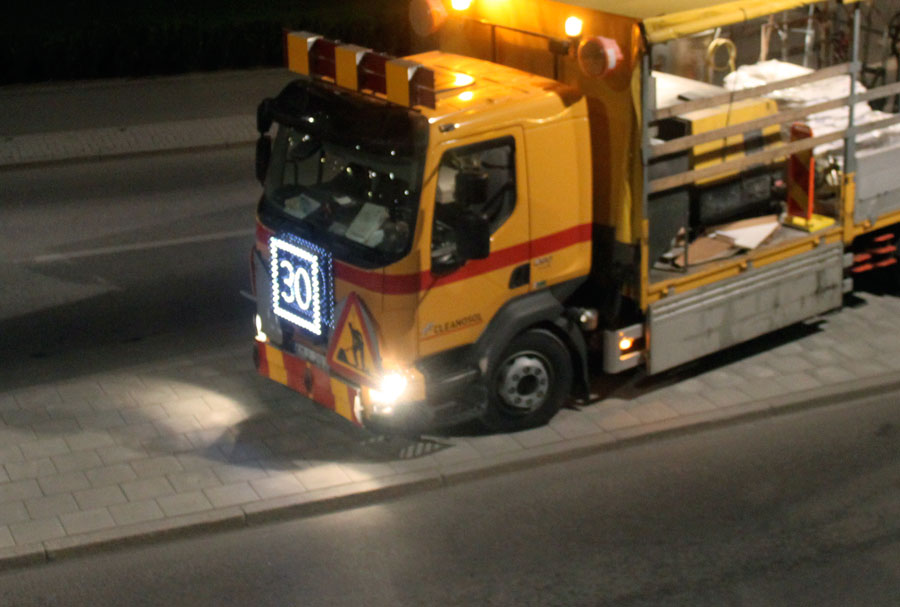
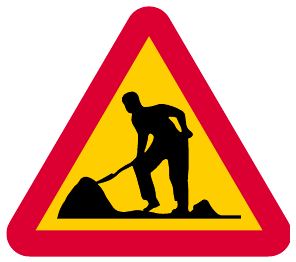
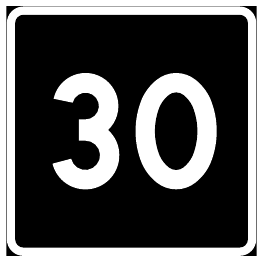
How should you interpret this situation?

Picture for the question

Explanation

Roadworks
RoadworksA20

This sign indicates the end of a road section where roadworks or similar works are underway.

Recommended maximum speed
Recommended maximum speedE13

The sign is only used as an adjustable road sign and indicates that the conditions are such that, for a limited period, it is not advisable to travel at a higher speed than the one indicated on the sign. The indicated speed is therefore lower than the maximum permitted speed.

“30” is shown in lights; is this really a valid road sign?
– Yes, it is a real road sign.

Would not “roadworks are underway” be the only correct answer?
– No, as this would be too shallow an interpretation of the situation. You must also take into consideration the maximum recommended speed.

Question 16

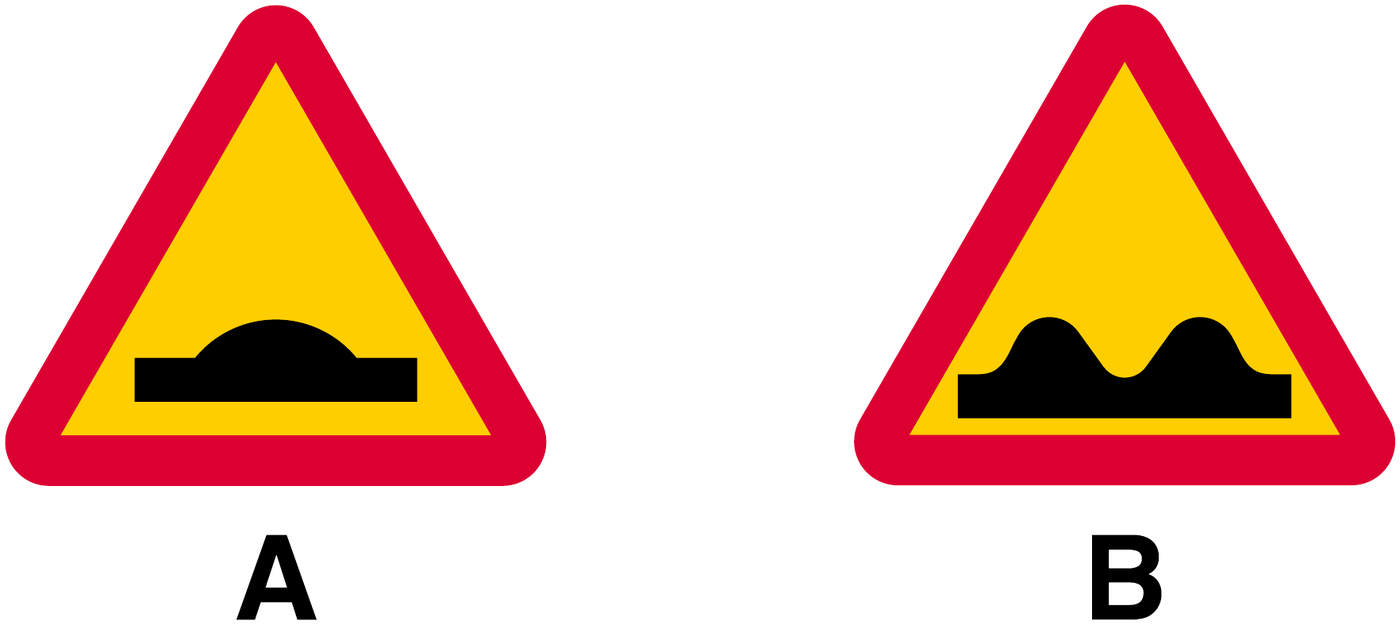
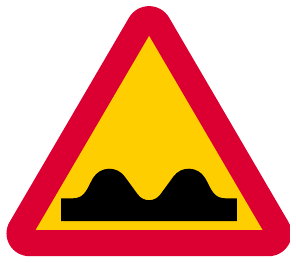
Which of these signs warns you of a speed bump?

Picture for the question

Explanation

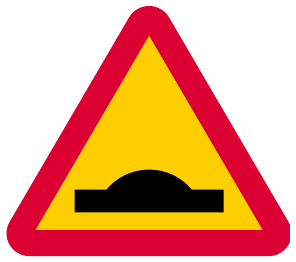
Speed bump warning
ASpeed bump warningA9

The signs indicate a raised hump or gutter installed as a speed-reducing measure.

Uneven road ahead
BUneven road aheadA8

The sign indicates bumps or damage to the road which make it appropriate to travel at a lower speed than what would otherwise be the case.

Question 17

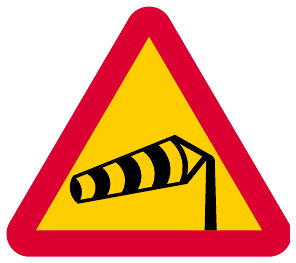
What does this road sign mean?

Picture for the question

Explanation

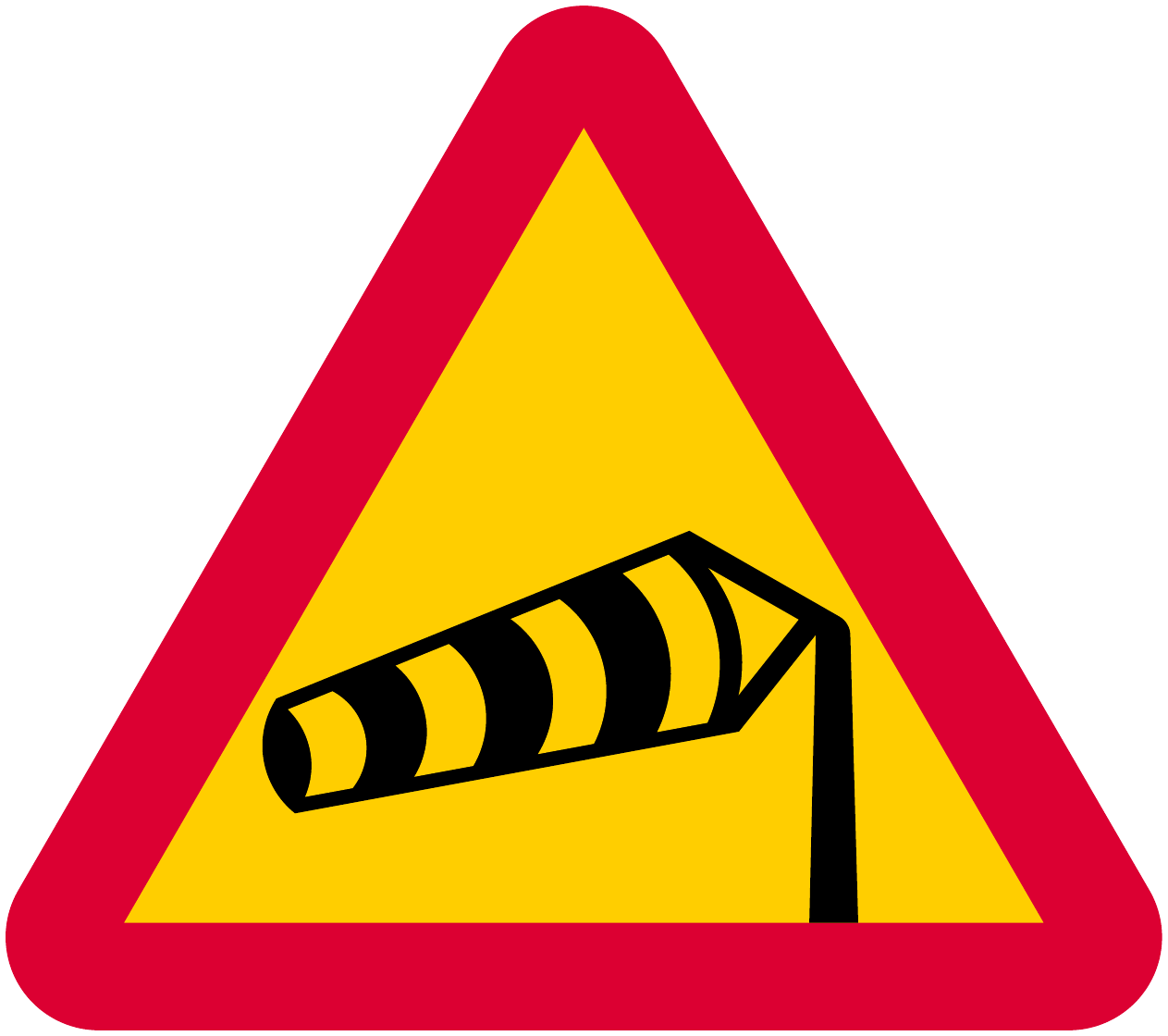
Crosswind
Crosswind

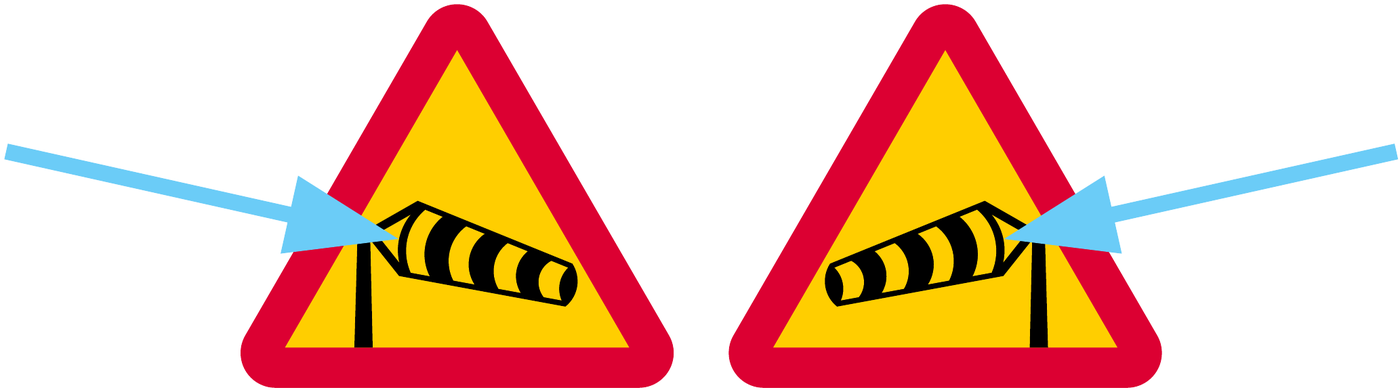
The sign indicates a section of road where there is often a strong crosswind. The symbol is specific to the conditions at the location.

Illustration
Question 18

Are you normally permitted to make a full turn on a clearway?

Explanation

Regulations for traffic on motorway and clearway [...] Vehicles may not turn around or reverse.
Swedish Road Traffic Ordinance

The reason is the one given in the correct answer.

Question 19

You are passing a railway crossing where there are no gates or signals. The visibility is severely limited by trees and hills along the tracks. How should you act?

Explanation

When arriving at an unguarded railway crossing with obscured or reduced visibility, it is wise to roll down your window to listen for trains before passing through.
Du och jag i trafiken [You and me in traffic], 28th Edition, page 186

It may seem like an exaggeration to stop and listen, but since the visibility is “severely limited”, it is still the wisest choice.

Question 20

Which alternative best describes a hybrid car?

Explanation

The hybrid car is a car with two power sources: an electrical motor and a regular combustion engine.
Driving Licence Book, 19th Edition, page 231
Question 21

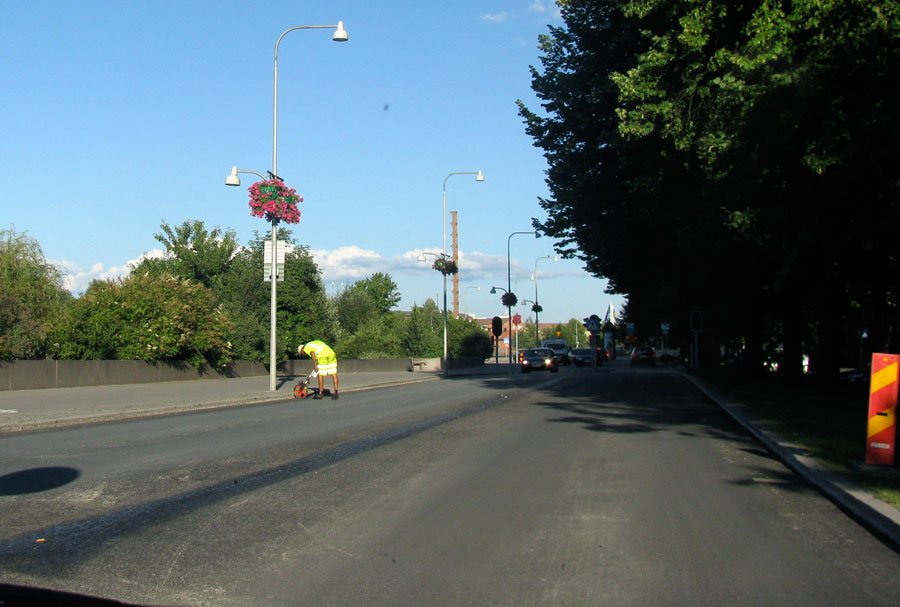
The picture is taken from your car. Should you think of anything in particular in this situation?

Picture for the question

Explanation

Some form of consideration should be shown to the road worker. He may forget the vehicle traffic for a moment and start to walk backwards with surveying equipment = good that the cars drive with wide safety margins.

The most reasonable and safe choice is to reduce your speed and drive on the right. Increasing speed would be unusual and unsafe.

Question 22

Can you be punished if you talk on your mobile phone while being involved in an accident?

Explanation

Using a mobile phones and other communication devices while driving have been tightened. This type of equipment may only be used if it does not impact the driver in a manner that causes a traffic hazard. […] Anyone violating these provisions can be sentenced to pay a fine. […] Previously, the police have only been able to report the more serious category of reckless driving, which in practice often requires an accident to have taken place.
The Swedish Police

The new mobile phone regulations do not impact on “reckless driving”, which has more serious sanctions than the fine you can get if you cause the car to zigzag while talking on your mobile phone.

Question 23

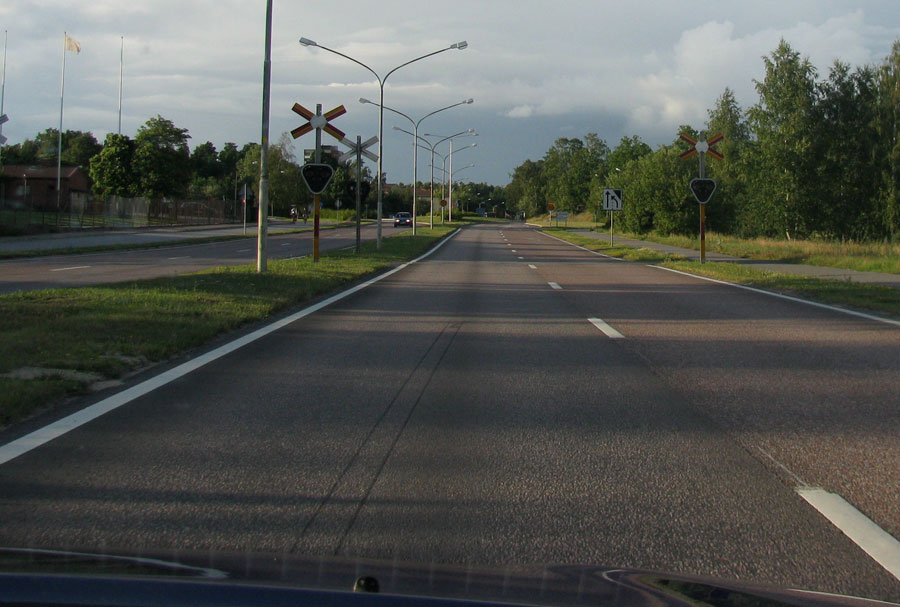
You are driving the car from which the picture is taken and have just overtaken a car. Should you change back to the right lane?

Picture for the question

Explanation

All types of manoeuvres entail increased risks. If you change to the right lane, you must check the car behind that you overtook. You then have to complete a lane change again after a few metres. It is true that you normally have to keep to the right lane, but in this situation it is clearly better to stay in the left.

The railway crossing does not have any direct regulatory impact on changing lanes.

Question 24

Must all new cars be fitted with reflectors?

Explanation

The car must have reflectors in order to be visible in the dark even when all electronics are turned off. The reflectors are nearly always mounted behind the plastic covers of the rear lights.

Question 25

Is the trailer considered a light trailer if it is connected to the car?

Picture for the question

Explanation

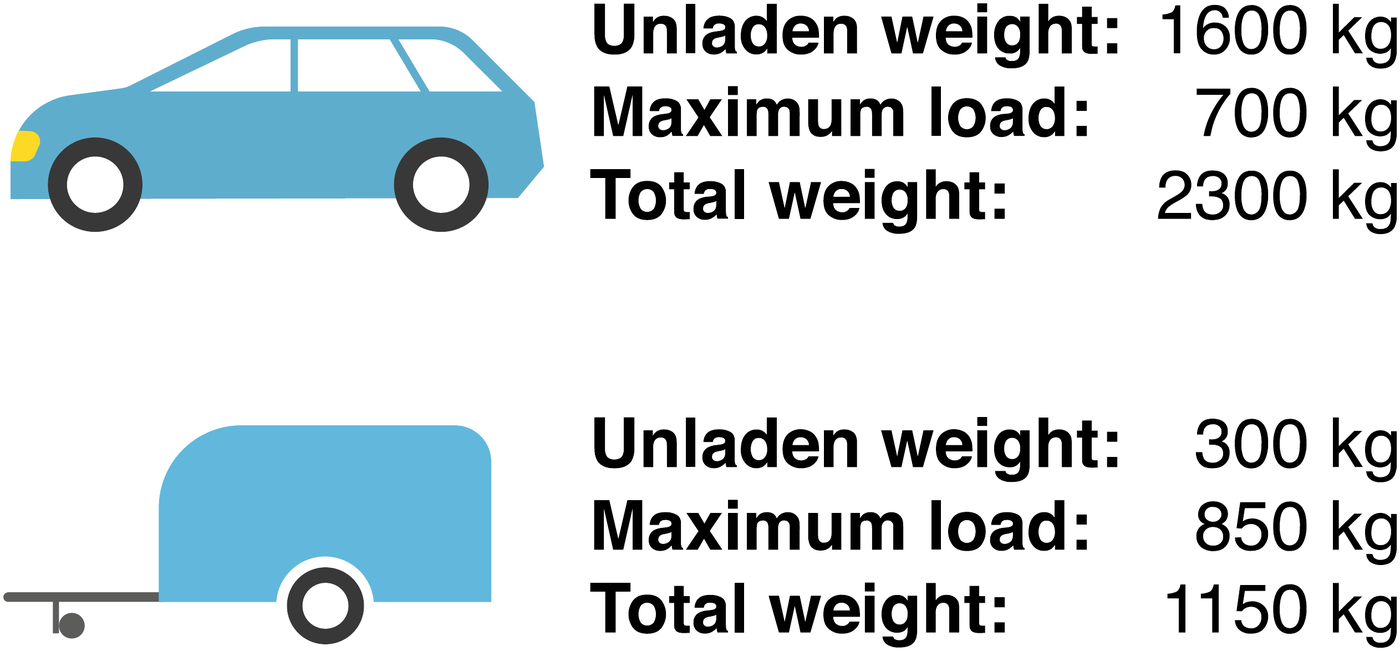
With a regular category B licence, you are only allowed to tow a light trailer. The following counts as a light trailer:

  • Trailer with a maximum total weight of 750 kg.
  • or
  • Trailer where the maximum total weight for car + trailer is 3.5 tonnes.

Does the combined total weight exceed 3.5 tonnes? 2300 kg + 1150 kg = 3450 kg = Under 3.5 tonnes

Question 26

Which type of traffic has the smallest environmental impact per passenger kilometre?

Explanation

Why is this relevant to know?
– The whole world is trying to reduce its carbon dioxide emissions. A significant part of those emissions is caused by vehicle traffic. This means that the government and its agencies have an interest in getting people to be as environmentally friendly as possible.

The curriculum for a category B licence states that: “This knowledge is to be useful in travelling as environmentally friendly as possible [...] how the choice of transport, travel companions and route impacts on traffic safety and the environment.” (Swedish Transport Agency)

Question 27

You are passing a 14-metre long bus on a sunny day in May. Just as you pass the rear of the bus, a child runs out in front of the bus. What is the maximum speed that would allow you to stop in time, if you react within 1 second?

Explanation

First, consider the calculations of stopping distance, reaction distance and breaking distance.

A “sunny day in May” = assume that the condition of the road is normal/good.

You must try the different options. 70 km/h feels like it is too fast. 30 km/h seems more reasonable. Try 30 km/h first:

Reaction distance:

  • remove the zero in the speed * reaction time * 3
  • 3 * 1 * 3 = rounded to 9 metres

Braking distance:

  • remove the zero in the speed * remove the zero in the speed * 0.4
  • 3 * 3 * 0.4 = 3.6 metres

Stopping distance:

  • reaction distance + braking distance
  • 9 + 3.6 = 12.6 metres

Speed Stopping distance

70 km/h 40.6 metres

50 km/h 25 metres

30 km/h 12.6 metres (closest to 14 metres) 20 km/h 7.6 metres

Question 28

What does this road sign mean?

Picture for the question

Explanation

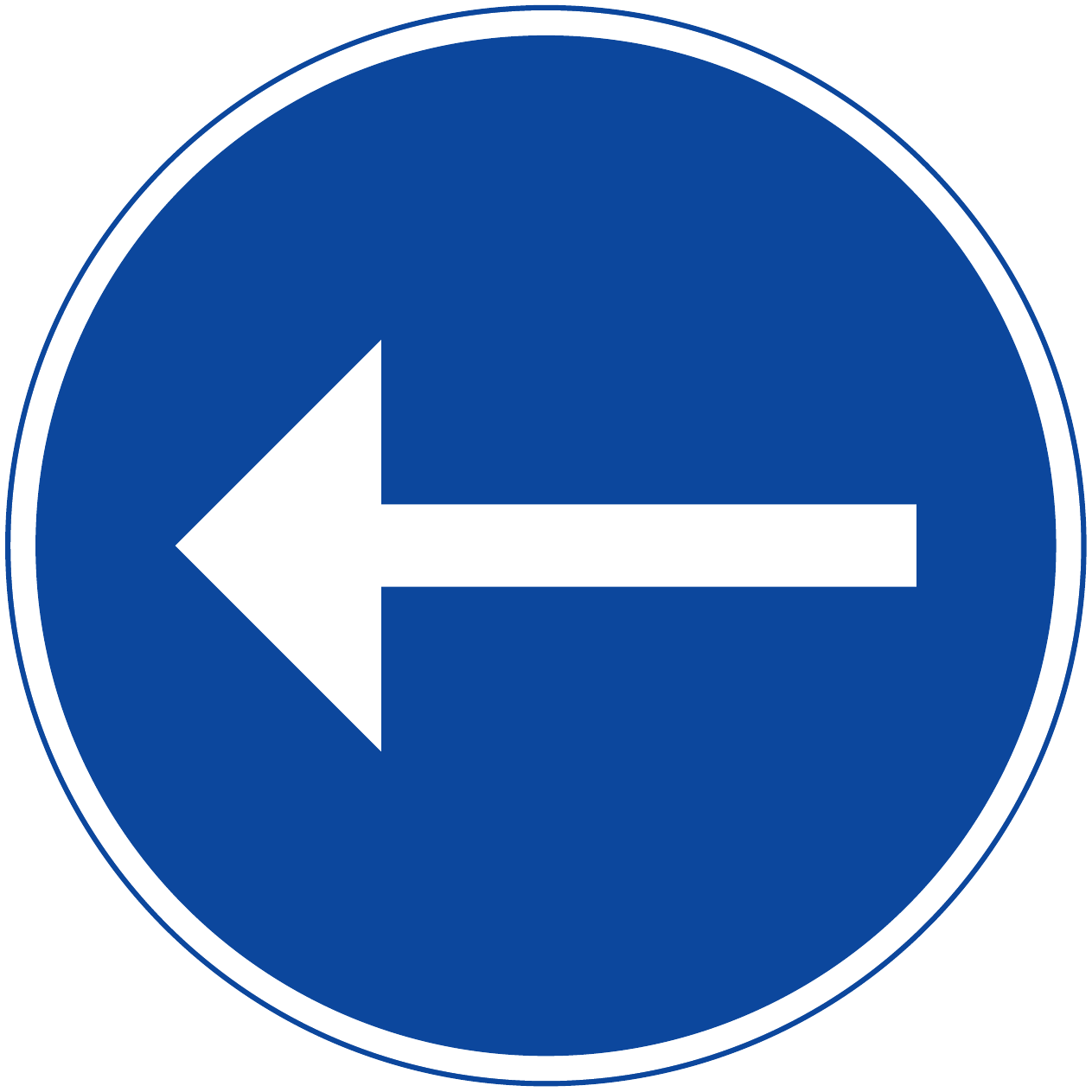
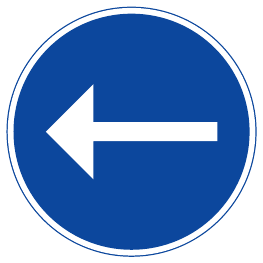
Direction to be followed
Direction to be followedD1

The signs indicate that the vehicle may only drive in the direction that the arrow is pointing or, in the case of two arrows, in the direction of either arrow. The symbol is specific to the conditions at the location.

Question 29

How do the right of way rules work in the situation in the picture?

Picture for the question

Explanation

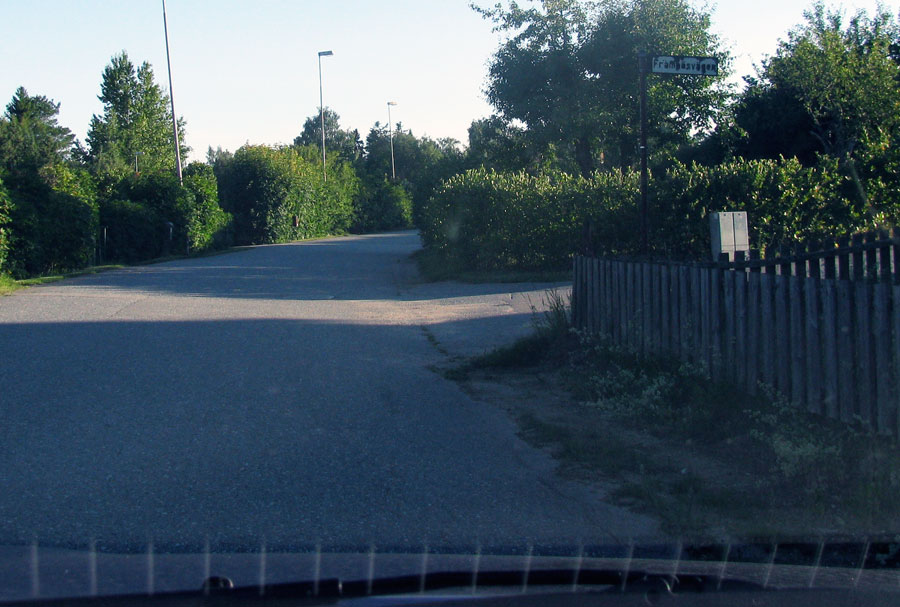
The right-hand rule: “When the paths of two vehicles intersect, the one driver must give way to the vehicle approaching from the right”. (Swedish Road Traffic Ordinance) Why not the exit rule?
– There is a sign with a street name, which is a strong indication that it is not an exit.

Question 30

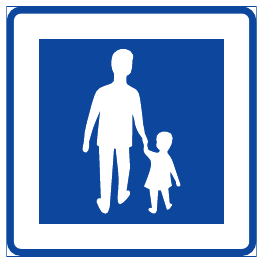
You are driving out from a property and must cross a dual track for pedestrians, cyclists and moped drivers. Who must you give way to?

Explanation

On foot paths, [...] drivers must give way to pedestrians. […] On bicycle paths, cyclists and drivers of class II mopeds must be given right of way by other vehicle drivers.
Swedish Road Traffic Ordinance
Question 31

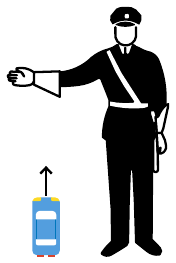
What does this signal mean?

Picture for the question

Explanation

Stop
StopP1

The signal means stop for the road user coming head on or from behind. The signal is used in a junction and applies as long as the officer is facing in the same direction. For road users approaching from the side, the signal means that the road is free and that it is permitted to drive. The signal may be given in combination with the signal P2, stop. The signal may be given using a stop paddle.

The word “or” in the above quote is used because the Swedish Transport Agency is describing the sign’s significance from a single road user’s perspective. A road user cannot be coming head on and from behind at the same time, hence the “or”. However, the question is asking about “traffic”, which is to be interpreted as multiple road users.

Question 32

How often do you have to inspect a car that is more than 5 years old?

Explanation

On 20 May 2018, the old system with the last digit in the registration number was discontinued.

New inspection rules as of 20 May 2018:

  • A new car must be inspected for the first time no later than 3 years (36 months) after the month when it was first used.
  • The second inspection no later than 2 years (24 months) after the month when the first inspection was made.
  • Then no later than 14 months after the month when the most recent inspection was made.

To simplify, a car older than 5 years must be inspected every year. It is recommended to schedule an inspection the same month every year and treat the 2 extra months as a margin of safety.

Please note that the last day for inspection is always the last day of the month. This is because you start counting the month after the most recent inspection.

Question 33

It is dark outside, and you have your daytime lights on. At what distance will you spot a pedestrian wearing reflectors?

Explanation

Driving Licence Book (19th Edition, page 152): “with reflectors […] daytime lights […] 125 metres”.

Question 34

It is winter, and it has been snowing for several days. Which alternative applies to junctions?

Explanation

Many cars will stop and start at a junction. This compacts the snow, which makes it slippery and thereby means it provides less traction.

Ploughing can make the problem worse, as this removes the loose snow and leaves only the compacted icy snow, which is practically impossible to get rid of.

Question 35

What is PM10?

Explanation

Inhalable particles, PM10, are microscopic particles. PM10 stands for ‘particulate matter 10’ and indicates the mass of particles with a diameter of less than 10 micrometres (millionth of a meter). These particles can be inhaled and the smallest ones can get down into the lungs.
Swedish Transport Administration
Question 36

What is true about the right of way rules for vehicles exiting this area?

Picture for the question

Explanation

Pedestrian street
Pedestrian streetE7

The exit rule (part of it): “A driver is also obliged to give way to every vehicle whose path intersects theirs when the driver is entering a road [...] from a bicycle path, a pedestrian street, a home zone or from terrain.” (Swedish Road Traffic Ordinance)

Question 37

You are driving on a two-way road. Where would you see this verge post?

Picture for the question

Explanation

The reflectors shall be white, with the exception of bus stops, parking spaces and junctions/intersections, where the reflectors shall be yellow.
Swedish Transport Administration

When not around a junction, posts with white round reflectors are placed on the left side and posts with white rectangular reflectors are placed on the right side of the road.

Question 38

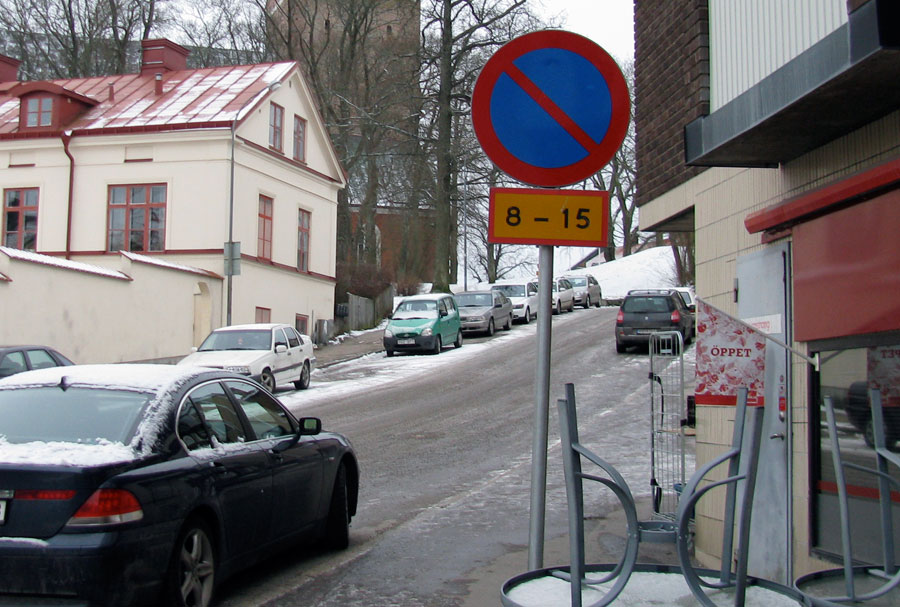
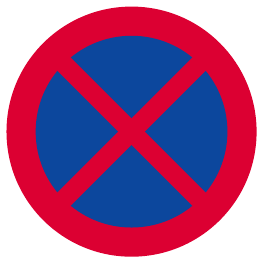
Is it permitted to stop here on a weekday at 13:00?

Picture for the question

Explanation

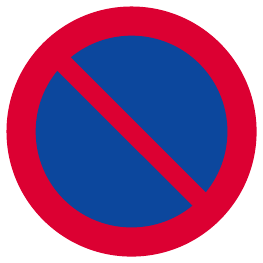
The question asks if you are permitted to stop. Parking is never mentioned in the question. Do not mix up these signs:

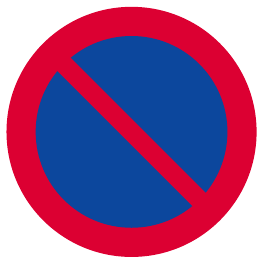
Vehicle parking is prohibited
Vehicle parking is prohibitedC35
No stopping or parking
No stopping or parkingC39
Question 39

What does this road sign mean?

Picture for the question

Explanation

Zone sign
Zone signE20

The sign indicates the start of an area with the prohibitions or allowances indicated by the inserted sign. Exceptions from the directions given on the sign may be provided through additional panels. Time restrictions can also be included in the sign. The sign is erected at the entrances to the area and applies up to the point where the sign E21, end of zone, is erected or it is otherwise clearly indicated that the instructions on the sign no longer apply. Within the area, there may be deviations from the instructions on the sign. These deviations are indicated through other road signs and additional panels. The instructions on the sign also apply after such deviations without the sign being repeated. Other prohibitions or allowances may be indicated on the sign. The Swedish Transport Agency has the authority to issue provisions regarding which prohibitions or allowances may be indicated.

You are not permitted to park “everywhere” (you are, for example, never permitted to park in a junction). There may also be other directions, which makes “everywhere” an incorrect option.

Question 40

It is dark outside, and you have your daytime lights on. At what distance will you spot a pedestrian wearing dark clothes and no reflectors?

Explanation

Driving Licence Book (19th Edition, page 152): “dark clothes […] daytime lights […] 25 metres”.

Question 41

What is the most dangerous aspect of fog?

Explanation

Good visibility is extremely important, as around 90% of all information required to drive safely is provided by visual input.

Question 42

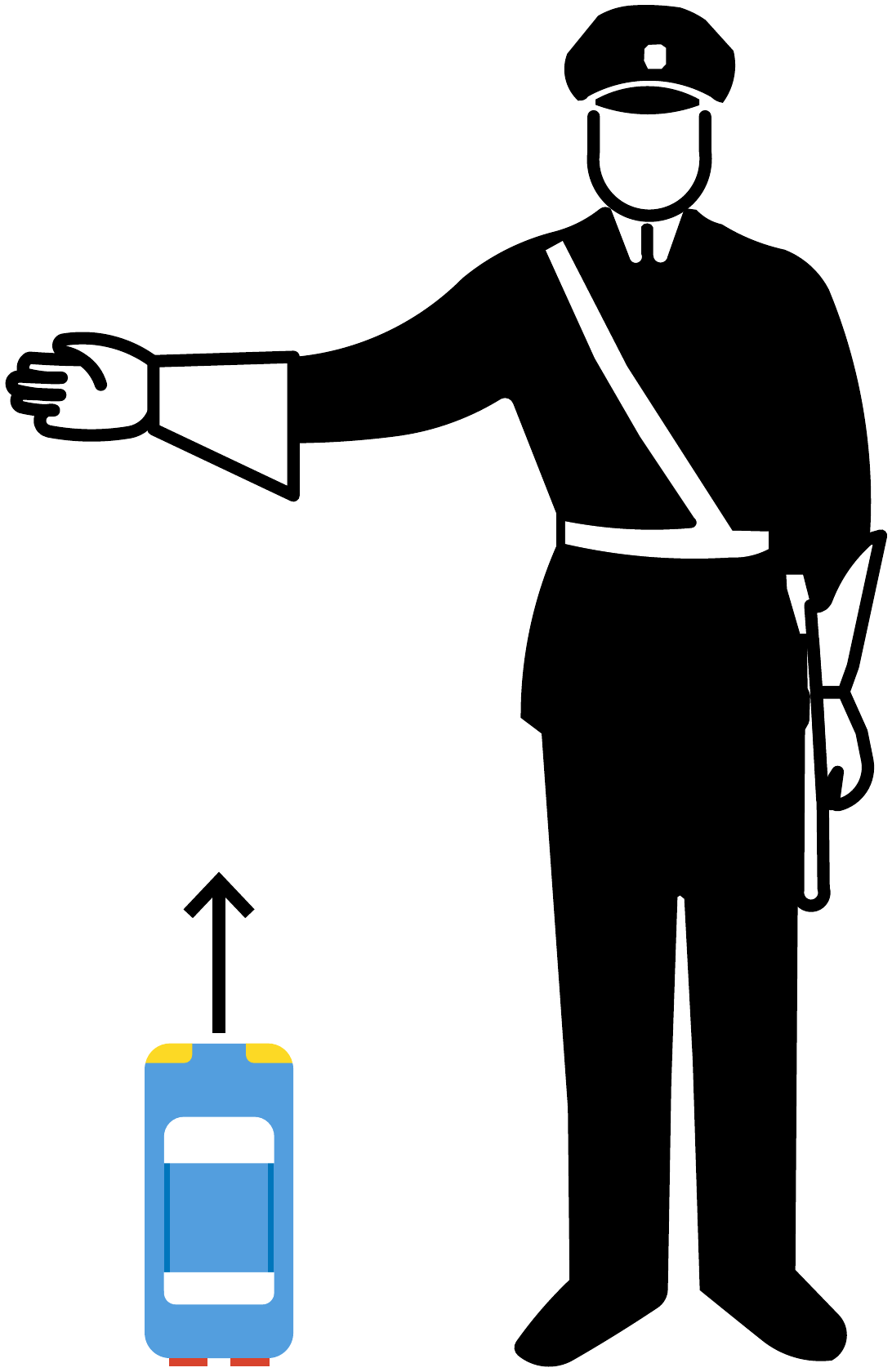
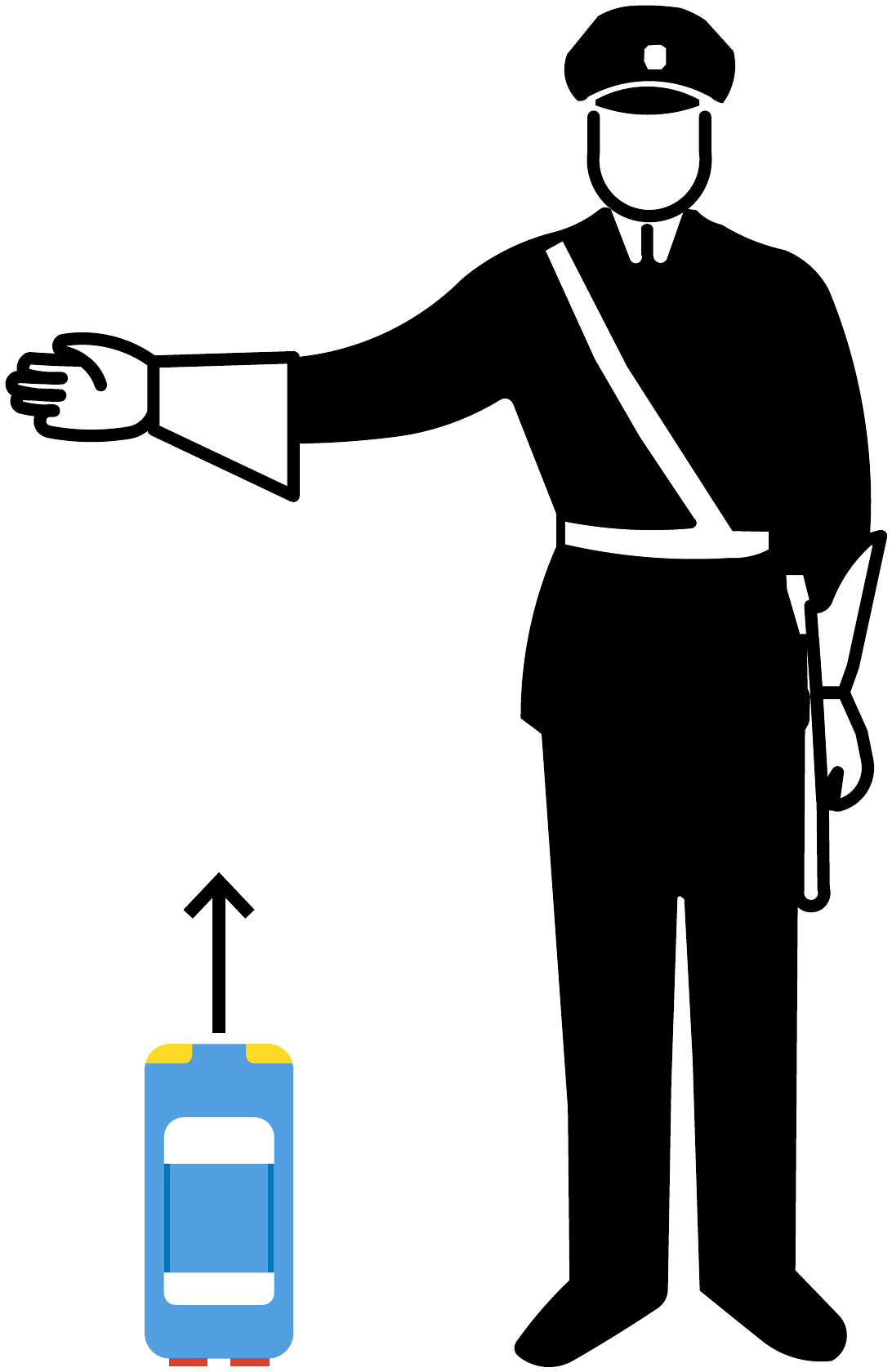
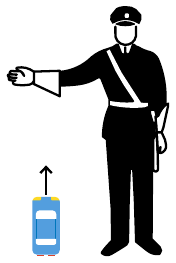
The police officer is holding their hand still. What does this signal mean?

Picture for the question

Explanation

Stop
StopP1

The signal means stop for the road user coming head on or from behind. The signal is used in a junction and applies as long as the officer is facing in the same direction. For road users approaching from the side, the signal means that the road is free and that it is permitted to drive. The signal may be given in combination with the signal P2, stop. The signal may be given using a stop paddle.

Question 43

What can be the result of the brain receiving insufficient information to make a correct interpretation of a traffic situation?

Explanation

Optical illusions “happen when the brain receives insufficient information. This means that it cannot make a correct assessment.” (Driving Licence Book, 19th Edition, page 197)

Question 44

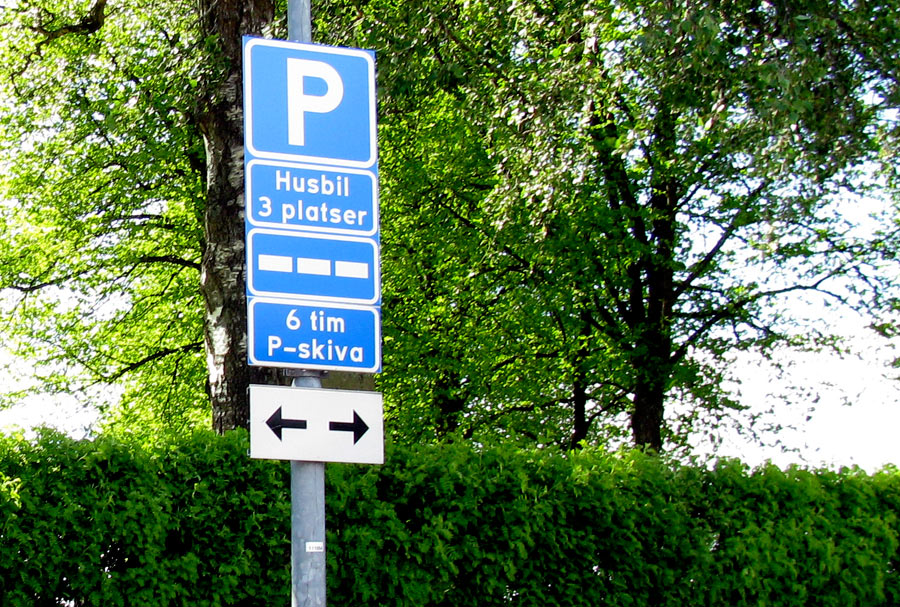
Does the white sign with arrows have anything to do with the blue signs above it?

Picture for the question

Explanation

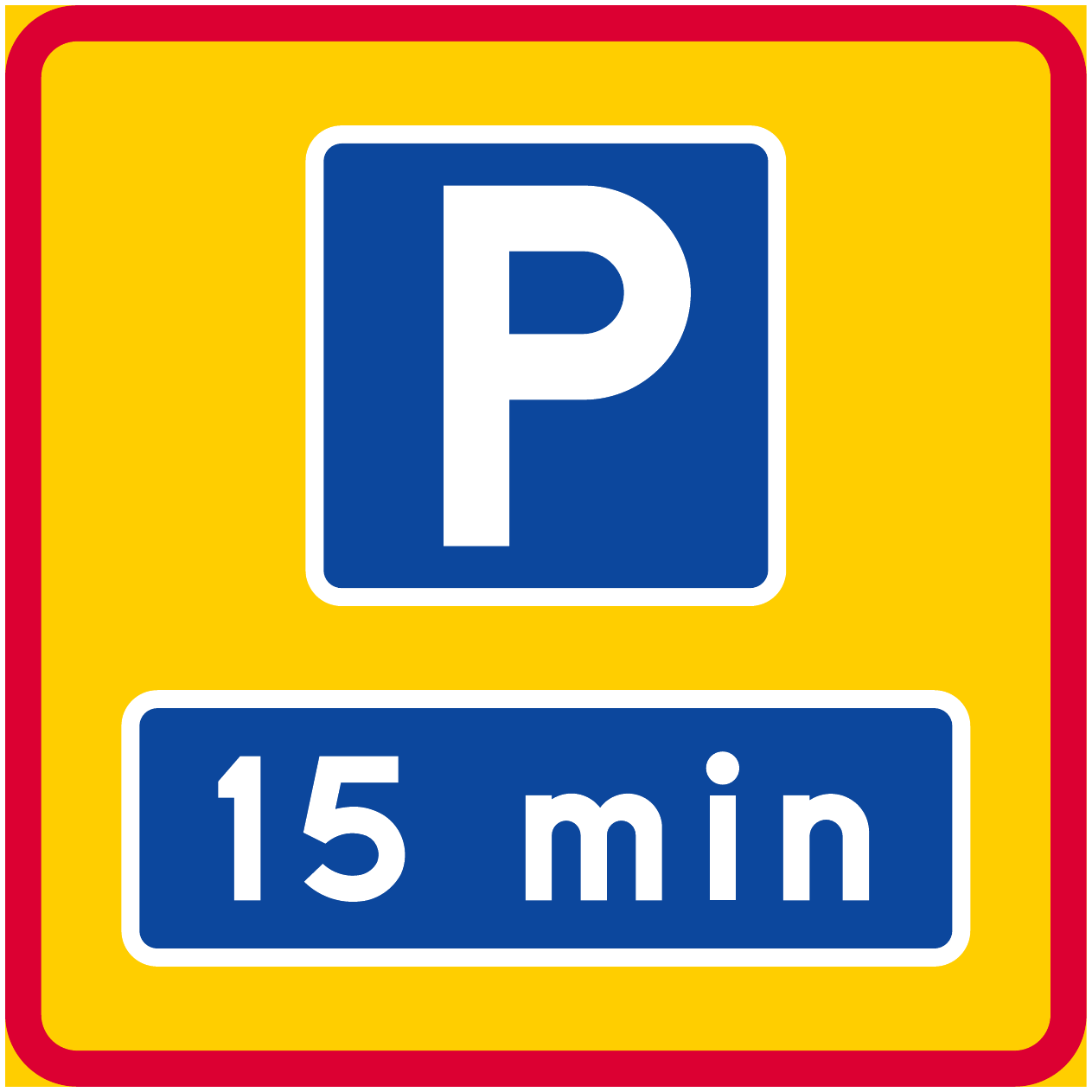
”Husbil, 3 platser” = Mobile home, 3 spaces

”P-skiva” = Parking disc

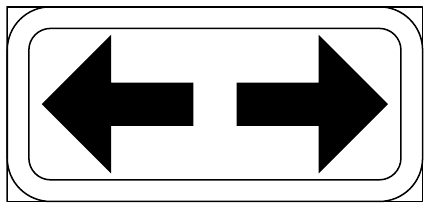
Extension
ExtensionT11

The panel with arrows pointing in two directions, placed horizontally or vertically, means that the indication applies to both sides of the sign. The panel with the arrow pointing down means that the indication ends there. The panel with a right or left-pointing arrow means that the indication applies in the direction to which it points. If the panel is used under an E19 sign, parking, the black symbol is on a white background with no border. The panels can also be used independently to demarcate parking spaces in an area, if there is a sign at the entrance to the area stating that parking is permitted.
Question 45

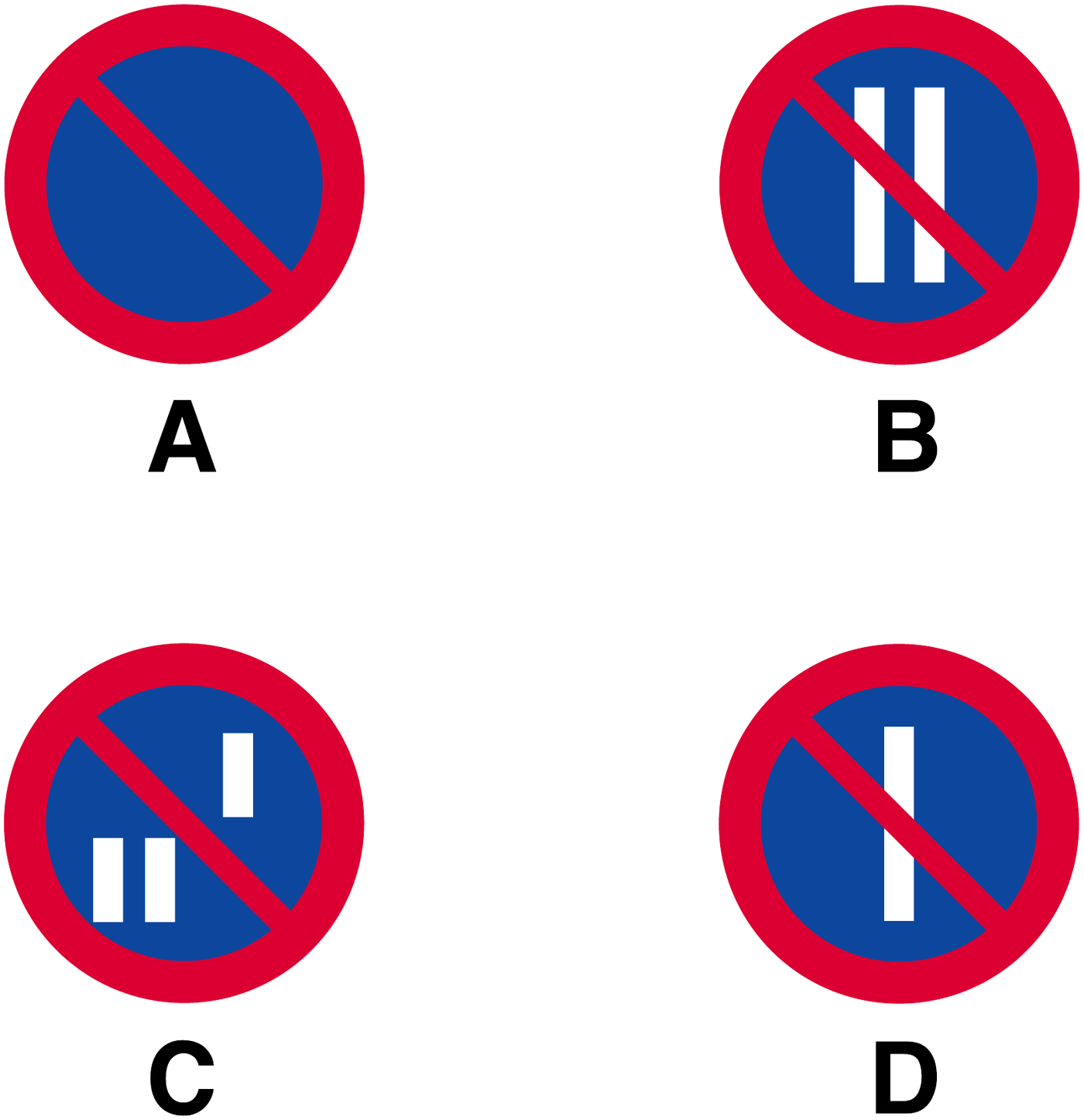
Which sign indicates that vehicle parking is prohibited only on odd-numbered dates?

Picture for the question

Explanation

Vehicle parking is prohibited
AVehicle parking is prohibitedC35

The sign indicates it is prohibited to park a vehicle. The directions apply on the side of the road where the sign is posted.

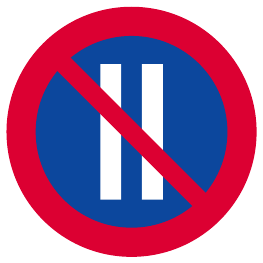
Vehicle parking is prohibited on even-numbered dates
BVehicle parking is prohibited on even-numbered datesC37

The more detailed provisions relating to sign C35, Vehicle parking is prohibited, also apply to this sign.

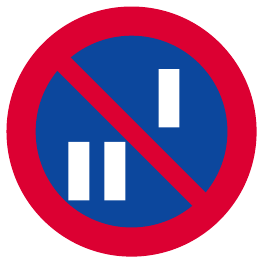
Date parking
CDate parkingC38

The sign indicates that it is prohibited to park vehicles on days with even-numbered dates on the side of the road that has even-numbered addresses and on days with odd-numbered dates on the side of the road that has odd-numbered addresses. The more detailed provisions relating to sign C35, Vehicle parking is prohibited, also apply to this sign.

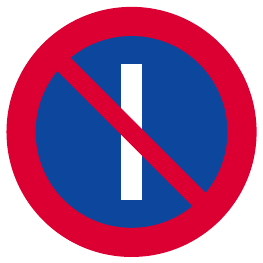
Vehicle parking is prohibited on odd-numbered dates
DVehicle parking is prohibited on odd-numbered datesC36

The more detailed provisions relating to sign C35, Vehicle parking is prohibited, also apply to this sign.

Question 46

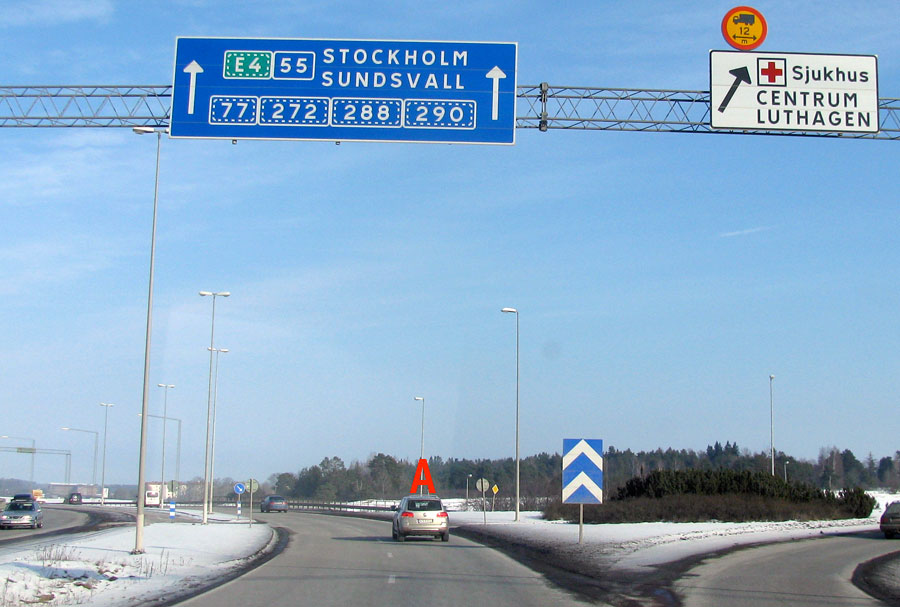
What is the number of the road car A is driving on?

Picture for the question

Explanation

Illustration
Road numberF14

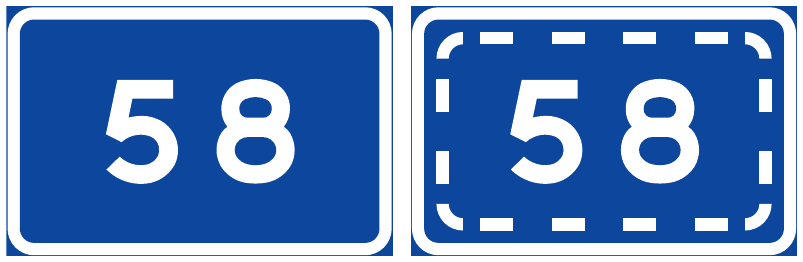
A road number is only given for roads in the number group 1–499. A sign with a dashed border indicates that the road is leading to the route with the number on the sign.

This means that you are driving on road 55 and can arrive at the other ones if you continue. You are in other words not driving on road 77 or 272 yet.

Question 47

How does engine braking work?

Explanation

Use engine braking as much as possible. [...] If you let up on the accelerator completely when the engine is running at above 1,500–1,600 rpm, there will be no fuel at all delivered to the engine.
Swedish Transport Administration
Question 48

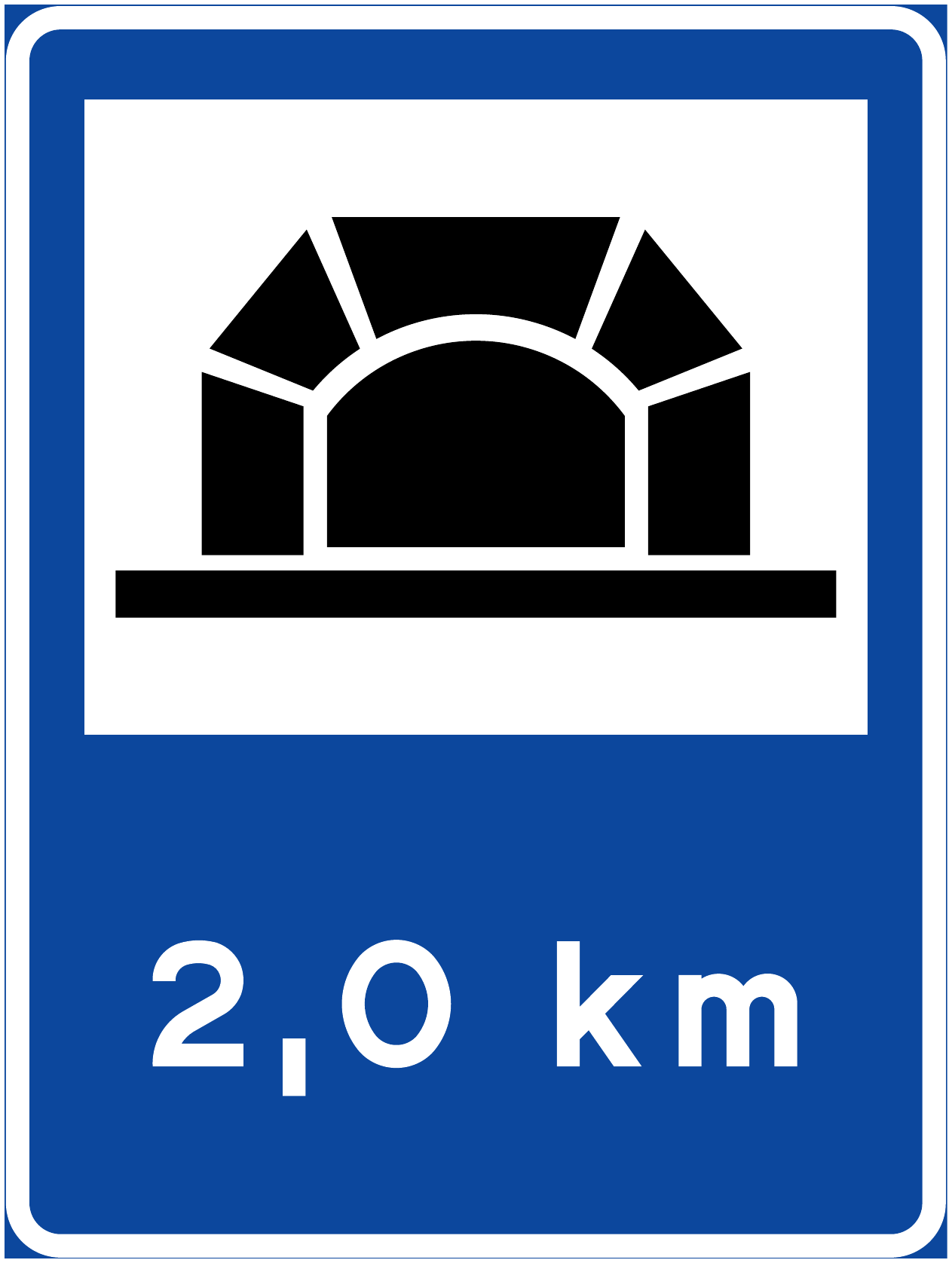
What does this road sign mean?

Picture for the question

Explanation

Tunnel
TunnelE26

The sign indicates a tunnel. The tunnel’s length is indicated and the tunnel’s name may be given on the sign. The sign repeats after every kilometre and the remaining length of tunnel is stated on the sign.

Question 49

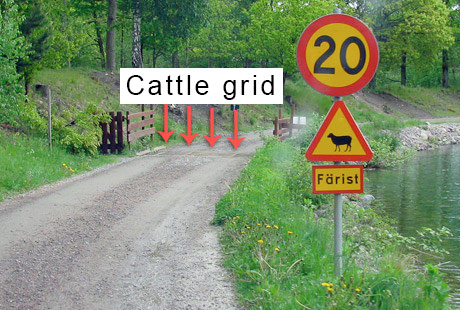
What is a cattle grid?

Explanation

Nationalencyklopedin: “cattle grid, a metal grid covering a road in order to prevent cattle from crossing.”

If the animals attempt to cross, their legs get stuck between the bars.

A cattle grid means you do not have to put up a gate, which makes it easier for cars to pass through.

“Färist” = Cattle grid

Illustration
Question 50

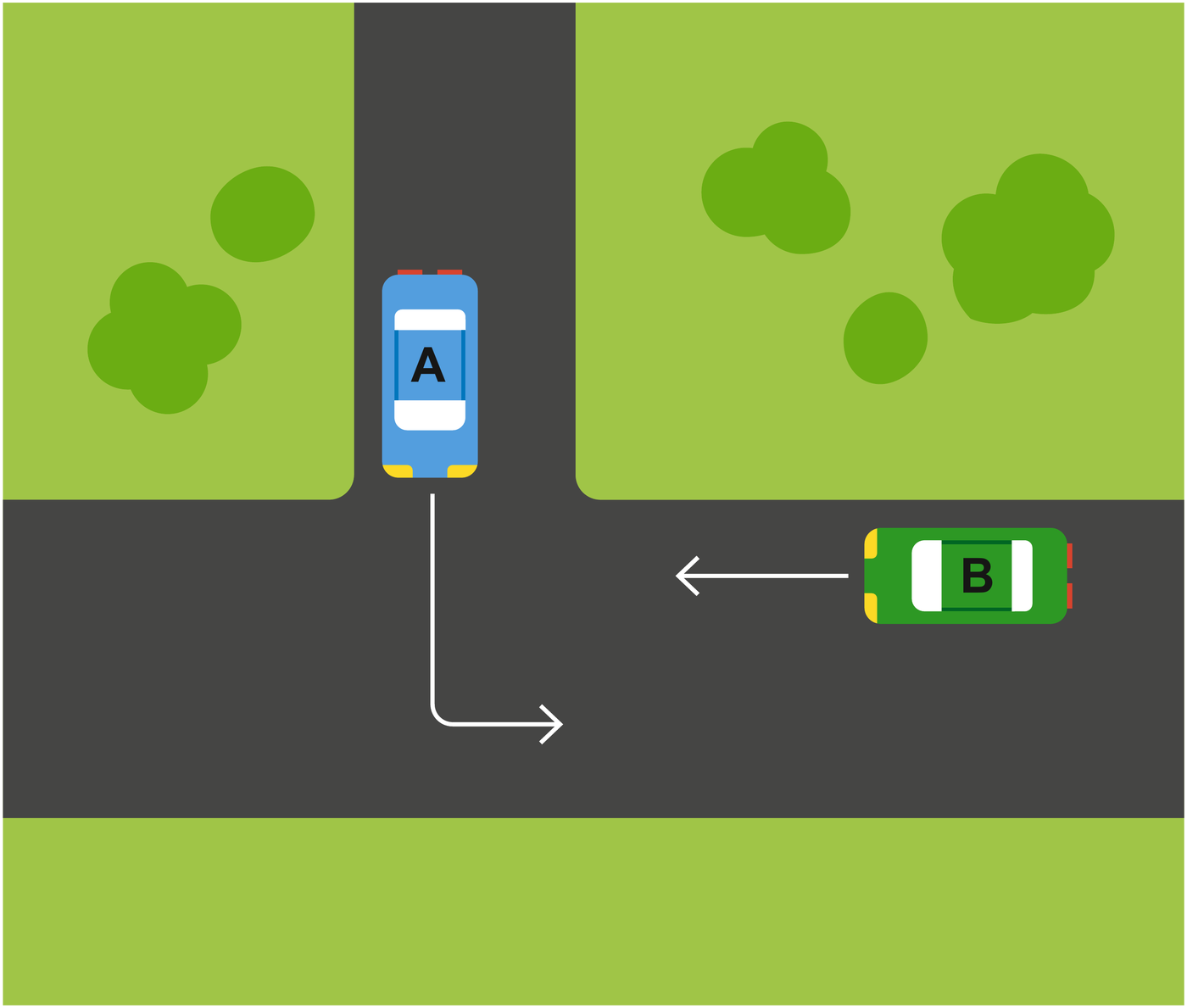
Which statement is true regarding right of way rules?

Picture for the question

Explanation

As there are no visible signs or traffic signals, the right-hand rule applies and this rule does not take into consideration the size of the roads or who is driving straight ahead and who is turning. A is approaching B from the right = B has to give way to A.

Question 51

Which option is true?

Explanation

The airbag does not need to be physically removed as suggested in the alternative, it only needs to be deactivated. If you want to be 100% sure, it is best to physically remove the airbag (there is always the possibility of malfunction), but it is not a requirement.

A normal distance to the airbag is the best. The airbag “can cause very serious injuries if you are too close to it when it is released.” (Driving Licence Book, 19th Edition, page 117).

“The airbag fills up in 0.1 seconds” (Driving Licence Book, 19th Edition, page 116). 0.1 seconds is less than 1 second, which makes this the correct alternative.

Question 52

You intend to use your car to tow a cement mixer on steel wheels. What rule applies?

Explanation

A motor vehicle, or a vehicle connected to it, with wheels of iron or another hard material [may be driven at a maximum] 10 [km/h].
Swedish Transport Agency
Question 53

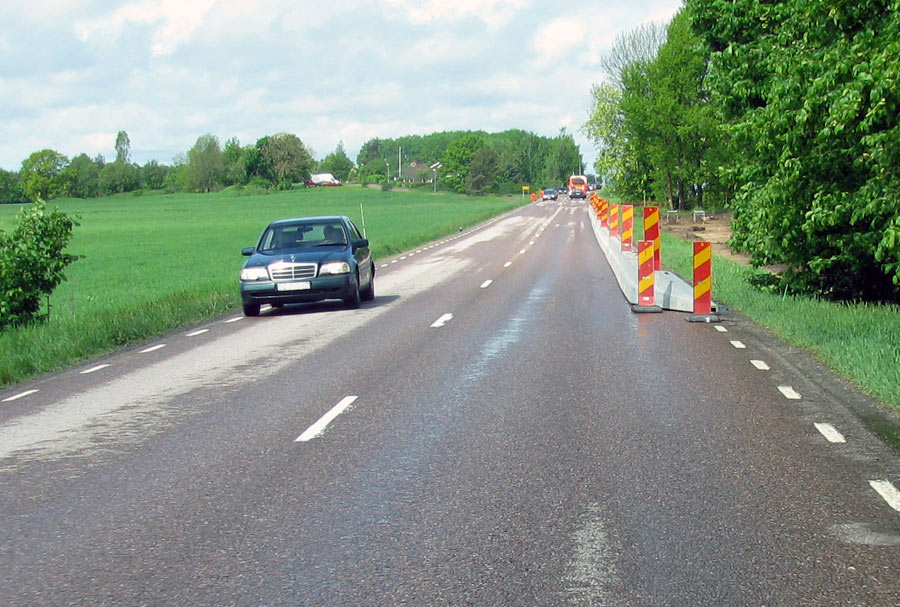
You are driving the car from which the picture is taken. How should you act?

Picture for the question

Explanation

There are several reasons not to stop:

  • Your lane is still fairly wide, so you may not even have to drive with one set of wheels in the oncoming lane.
  • The obstacle continues for a longer stretch. This means that you could get stuck for quite a while waiting for the road to clear. You would cause a queue, which is not good (it could hinder an ambulance in the back, for example).
  • It looks as if the oncoming traffic has plenty of room to keep to the side. They may not “insist on their right” since “A road user shall act to ensure that they do not unnecessarily obstruct or disturb other traffic.” (Swedish Road Traffic Ordinance)
Question 54

You are driving on a country road. Due to a load on the roof, you are driving 15 km/h slower than the speed limit, which means that a queue has formed behind you. How should you act?

Explanation

Not paying attention to the queue is unwise. You may indirectly cause an accident if an annoyed and stressed driver tries you overtake you, or the car right behind you is not keeping a proper distance.

Speeding up is not good either, as you probably have made the assessment that driving any faster would not be safe.

The safest thing for all involved is if you move into a parking space to let the queue pass you.

Section of law that can be (but is not necessarily) applicable in this question: “If a vehicle is driving slowly or taking up a large space in a lane that is narrow, winding or where there is a significant amount of oncoming traffic, the driver shall facilitate overtaking by reducing their speed and, if necessary, pull their vehicle aside as soon as possible.” (Swedish Road Traffic Ordinance)

Question 55

Which rpm level should you avoid exceeding if you want the catalytic converter to be effective?

Explanation

It “is important not to exceed 3,000 rpm and do not push the accelerator more than half way down. Otherwise, you risk disabling the catalytic converter.” (Swedish Transport Administration)

Question 56

Are you allowed to use summer tyres on a snowy day in January?

Explanation

One acceptable alternative to winter tyres is summer tyres fitted with snow chains.
Driving Licence Book, 19th Edition, page 175
Question 57

It is sometimes forbidden to overtake right before a railway crossing. What does that mean?

Explanation

There are no exact limits, as the layout of different crossings varies a lot.

Overtaking is not allowed just before or on a level crossing, except when
1. the crossing is gated, or
2. the traffic in the crossing is regulated through such traffic signals as are used in regular junctions.
Swedish Road Traffic Ordinance
Question 58

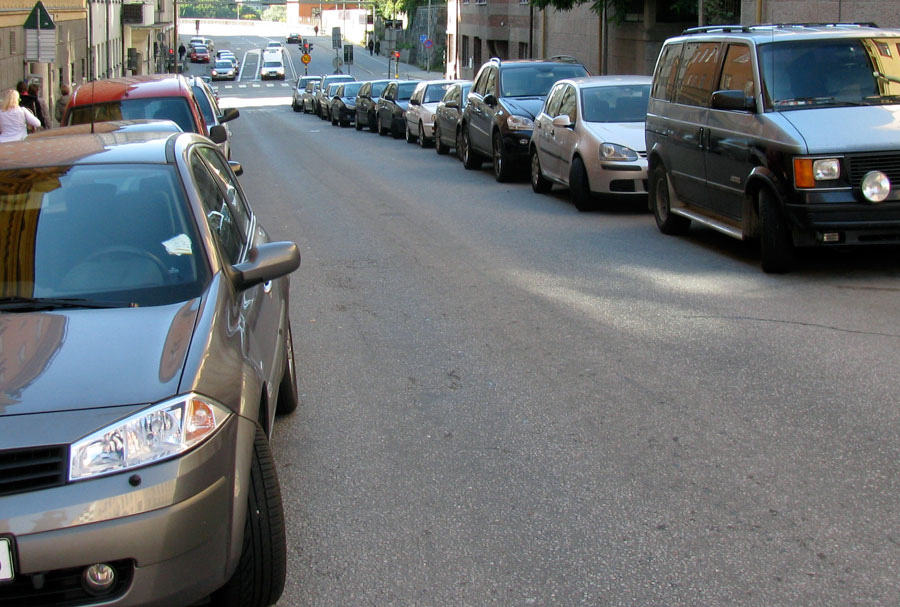
How can you conclude that the street in the photo is one-way?

Picture for the question

Explanation

On a road, vehicles may only stop or park on the right hand side in the direction of travel. […] On roads with one-way traffic, vehicles may also stop or park on the left hand side in other cases.
Swedish Road Traffic Ordinance

The other options do not give any clues to indicate that the road would be one-way.

Why is identifying clues important?
– Traffic is complex and sometimes you miss signs. It is therefore good to also be able to analyse situations with the help of clues. There are indications that similar questions may appear on the real test.

Question 59

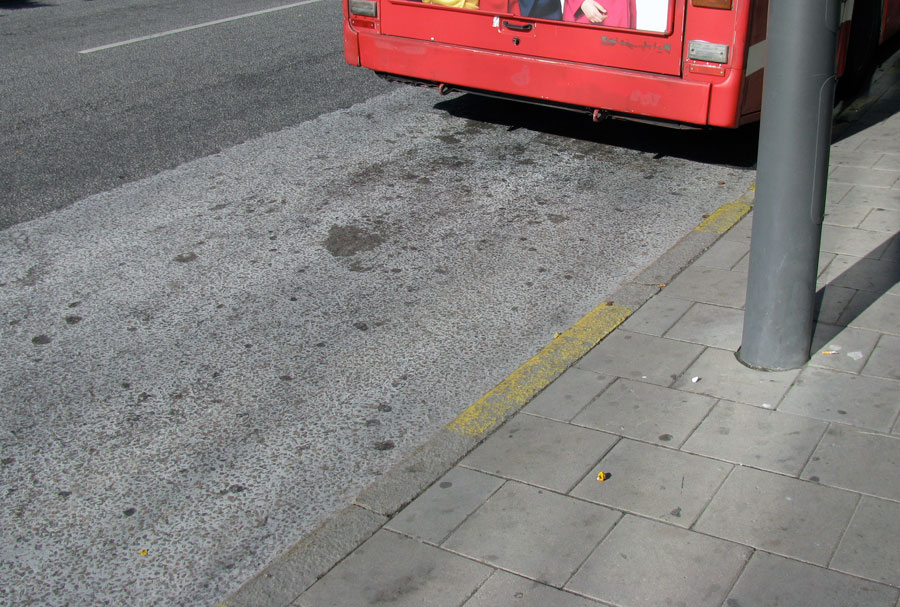
Is it permitted to stop in order to unload items at the bus stop?

Picture for the question

Explanation

At a marked stop for trams, vehicles operating a regular service or school buses, other vehicles may not stop or park for anything other than setting down or picking up passengers, and this must be possible without obstructing tram, public transport or school bus traffic.
Swedish Road Traffic Ordinance

Stopping and setting a passenger down usually only takes a few seconds and you can quickly move the car since you never leave it. Stopping, for example, to load and unload items usually involves you leaving the car there for several minutes and thereby obstructing buses, which is not permitted. (Note that it does not matter how fast the unloading takes, it is still prohibited.)
Question 60

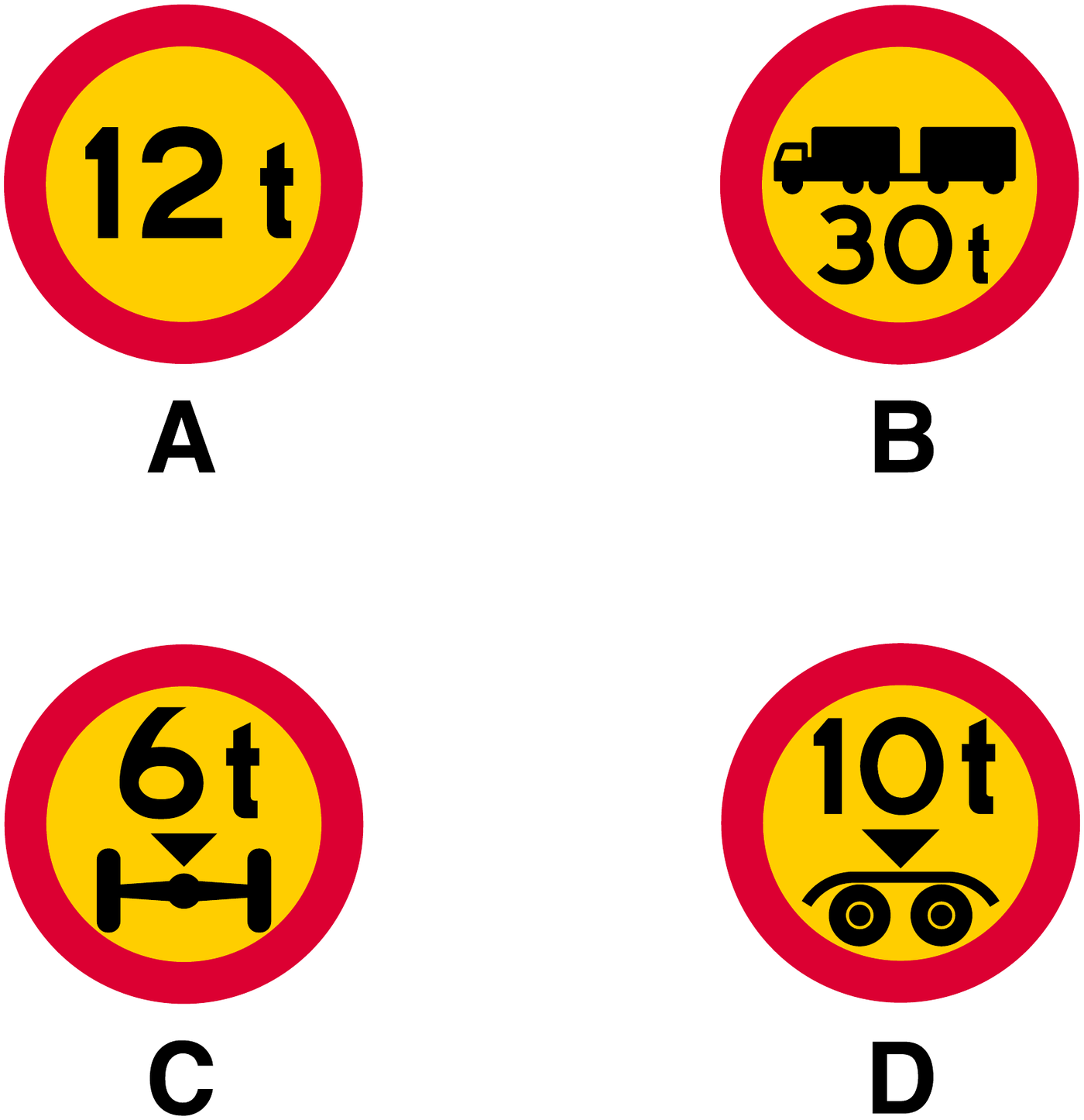
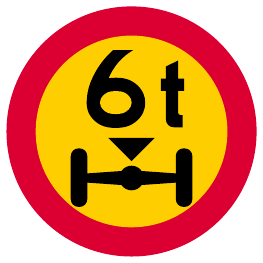
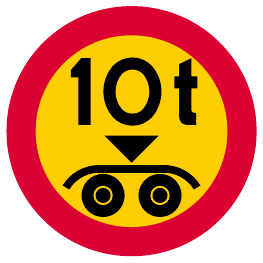
Which sign indicates the maximum permitted load on a tandem axle?

Picture for the question

Explanation

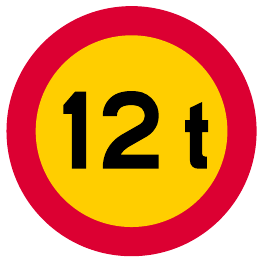
Restricted gross weight of vehicle
ARestricted gross weight of vehicleC20

Maximum permitted gross weight is indicated on the sign.

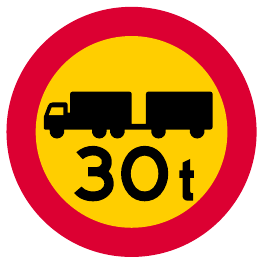
Restricted gross weight of vehicle and vehicle combination
BRestricted gross weight of vehicle and vehicle combinationC21

Maximum permitted gross weight is indicated on the sign.

Restricted weight on one axle
CRestricted weight on one axleC23

Maximum permitted weight on an axle is indicated on the sign.

Restricted weight on tandem axle
DRestricted weight on tandem axleC24

Maximum permitted weight on a tandem axle is indicated on the sign.

Question 61

What is the three-second rule?

Question 62

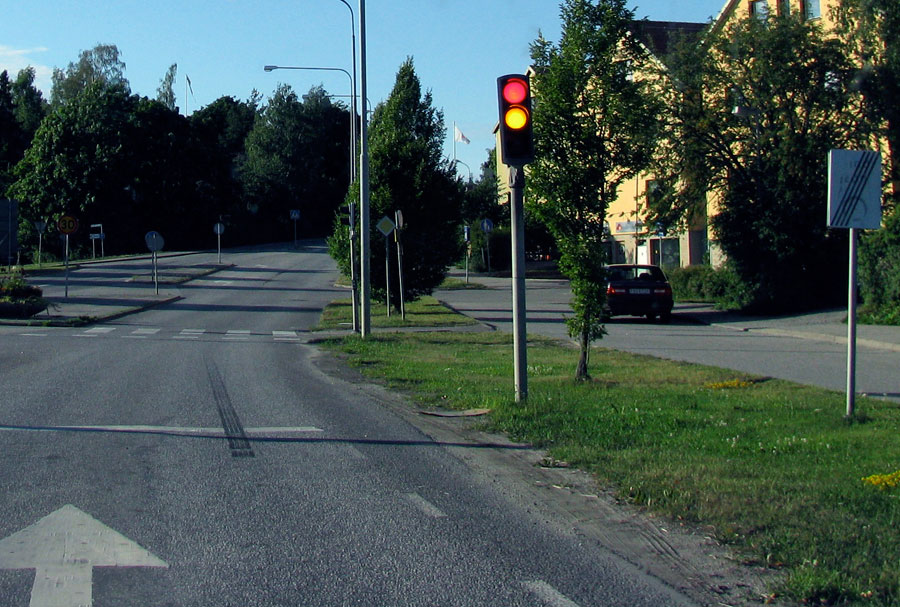
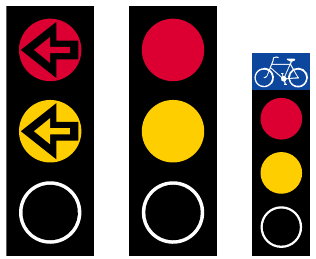
What colour will the traffic light turn next?

Picture for the question

Explanation

Red + amber
Red + amberSIG2

The change to a green signal is imminent. Otherwise, the signal has the same meaning as red.

When it is about to change to red, the amber and red lights are never lit at the same time.

Question 63

About how much carbon dioxide does an average car in Sweden emit each year?

Explanation

A normal car driver releases around three tonnes of carbon dioxide per year.
Sveriges Radio
Question 64

You are crossing a dual track for pedestrians, cyclists and moped drivers. Which statement is true regarding traffic on that track?

Picture for the question

Explanation

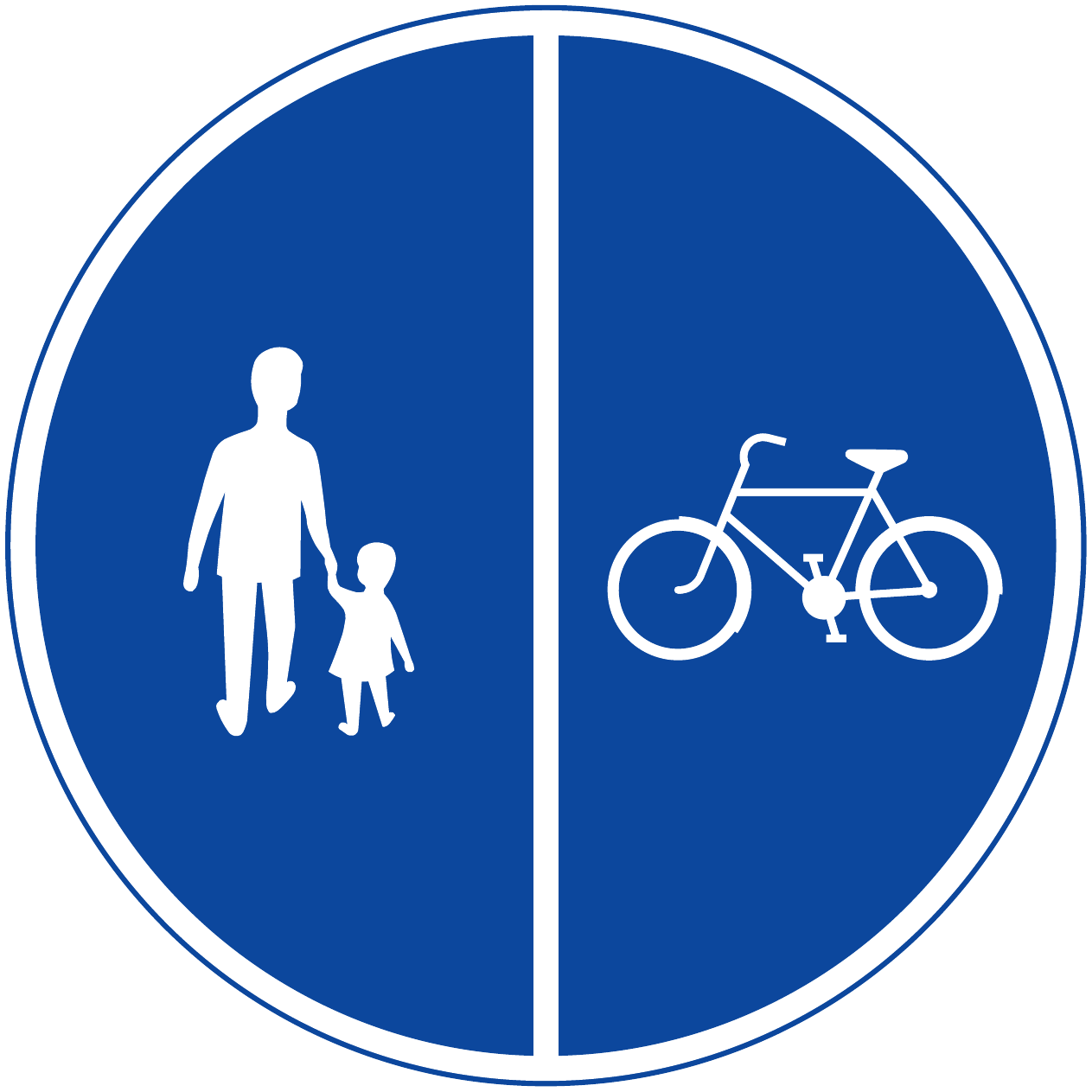
Compulsory tracks for pedestrians, cyclists and moped drivers
Compulsory tracks for pedestrians, cyclists and moped driversD7

The sign indicates tracks separated by road marking, median strip or similar into one lane for pedestrians and another for cyclists and moped drivers. The placement of the symbols on the sign shows which part of the track is intended for which type of traffic. If class II mopeds may not be driven on the track, this is indicated on an additional panel.

On bicycle paths, cyclists and drivers of class II mopeds must be given right of way by other vehicle drivers.
Swedish Road Traffic Ordinance
Question 65

How should you store tyres when they are not being used?

Explanation

Store your tyres in a cool, dry and dark place.
Swedish Transport Agency

The reason for this is that heat, moisture and sunlight are not good for the rubber of the tyre. Surely, you have seen outdoor furniture in plastic that has been standing out in the sun for years? The plastic is usually in a fairly poor condition. The same principle applies to tyres.

Question 66

When is a car that was first registered on 5 May 2020 to undergo inspection?

Explanation

On 20 May 2018, the old system with the last digit in the registration number was discontinued.

New inspection rules as of 20 May 2018:

  • A new car must be inspected for the first time no later than 3 years (36 months) after the month when it was first used.
  • The second inspection no later than 2 years (24 months) after the month when the first inspection was made.
  • Then no later than 14 months after the month when the most recent inspection was made.

To simplify, a car older than 5 years must be inspected every year. It is recommended to schedule an inspection the same month every year and treat the 2 extra months as a margin of safety.

Please note that the last day for inspection is always the last day of the month. This is because you start counting the month after the most recent inspection.

Question 67

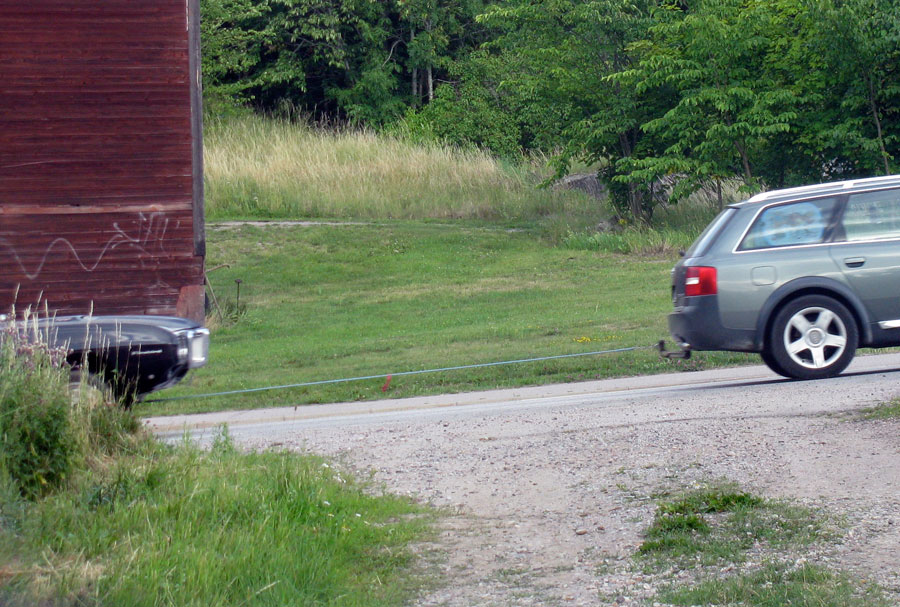
Towing is being done and the distance between the cars is over three metres. Which option is true?

Picture for the question

Explanation

When travelling by road, the connecting device must be clearly marked if the vehicle being towed is not equipped for being coupled to the pulling vehicle and the distance between the vehicles exceeds 2.0 metres.
Swedish Road Traffic Ordinance
Question 68

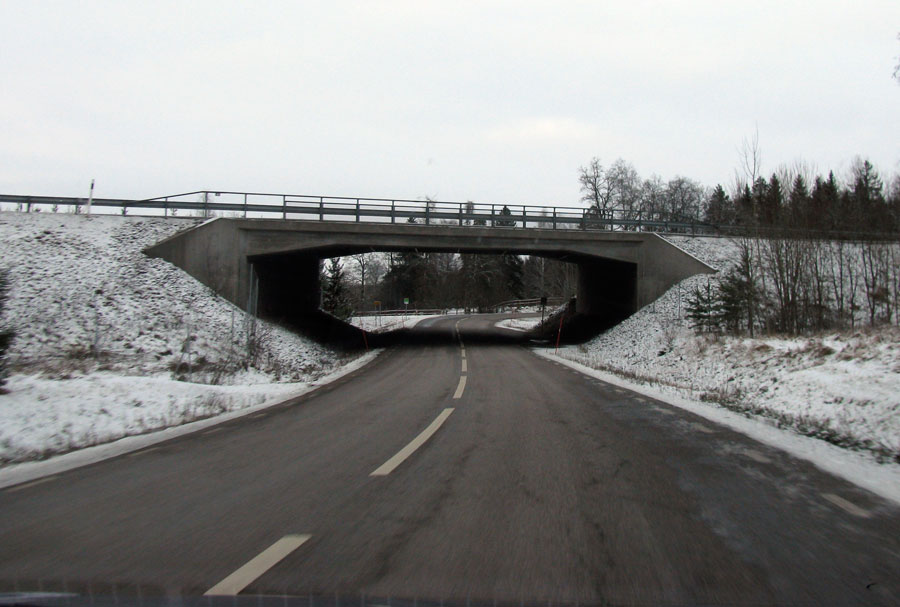
Is it possible to understand something about the bridge’s height despite no indication being given?

Picture for the question

Explanation

The answer is got through looking at the following sign (not presented in the picture):

Restricted vehicle height
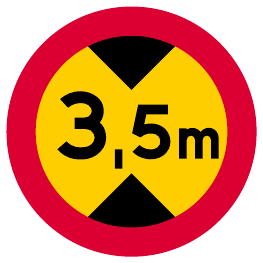
Restricted vehicle heightC17

The sign indicates that traffic with vehicles over a certain height is prohibited if the free height is lower than 4.5 metres. The greatest permitted vehicle height is indicated on the sign.

As stated, the sign is not presented in the picture, which must mean that the height is over 4.5 metres. If it was under 4.5 metres, this sign would be erected. (The fact that it says 3.5 metres on the sign above has no significance. 3.5 metres is used as a standard measurement by the Swedish Transport Agency to illustrate the road sign).
Question 69

You intend to pull a trailer with your car. Which of the following is true?

Explanation

As soon as a trailer is connected to a car, it alters the car’s traction. It can improve it or make it worse, depending on the situation. Ball pressure is an important factor:

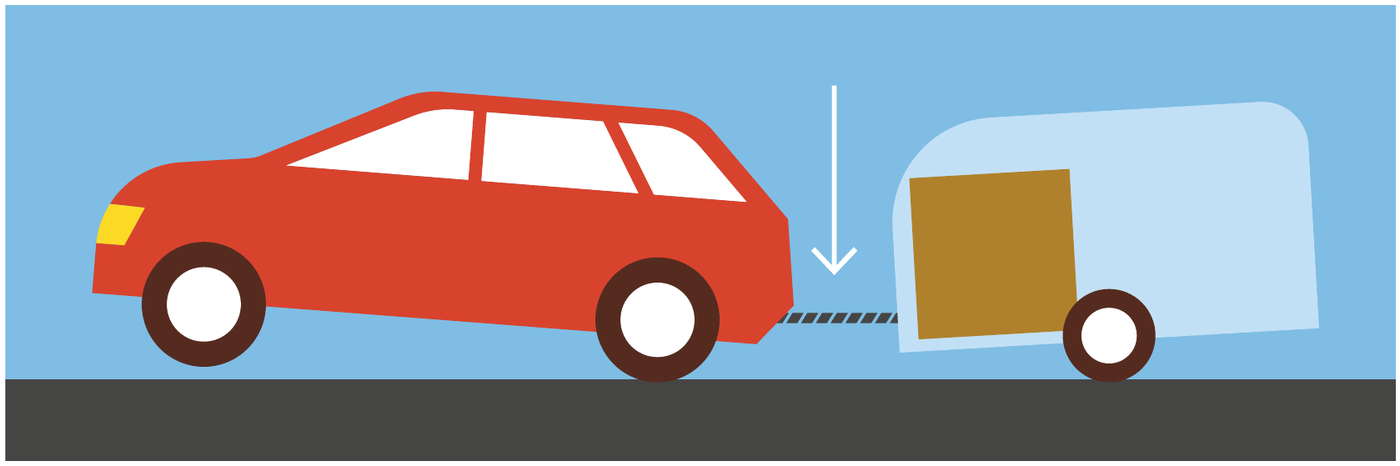
High ball pressure:

Excessive load at the front of the trailer. This gives poor traction with the front wheels and makes the dipped headlights dazzle.

Illustration

The load is all the way forward in the trailer (the red box) and is therefore pressing the coupling device towards the ground. The car is forced to follow it, and since the car is straight, the front end is elevated.
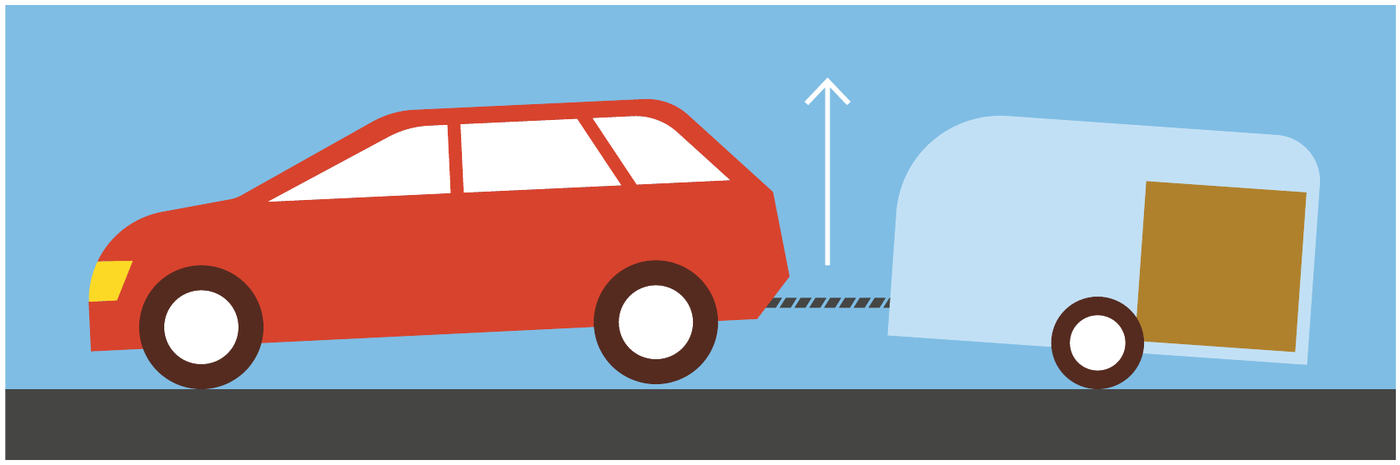
Low ball pressure:

Excessive load at the back of the trailer. This gives poor traction in the rear wheels. Can lead to a driving ban.

Illustration

The load is placed far back in the trailer (the red box) and is therefore tipping the trailer backwards so that the coupling device is pushed upwards. The rear of the car is lifted by the coupling device.

Question 70

Which statement is true about moving a vehicle at the site of an accident?

Explanation

If, following an accident, a vehicle is placed in a way that makes it a hazard or obstruction to traffic, the road user shall ensure that it is promptly moved to another location. However, if anyone has been killed or seriously injured, the vehicle may only be moved if it poses a danger to other traffic. In such a case, the road user may not otherwise remove any traces that may be of significance to the investigation of the accident nor otherwise alter the conditions at the site of the accident.
Swedish Road Traffic Ordinance

No questions to show here.