Driving licence · Theory practice

Practice test 6

70 questions · Pick an answer to see whether you are right. Your answers are saved in this browser.

0of 70 correct
Not started

0 of 70 answered

0Correct
0Incorrect
70Unanswered
14Mistakes allowed

The real test has 70 questions in 50 minutes. You need 56 correct (80%) to pass.

Question 1

The air pressure in your tyres is 25% too low. What is true in comparison to having recommended air pressure?

Explanation

If the air pressure in the tyres is too low, it leads to higher fuel consumption, quicker wear on the tyres and reduced traction.
City of Stockholm
Question 2

Can it be a punishable offence to lend your car to a person who is under the influence of alcohol?

Explanation

Woman convicted of complicity in drunk driving
Dagens Juridik

There are no general or evident rules in this regard, but rather it is a matter of the police/prosecutor/court assessing each case based on its unique circumstances.

Question 3

Does your fuel consumption generally increase when you use the air conditioning (AC)?

Explanation

When the air conditioning (AC) is on, it increases the load on the motor, which means that it consumes more fuel.
Swedish Consumer Agency
Question 4

What is preparedness?

Explanation

Preparedness [...] always ready to act when you perceive a possibly critical situation.
Du och jag i trafiken [You and me in traffic], 28th Edition, page 169

Could preparedness not involve releasing the accelerator and/or moving your foot to the brake?

– Yes, but it can also be other things (such as being prepared to make a sharp turn). The first alternative covers all of this and is therefore the best option.

Question 5

Do you have to report a collision with a deer to the Police?

Explanation

Mark the location and report to the Police if you have collided with: [...] a deer
Driving Licence Book, 19th Edition, page 102
Question 6

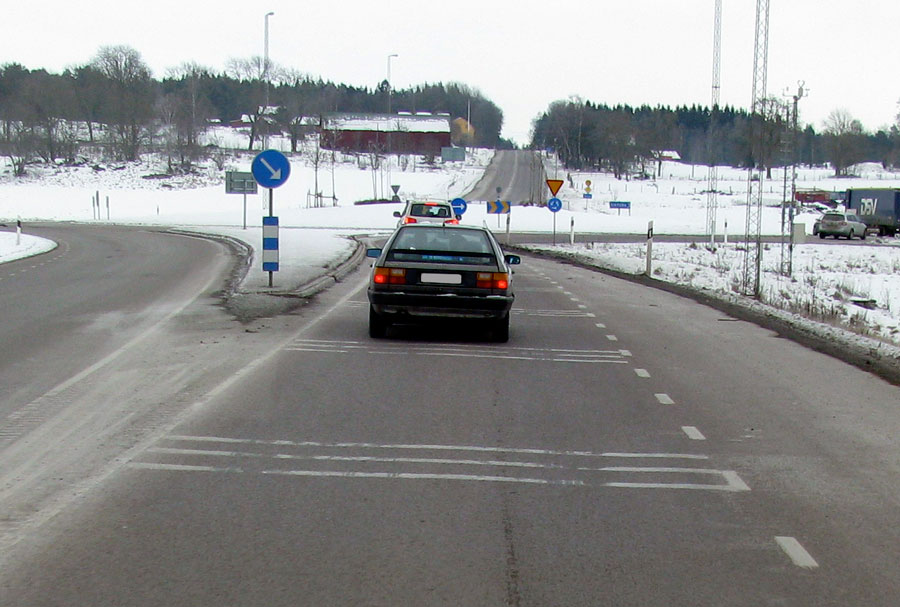
You want to make a turn in this crossing, which is regulated by the give way sign at the centre of the image. Which of the following is true?

Picture for the question

Explanation

Review of the options

  • I only have to give way to traffic from crossing my way from the right.Wrong, the mandatory sign does not regulate priority.
  • I am not free to choose which way I turn in the crossing.Correct, you have to turn right according to the mandatory sign.
  • I do not have to use my indicator when turning in the crossing.Wrong, you must always indicate a turn.
Direction to be followed
Direction to be followedD1

The signs indicate that the vehicle may only be driven in the direction of the arrow or, in the case of two arrows, in either arrow’s direction. The symbol is adapted to the conditions of the location.

Question 7

Which road conditions provide the most friction between the tyres and the road?

Explanation

Nationalencyklopedin: “friction […], resistance that one surface or object encounters when moving over another.”

Review of the options

  • Smooth asphaltCorrect, the tyres will get a good grip since there is great resistance to the road surface = a lot of friction.
  • GravelWrong, the tyres will get a poor grip since there is little resistance to the road surface (the tyres slip on the gravel) = limited friction.
  • Icy road conditionsWrong, the tyres will get a poor grip since there is little resistance to the road surface (the tyres slip on the ice) = limited friction.
  • Wet road conditionsWrong, the tyres will get a poor grip since there is little resistance to the road surface (the tyres slip on the wet road) = limited friction.
Question 8

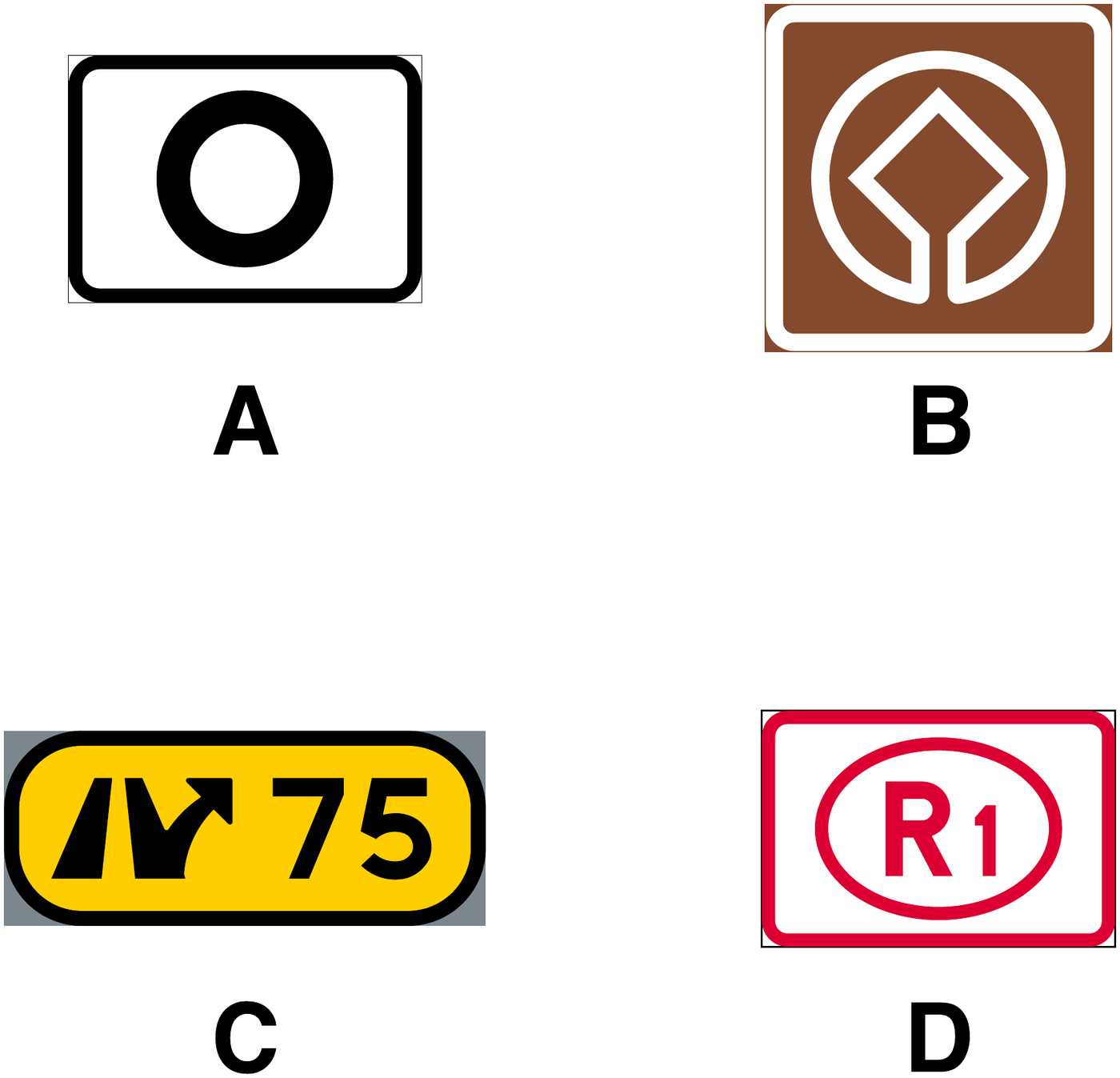
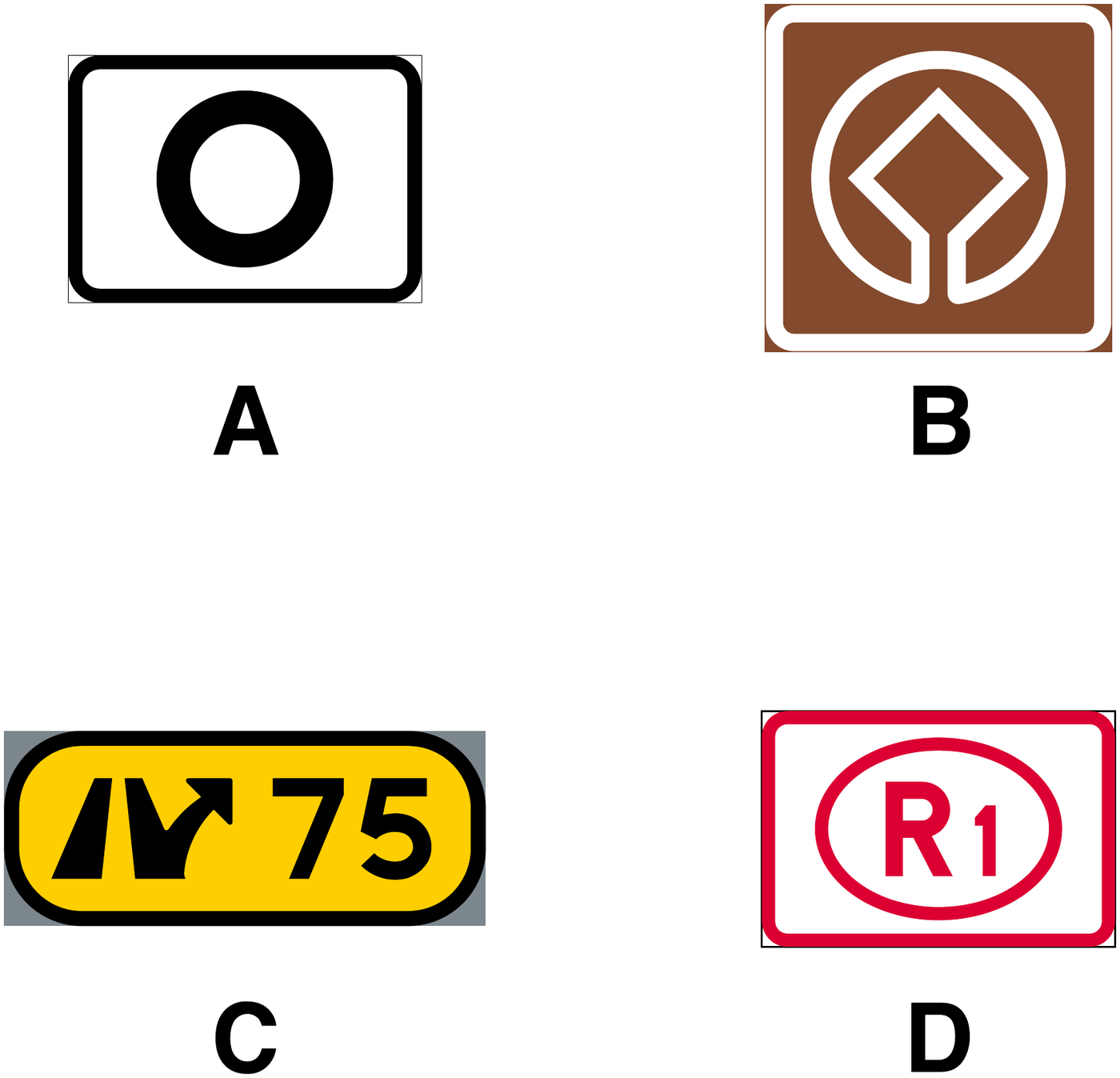
Which sign indicates a national heritage site?

Picture for the question

Explanation

Local loop
ALocal loopF30

The sign indicates a ring road or equivalent. The sign may be supplemented with a designation or similar. No other colour may be used.

World heritage
BWorld heritageI4

The sign indicates world heritage as decided by UNESCO. The sign may be incorporated in a location sign for direction.

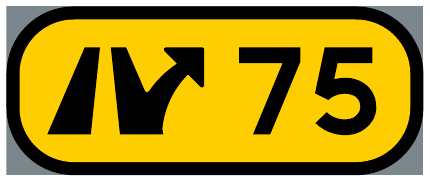
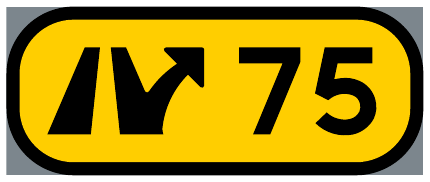
Interchange number
CInterchange numberF27

The sign indicates the number of the interchange. The sign may be supplemented with the exit road's designation. No other colour may be used.

Emergency site
DEmergency siteF33

The sign indicates an emergency site during roadworks or similar. No other colour may be used.

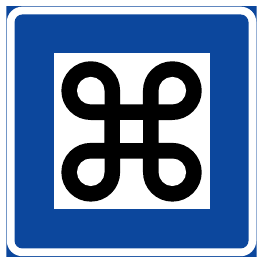
National heritage
National heritageH22

The sign indicates heritage of national interest. The nature of the national heritage is indicated adjacent to the sign.

Question 9

Which option is an example of one of the fundamental rules of traffic?

Question 10

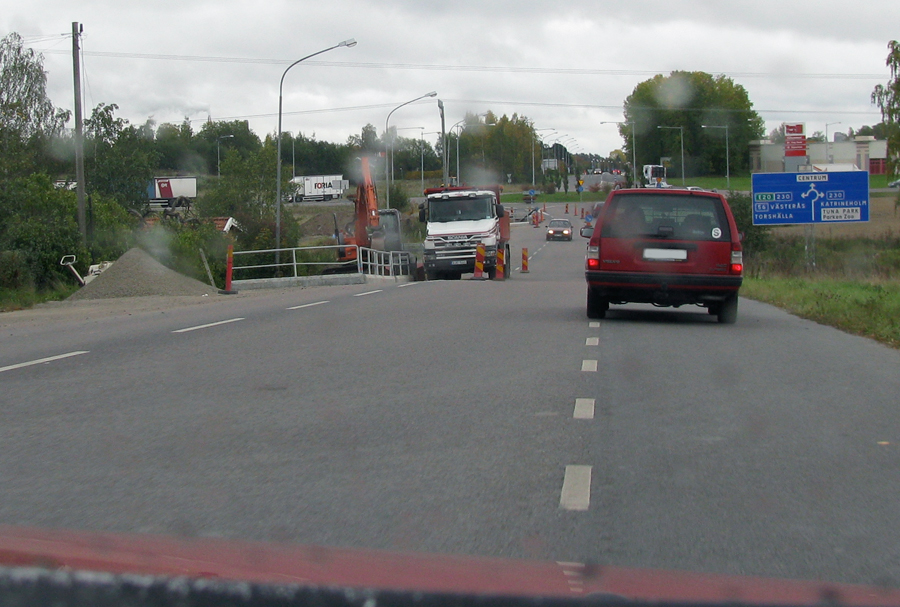
You are driving the car from which the picture is taken. How should you act?

Picture for the question

Explanation

Review of the options

  • Stop to give way to oncoming vehicles, as the lorry to the left of the picture is blocking the lane intended for such vehicles.Unnecessary and not in accordance with the rules: the obstacle is on the oncoming vehicles’ side and consequently you should not stop.
  • Drive out on the hard shoulder following the red car in front of you, as this is helpful to oncoming vehicles.Good, there appears to be plenty of room and you help traffic flow smoothly in both directions. It appears that the oncoming traffic can use “your” lane without problem if you stick to the hard shoulder. A typical example of good cooperation between drivers, which is encouraged by the authorities.
  • Drive between the lane and the hard shoulder, as this is helpful to oncoming vehicles but also safe.This does no good. You will probably block the path of oncoming vehicles, while at the same time there is hardly any improvement in terms of safety (it appears to be perfectly safe to drive on the hard shoulder; it can also be assumed that the speed is low, considering the situation).
  • Stay in the lane intended for traffic in your direction, as the hard shoulder should not be used in this situation.This situation is a typical example of when the hard shoulder should be used to make things easier for all involved.
Question 11

You want to turn left at a heavily trafficked junction. Could you be forced to refrain from turning?

Explanation

A driver may only turn in a junction if this can be done without danger or unnecessary obstruction to others travelling in the same direction. Particular attention is to be given to the traffic behind.
Swedish Road Traffic Ordinance
Question 12

Which alternative describes something that reduces the blood’s ability to take up oxygen and is lethal in large doses?

Explanation

Carbon monoxide “limits the blood’s capacity to take up oxygen [...] in large doses, it is lethal.” (Driving Licence Book, 19th Edition, page 228)

Question 13

You have stopped your car on a dark country road and are talking on your mobile phone. Which lights should you have on?

Explanation

When a vehicle has stopped or parked on a road, the vehicle’s parking and rear lights are to be turned on at night, at dusk or dawn and at other times when the weather or other circumstances require it in order for other road users to become aware of the vehicle.
Swedish Road Traffic Ordinance
Question 14

What rule applies to motorway entry ramps with an acceleration lane?

Explanation

An acceleration lane is counted as a traffic lane:

Acceleration lane: “A lane intended solely for connecting traffic”. (Road Traffic Definitions Act)

If two lanes merge into one, the drivers shall adapt to the new conditions through mutual consideration.
Swedish Road Traffic Ordinance
Question 15

Is it permitted to drive very slowly with no reason?

Explanation

A driver may not drive at excessively low speed without a valid reason
Swedish Road Traffic Ordinance
Question 16

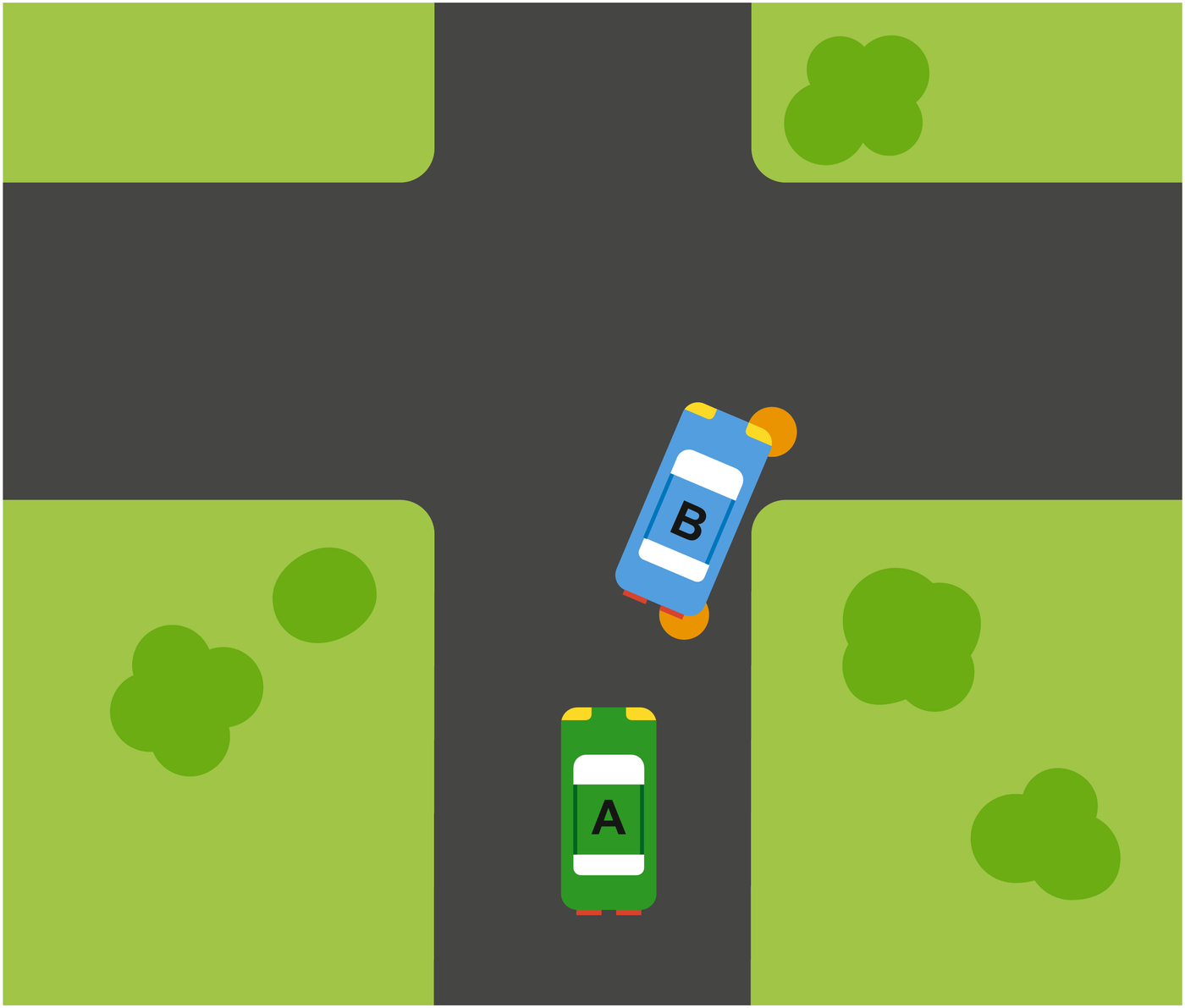
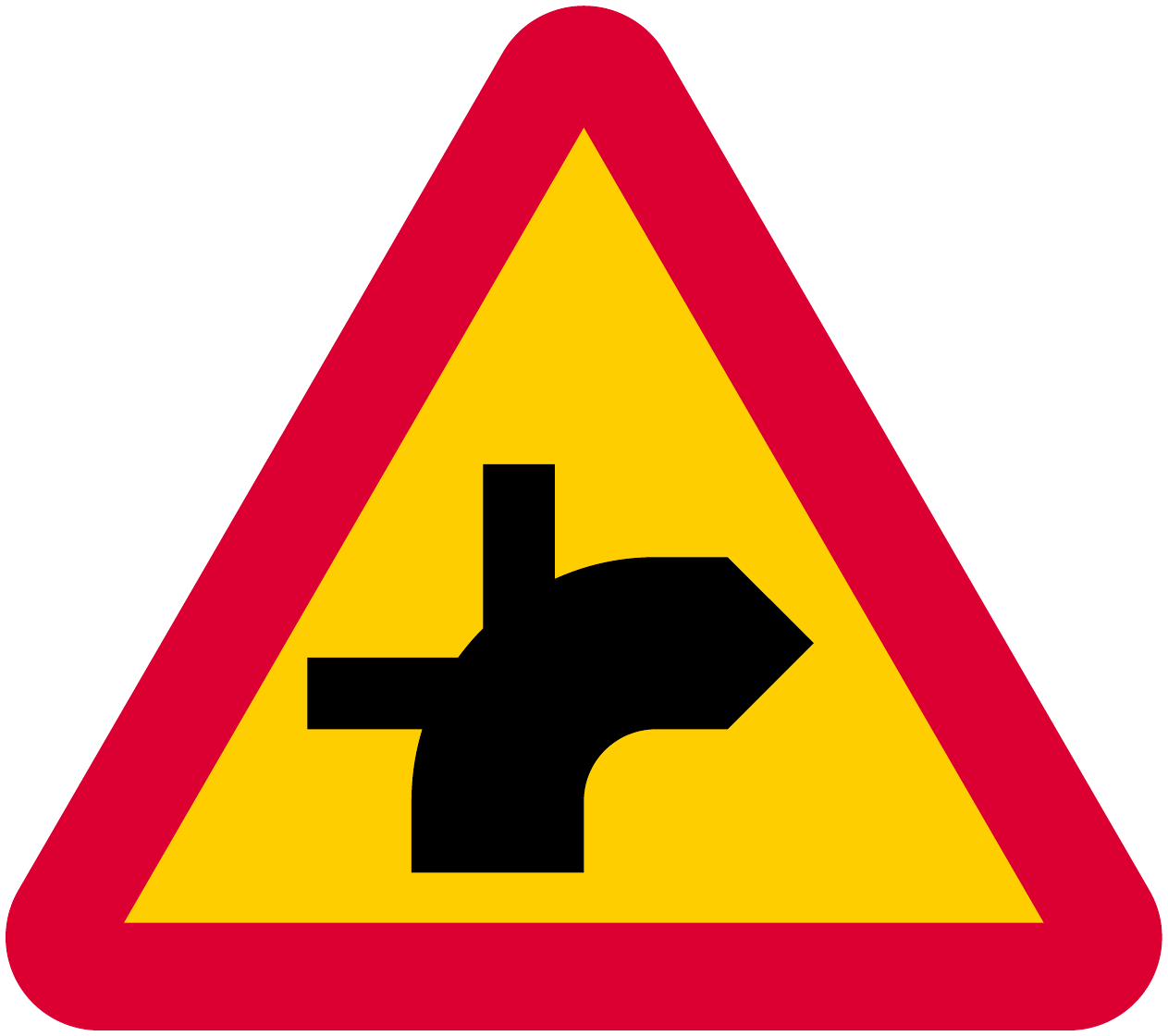
You are driving car A, heading straight ahead. Car B is turning right in the junction, where there are no signs. What rule applies?

Picture for the question

Explanation

Overtaking is not allowed just before or in a junction, except when
1. the overtaking is done on the right;
2. the traffic in the junction is regulated by a police officer or through traffic signals; or
3. It is clear from the road signs or other circumstances that drivers on the intersecting road have an obligation to give way or stop.
Swedish Road Traffic Ordinance

Non of the exceptions apply in this situation = not permitted.

Car A would have to drive out into the centre of the junction, which is not safe.

Question 17

Is it suitable to follow the traffic rules in all situations, with no exceptions?

Explanation

Drivers should generally respect the rules, but traffic is very complex and every situation is unique in some way. For this reason, the regulations cannot cover every possible aspect, and in these situations, experience and consideration come into play.

According to the curriculum for a category B licence, you must display “good judgement when interacting with other road users.” A reasonable interpretation of this statement is that you may depart from the rules in some cases.

The cogwheel principle is not included in any legislation for example. And yet, the Swedish Transport Administration, the National Society for Road Safety and FMK all recommend using it in certain situations.

There is no simple answer to when the rules may be disobeyed; you must assess each individual situation as it arises. However, here are three general points that should be fulfilled:

  • It should benefit the traffic situation as a whole (for example smoothly reducing a queue using the cogwheel principle).
  • Everyone involved should be aware of what is happening (caution, eye contact and clarity).
  • Never deviate from the rules by “helping yourself”, instead be the one who gives way to others.
Question 18

How fast are you allowed to drive with a towed vehicle?

Explanation

A motor vehicle, a piece of class I heavy equipment or a heavy off-road vehicle with a towed sled or towed vehicle [may be driven at a maximum] 30 [km/h].
Swedish Transport Agency

Note that a towed vehicle is not the same as a trailer. With a trailer, you are allowed to drive faster than 30 km/h.

Towed vehicle: “A vehicle connected to a car, a tractor, a piece of heavy equipment or a terrain vehicle, and which is not a trailer.” (Act on road traffic definitions)

Question 19

Which alternative is true?

Explanation

Fertilisation is good, but not eutrophication, which is when too many nutrients are added.

Question 20

What is true when it comes to the development of the air quality in built-up areas since the early 1990s?

Explanation

The levels of soot have been reduced by approximately 60 per cent since 1990. [...] Nitric oxide emissions have been reduced by approximately 60 per cent since the base year of 1990. [...] Hydrocarbon emissions have been reduced by approximately 80 per cent since 1990.
Swedish Transport Administration
The air quality has been significantly improved in built-up areas since the 1990s.
The Swedish Environmental Protection Agency
Question 21

How far may the load protrude from the side if you want to drive on a public road?

Explanation

If a motor vehicle or a vehicle coupled to this has a load where either side protrudes more than 20 centimetres outside the vehicle, [...] the vehicle or a vehicle coupled to this may only be driven on a private road.
Swedish Road Traffic Ordinance
Question 22

You are driving a car and approaching a pedestrian crossing. An elderly woman is standing on the pavement right in front of the crossing. However, she does not cross and instead waves for you to drive. How should you act?

Explanation

There is nothing stopping you from passing if the pedestrian is clearly indicating their intention of staying put and not crossing the street.
Written response from Swedish Transport Agency investigator

It would be unreasonable for a driver to “force” someone to cross the street. However, remember that it must be beyond doubt that the person does not intend to cross.

What does “clearly indicating their intention” mean?
– This is up to the police, or ultimately a court, to decide in each individual case.

Question 23

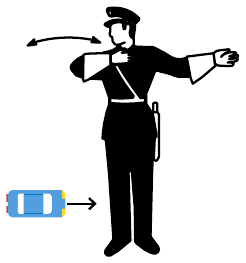
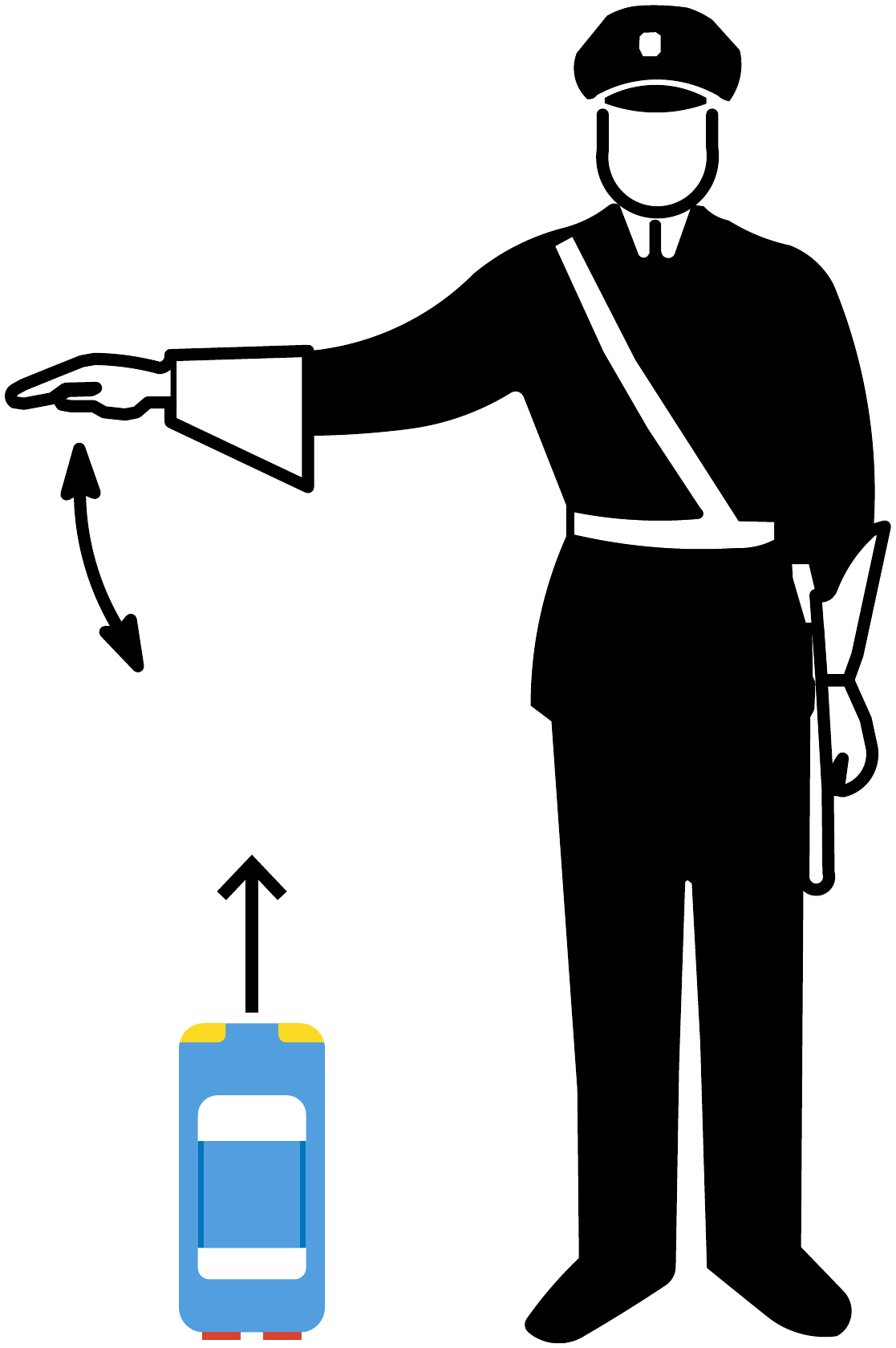
Are you obligated to adhere to the directions given by a traffic director?

Explanation

A road user shall adhere to the traffic directions of a police officer. […] This also applies to directions given by […] a traffic director
Swedish Road Traffic Ordinance
Question 24

When, as a rule, does a person perform best?

Explanation

When we are exposed to moderate stress, it improves our performance.
Driving Licence Book, 19th Edition, page 189

A relaxed person is sluggish and slow. A very stressed person is at risk of panicking. Everything is best in moderation; if you look at athletes, they usually look fairly tense and focused when it is time for them to perform. The brain knows that the situation is serious, which leads to stress (high expectations to perform) but also to a better focus.

Question 25

What does this road sign mean?

Picture for the question

Explanation

Clearway
ClearwayE3

If the sign is used as preparatory information indicating that a clearway is starting, the distance is given on an additional panel. The sign may also be included in a location sign.

Question 26

When driving in winter conditions, do you have to have studded tyres on the trailer when you have studded tyres on your car?

Explanation

If the car has studded tyres, a trailer connected to the car must also have studded tyres when driving in winter conditions.
Swedish Transport Agency
Question 27

The sign that the additional panel refers to has disappeared. What conclusion can you safely draw?

Picture for the question

Explanation

An additional panel has the same colour background, border and writing as the road sign it is used under, unless otherwise specified in Section 30. However, an additional panel underneath a sign prohibiting parking or a sign prohibiting parking and stopping will have a yellow background with black writing.
Traffic Sign Ordinance

Review of the options

  • The missing sign is a warning sign.Wrong, the warning signs are red and yellow.
  • The missing sign is not an instruction sign.Wrong, there are white and blue information signs, so it could be an information sign.
  • The missing sign is not a prohibitory sign.Correct, there are no blue and white prohibitory signs (also see the special colour rules for prohibition against stopping/parking in the quote above).
  • The missing sign is a priority sign.Wrong, the give way signs come in many different colours, so it is impossible to know for sure.

Is this relevant?
– Yes, reality is imperfect and you have to be able to draw conclusions even if you are given incomplete information. There are indications that similar questions may appear on the Swedish Transport Agency’s test.

Question 28

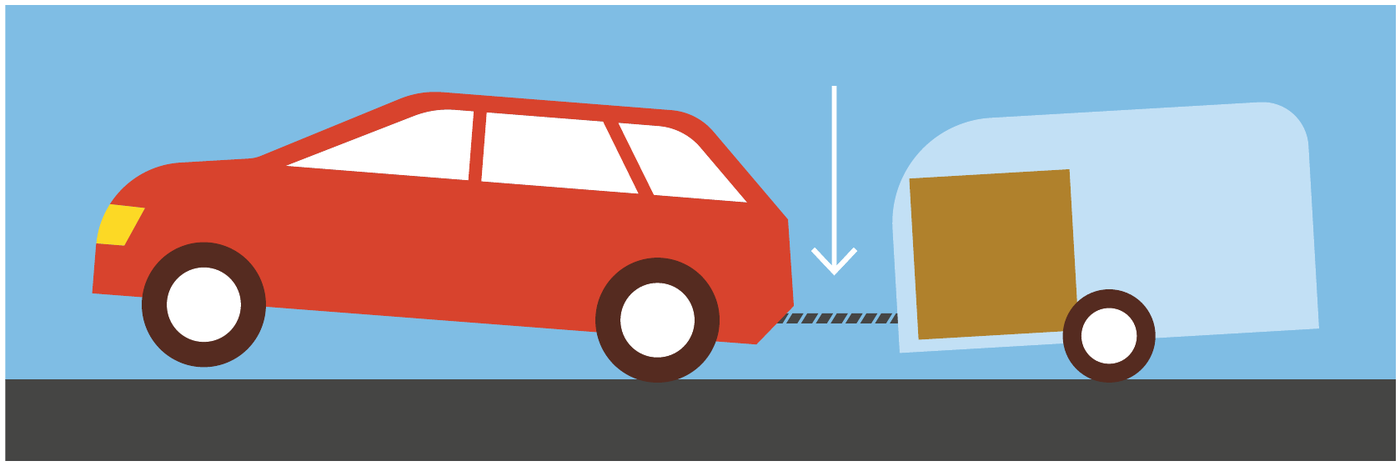
How is the load probably distributed in the trailer if the ball pressure is too high?

Explanation

Illustration

The load is all the way forward in the trailer (the red box) and is therefore pressing the coupling device towards the ground. The car is forced to follow it, and since the car is straight, the front end is elevated.

Question 29

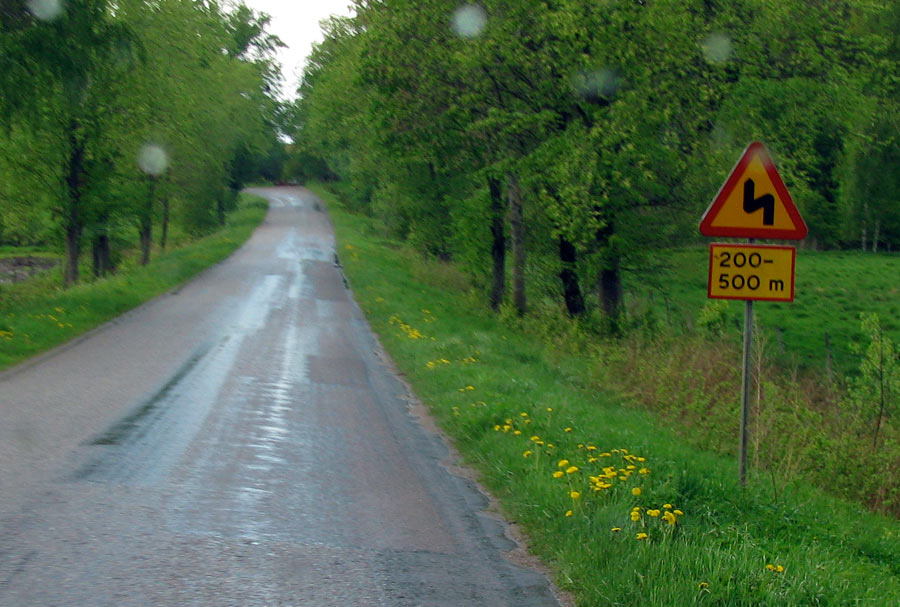
What do these road signs mean?

Picture for the question

Explanation

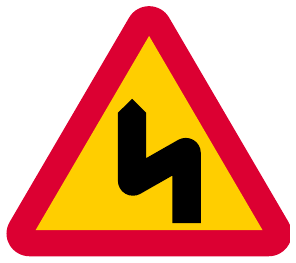
Multiple dangerous curves ahead
Multiple dangerous curves aheadA2

The sign indicates dangerous curves ahead and gives the direction of the first one.

The first three alternatives are incorrect, as they suggest that the signs indicate that the road may be slippery. This is wrong, the warning is for multiple dangerous curves.

200–500 metres must be considered to correspond to the “the road ahead”.

Question 30

Where should a reflector of this type be placed?

Picture for the question

Explanation

Reflector on a heavy lorry:

Illustration

Reflector on a trailer with a total weight exceeding 3.5 tonnes:

Illustration
Question 31

What does this road sign mean?

Picture for the question

Explanation

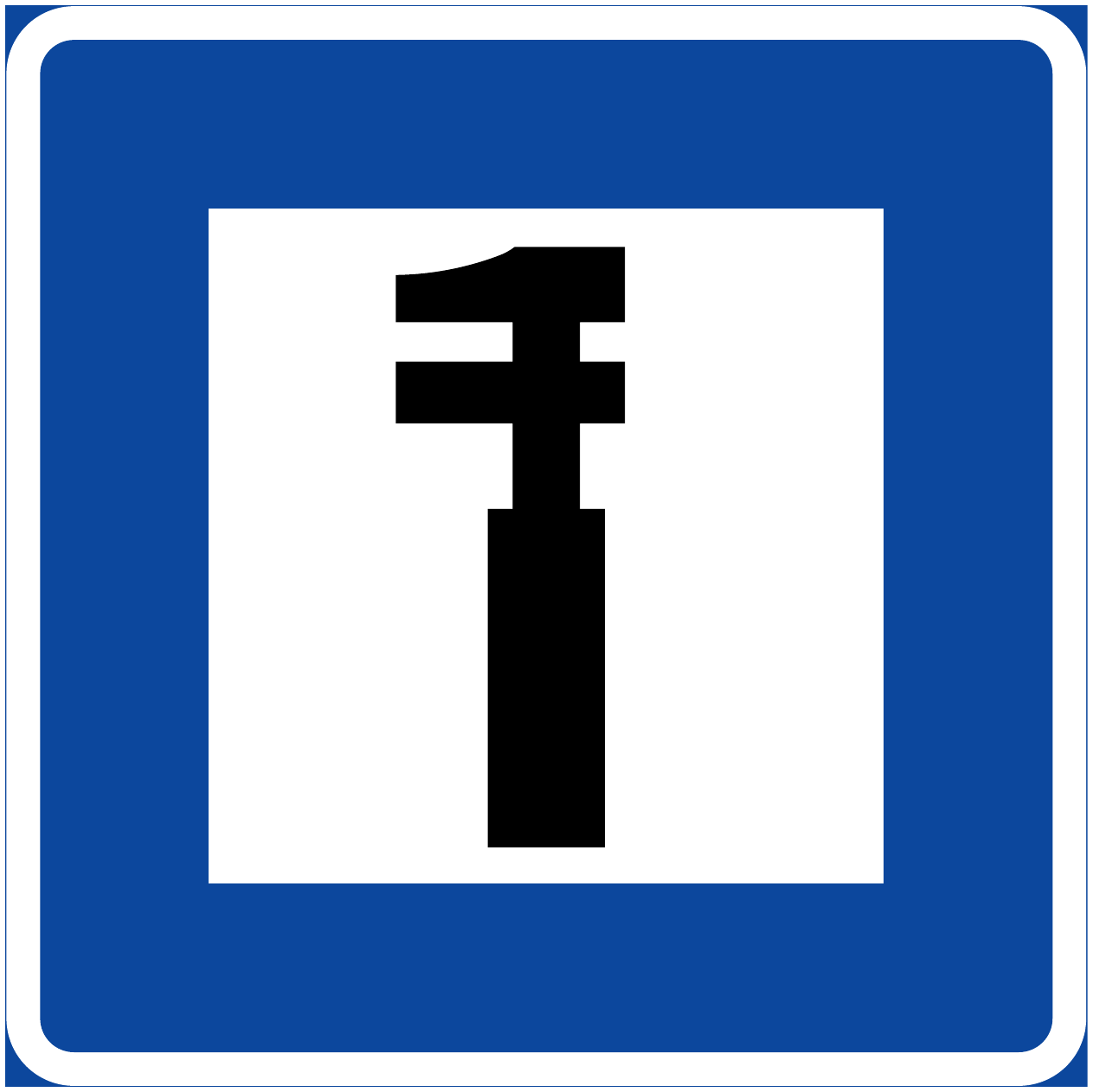
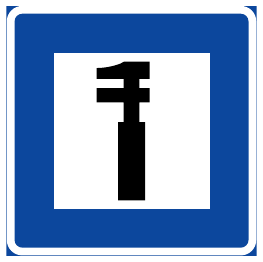
Vehicle workshop
Vehicle workshopH2
Question 32

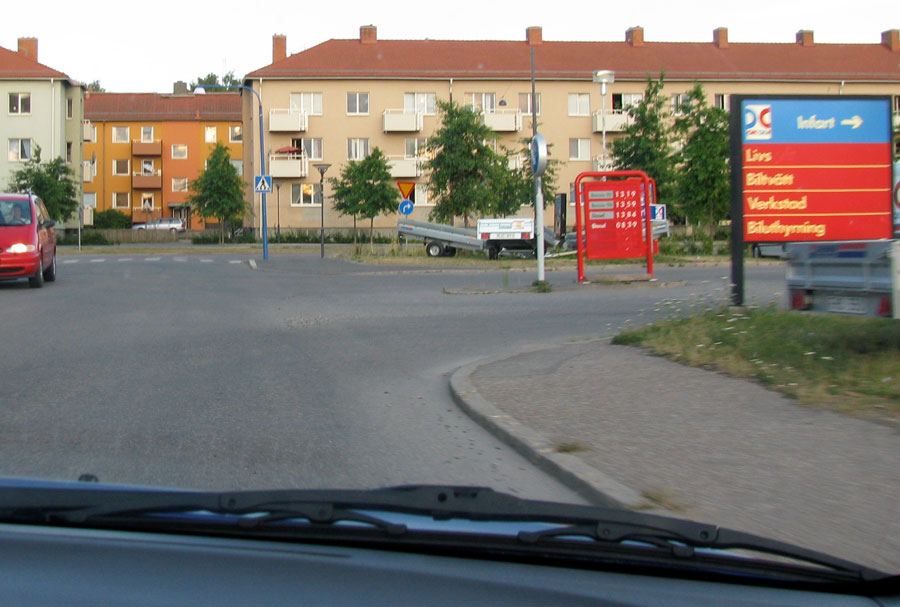
You want to turn right at a junction and see this sign. Which alternative applies to the use of blinkers?

Picture for the question

Explanation

When a driver intends to pull away from a curb or turn around, turn off, change lanes or move the car sideways in any way not considered insignificant, the driver shall use their indicator to show their intention.
Swedish Road Traffic Ordinance

The fact that the adjoining road has an obligation to give way does not mean you are allowed to skip using your blinkers.

Question 33

A person with a blood alcohol level of 1.1 per mille is driving a vehicle. Which of the following is true?

Explanation

Aggravated drunk driving: “The driver has a blood alcohol concentration of at least 1.0 per mille.” (Road Traffic Offences Act)

The risk of coma or death only becomes significant around 3.5–5.0 per mille.

Question 34

Which type of overtaking manoeuvre is generally preferred?

Explanation

  • Flying overtake means that you approach the car in front at high speed and change lanes in good time before driving past.
  • Accelerative overtake means that you drive closely behind a car at the same speed. When you go to overtake, you drive out and increase your speed quickly to pass the car.

The flying overtake is preferable since your high initial speed means that a shorter distance is needed to successfully overtake. Furthermore, it is more environmentally friendly than “flooring it”, as is required with an accelerative overtake. Accelerative overtakes also increase the risk of crashing into the car in front, as the distance maintained is usually far too short just before overtaking (Driving Licence Book, 19th Edition, page 85 & Du och jag i trafiken [You and me in traffic], 28th Edition, pages 248–250).

Question 35

What must you do if you modify the vehicle so that it no longer matches the registration certificate?

Explanation

If you modify the vehicle so that it is “no longer consistent with the registration certificate, you must subject the vehicle to a registration inspection within one month.” (Driving Licence Book, 19th Edition, page 239)

This is to ensure that the traffic safety is not negatively impacted by the modification to the vehicle.

Question 36

It is dark outside, and you have your full beams on. When should you be able to see a person wearing reflectors?

Explanation

Visibility with “reflectors [...] full beams 450 metres.” (Driving Licence Book, 21st Edition).

Question 37

What is true about the advice to put the best tyres in the rear?

Explanation

The tyres that have the greatest thread depth, or which have been deemed to provide the best traction should be fitted in the rear of the vehicle in order to reduce the risk of skidding when braking and turning. The tyres with the largest studs should be placed on the rear wheels. This applies to cars with rear-wheel drive and front-wheel drive alike.
Swedish Transport Agency
Question 38

Which option is true?

Explanation

Review of the options

  • Air pollution from traffic can cause allergies.Correct, “Health effects of vehicle emissions […] increased risk of allergies”. (Swedish Transport Administration)
  • Carbon dioxide is responsible for 40% of all new cases of cancer.Wrong, the carbon dioxide gas itself does not cause cancer.
  • Air pollution from traffic does not cause cancer.Wrong, hydrocarbons may cause cancer.
  • There are no benefits to the use of cars.Wrong, consider everyone who is dependent on taking their car to work (those living outside the cities). A week without cars would be a complete disaster for the world economy.
Question 39

What is the function of the two transverse lines on the ground?

Picture for the question

Explanation

When you drive over the lines, they will make a noise. Should you be inattentive and tired, the idea is that the sound will rouse you.

Question 40

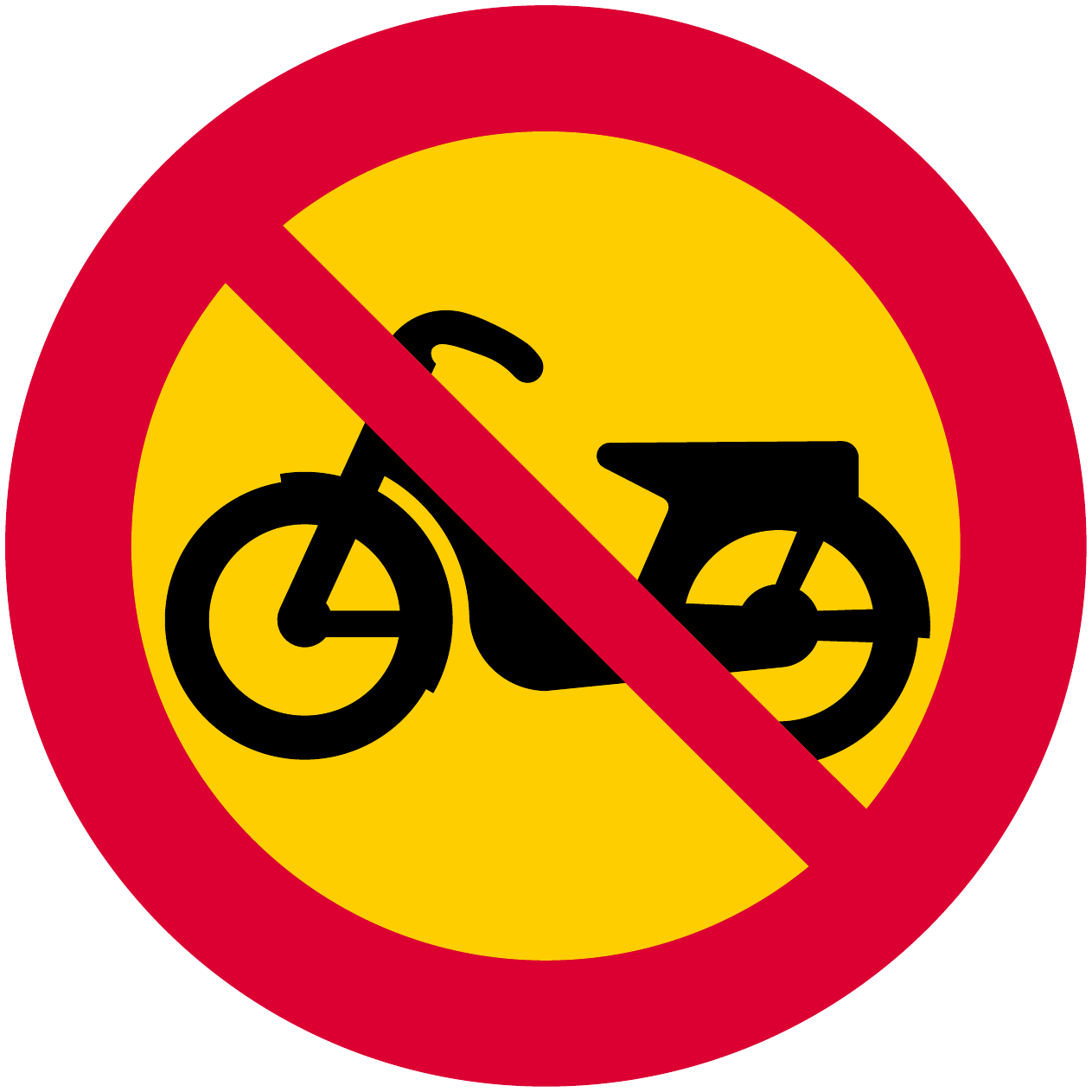
Does the following prohibitory sign also apply to class I mopeds?

Picture for the question

Explanation

No class II mopeds
No class II mopedsC11

If the prohibition also applies to class I mopeds, this is indicated on an additional panel.

Although they are equal in size, class II mopeds are classed more as a bicycle and class I mopeds are classed more as a motorcycle. Therefore the prohibition does not automatically apply to both the classes.

Question 41

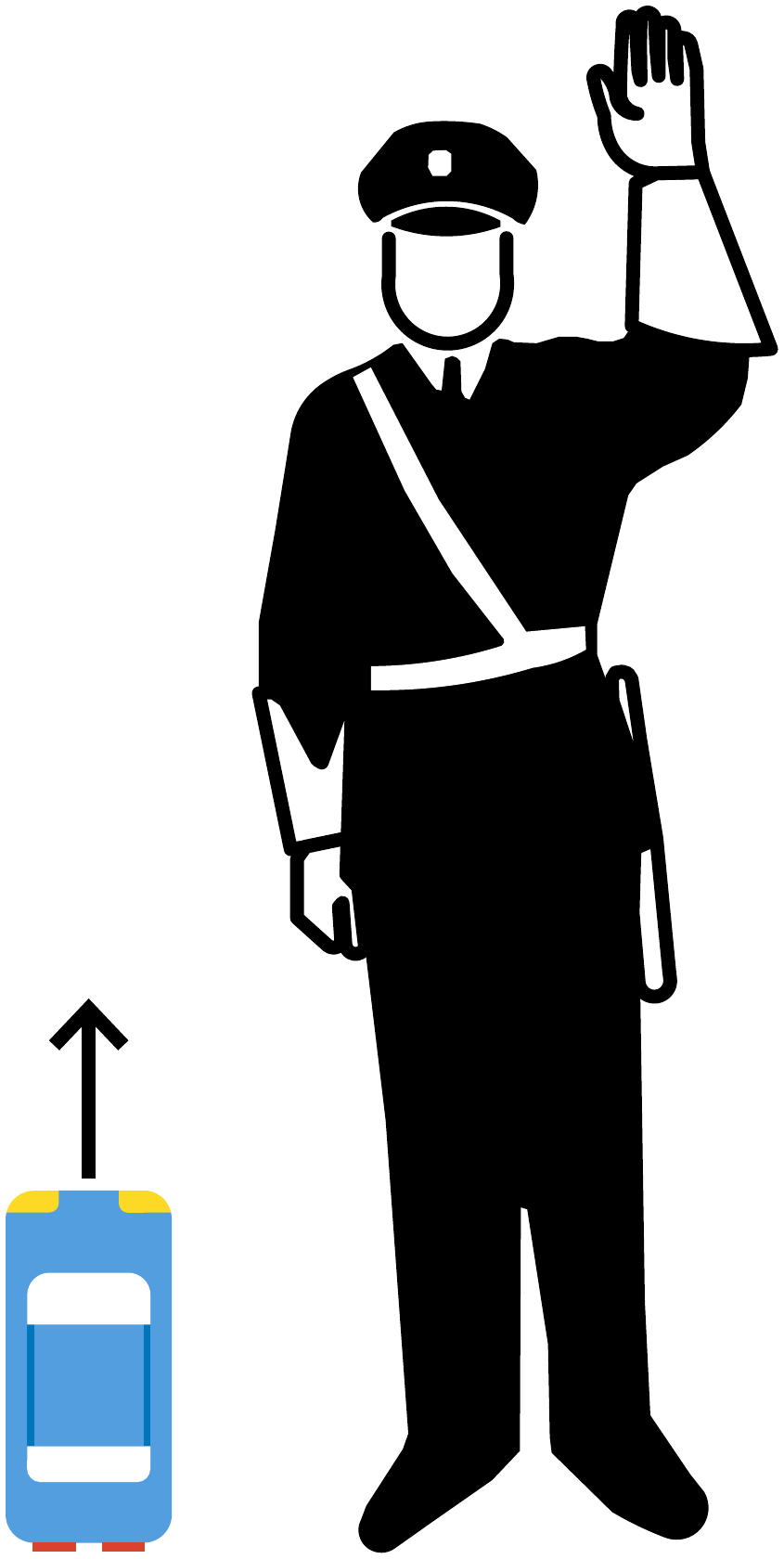
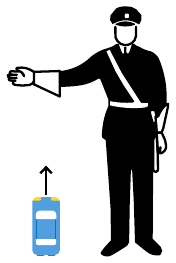
The police officer is holding their hand still. What does this signal mean?

Picture for the question

Explanation

Stop
StopP2

The signal means stop for the road user the palm is facing. The signal may be given using a stop paddle.

Question 42

Is it true that a vehicle registration plate, or number plate, always has three letters and three digits?

Explanation

Since 2019, the last character on a number plate can be a letter. Exampel: ABC 12A.

Also, there are personalised number plates:

The number plate shall have no less than two and no more than seven characters with a blank space counting as one character. The combination of characters may consist of digits or letters – or of both digits and letters. You may use all the letters of the alphabet.
Swedish Transport Agency

Also note that if the number plate is personalised, the car still has its original vehicle registration number (e.g. ABC 123).

Question 43

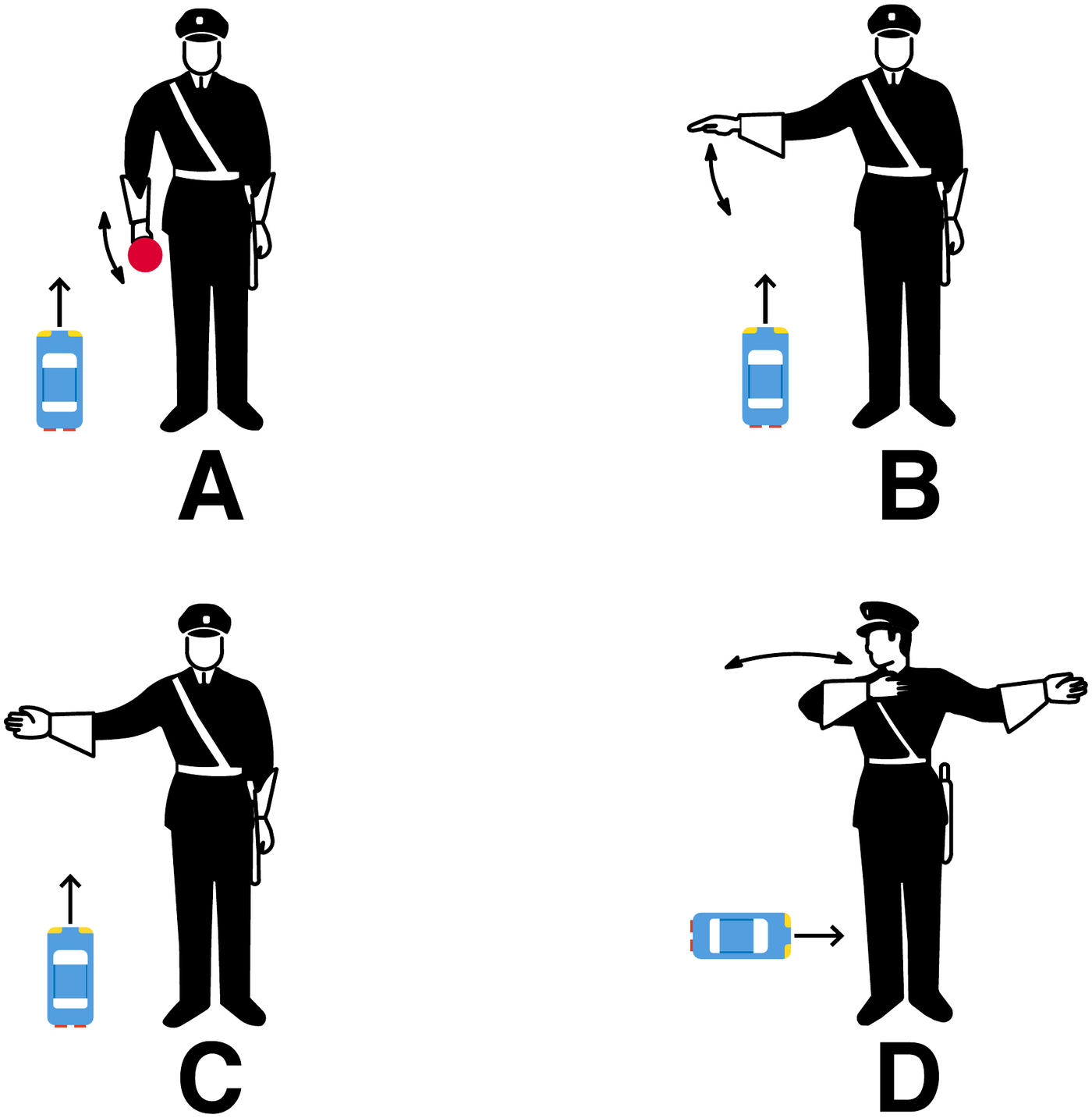
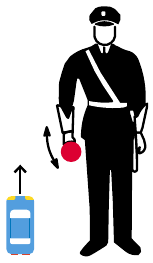
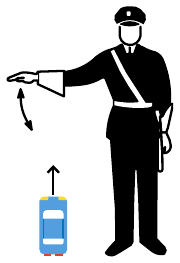
Which signal tells you to reduce your speed?

Picture for the question

Explanation

Stop
AStopP3

The signal indicates a stop for the road user the light is facing. The sign is used when it is dark and in case of limited visibility. The light is positioned where it can most easily be detected by road users.

Reduce speed
BReduce speedP5

The signal indicates that the road user whom the officer is facing must reduce their speed. When it is dark and visibility is poor, the signal may be highlighted with a white or amber light or a reflective device that reflects white or amber light.

Stop
CStopP1

The signal means stop for the road user coming head on or from behind. The signal is used in a junction and applies as long as the officer is facing in the same direction. For road users approaching from the side, the signal means that the road is free and that it is permitted to drive. The signal may be given in combination with the signal P2, stop. The signal may be given using a stop paddle.

Drive forward
DDrive forwardP4

The signal indicates that road users in the direction the signal is given may continue onwards. The signal is given with a waving motion in the direction of travel.

Question 44

Which statement is true regarding brake fluid?

Explanation

[…] change the brake fluid around every two years. This needs to be done because the brake fluid attracts water, which lowers its boiling point.
Driving Licence Book, 19th Edition, page 129
Question 45

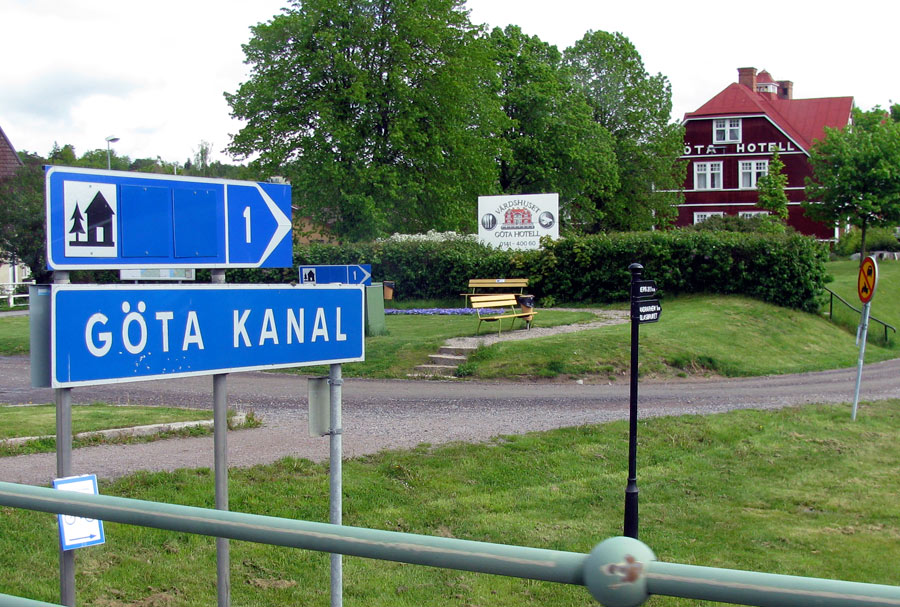
What does the top left road sign mean?

Picture for the question

Explanation

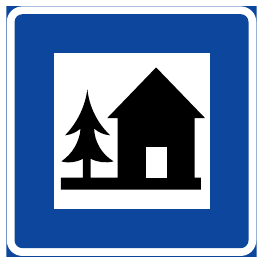
Hostel
HostelH8

1,000 m = 1 km

Question 46

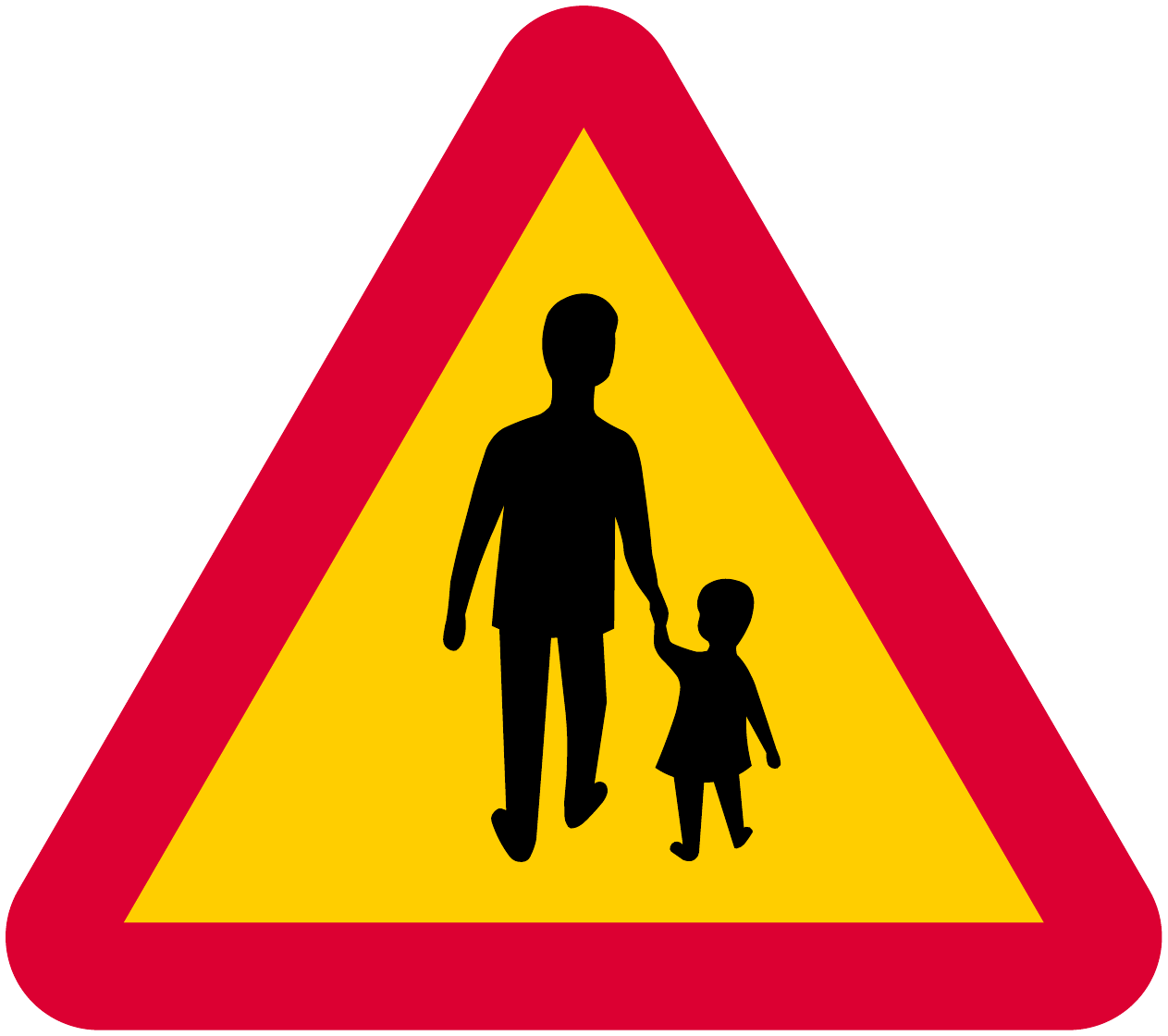
What does this road sign mean?

Picture for the question

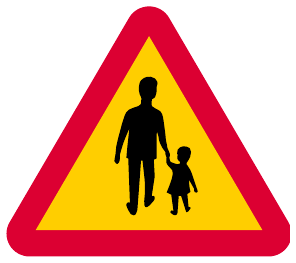
Explanation

Pedestrian warning
Pedestrian warning
Question 47

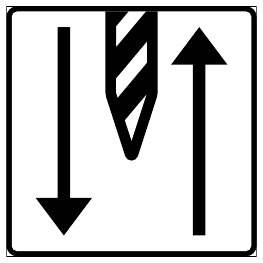
What do the white road signs on the right indicate?

Picture for the question

Explanation

Lane separation on this section
Lane separation on this sectionF18

The sign indicates the direction of traffic flow in lanes. The sign is specific to the conditions at the location. Symbols for vehicle type, road number or physical boundary between opposite lanes may be incorporated in the sign. The sign is also used as a preparatory notice that a lane is starting. The distance is then stated on an additional panel. In case of a temporary re-routing of traffic, the sign may have an orange base. Otherwise, no deviating colour may be used.

Distance
DistanceT2

The panel indicates the distance to what the sign relates to.

Question 48

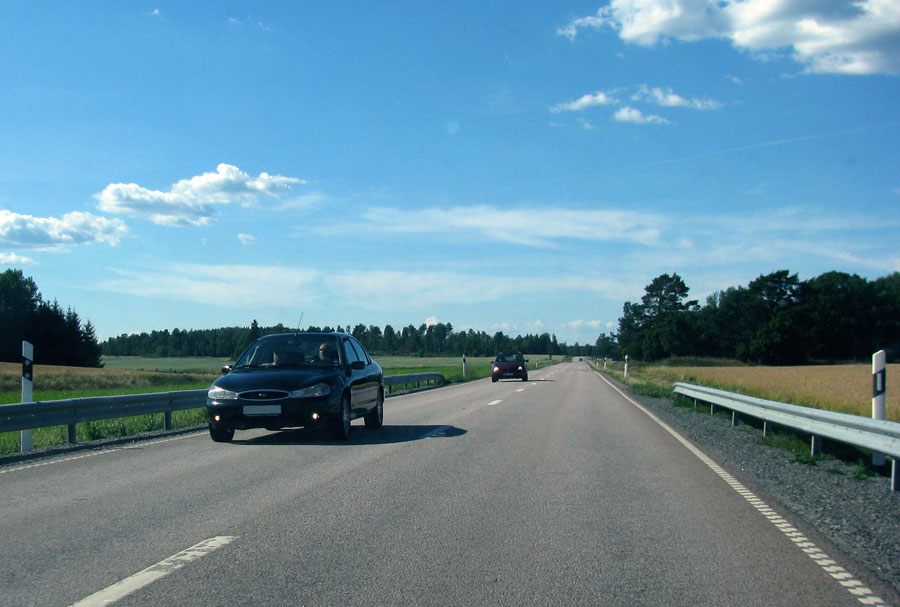
The cars in the picture are driving at 90 km/h. What do you think about the distance between them?

Picture for the question

Explanation

Two post sections, as in, the cars are each at a post and there is one post between them, is often a good distance on a highway. Therefore:

POST + 50 metres + POST + 50 metres + POST On the left of the picture, it may be difficult to see if there is another post between the cars. On the right however, it is easy to see that this is not the case. The car furthest back should therefore reduce its speed so that the distance is doubled.

Question 49

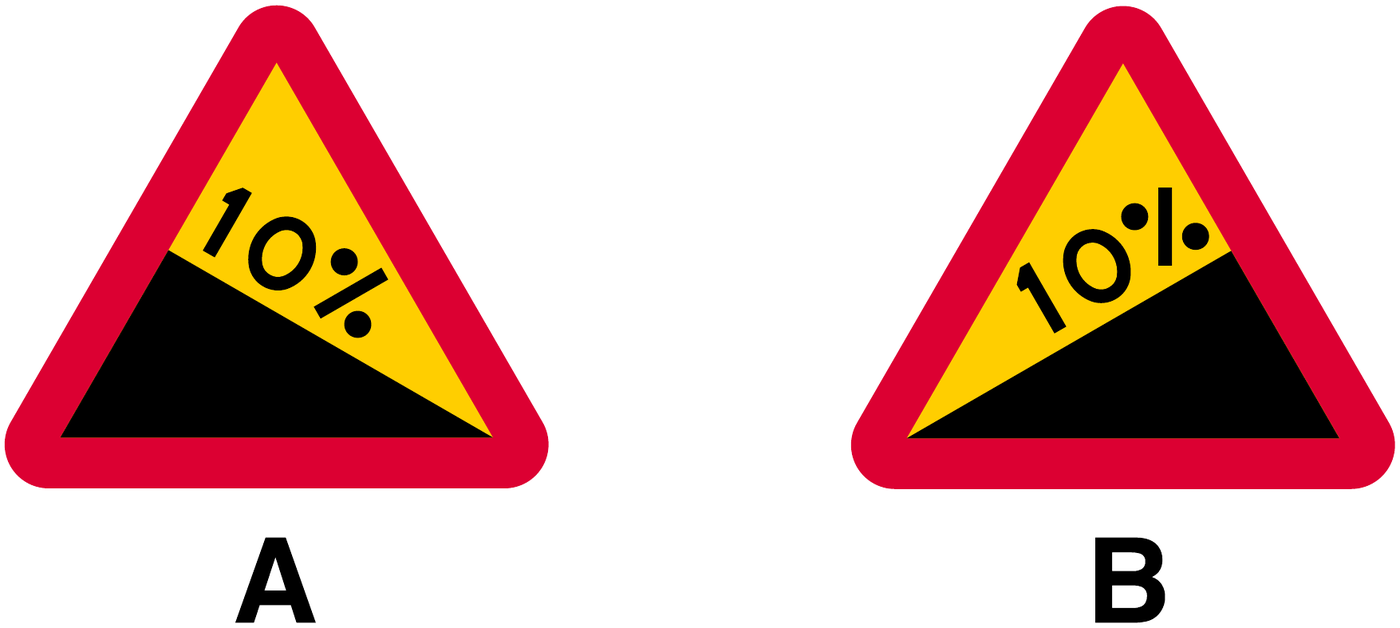
Which of these signs warns you of a steep incline?

Picture for the question

Explanation

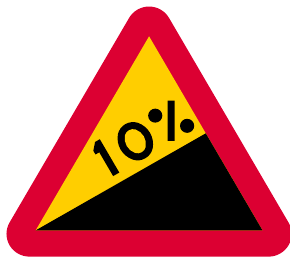
Mnemonic rule: “read” the sign from left to right, i.e. starting from the left side, then you will see that the slope is going upwards.

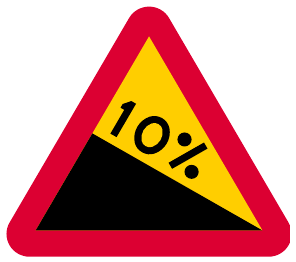
Steep hill downwards
ASteep hill downwardsA3

The sign indicates a steep hill downwards. The numbers indicate the gradient in per cent and is specific to the conditions of the location.

Steep incline
BSteep inclineA4

The sign indicates a steep incline. The numbers indicate the gradient in per cent and is specific to the conditions of the location.

Question 50

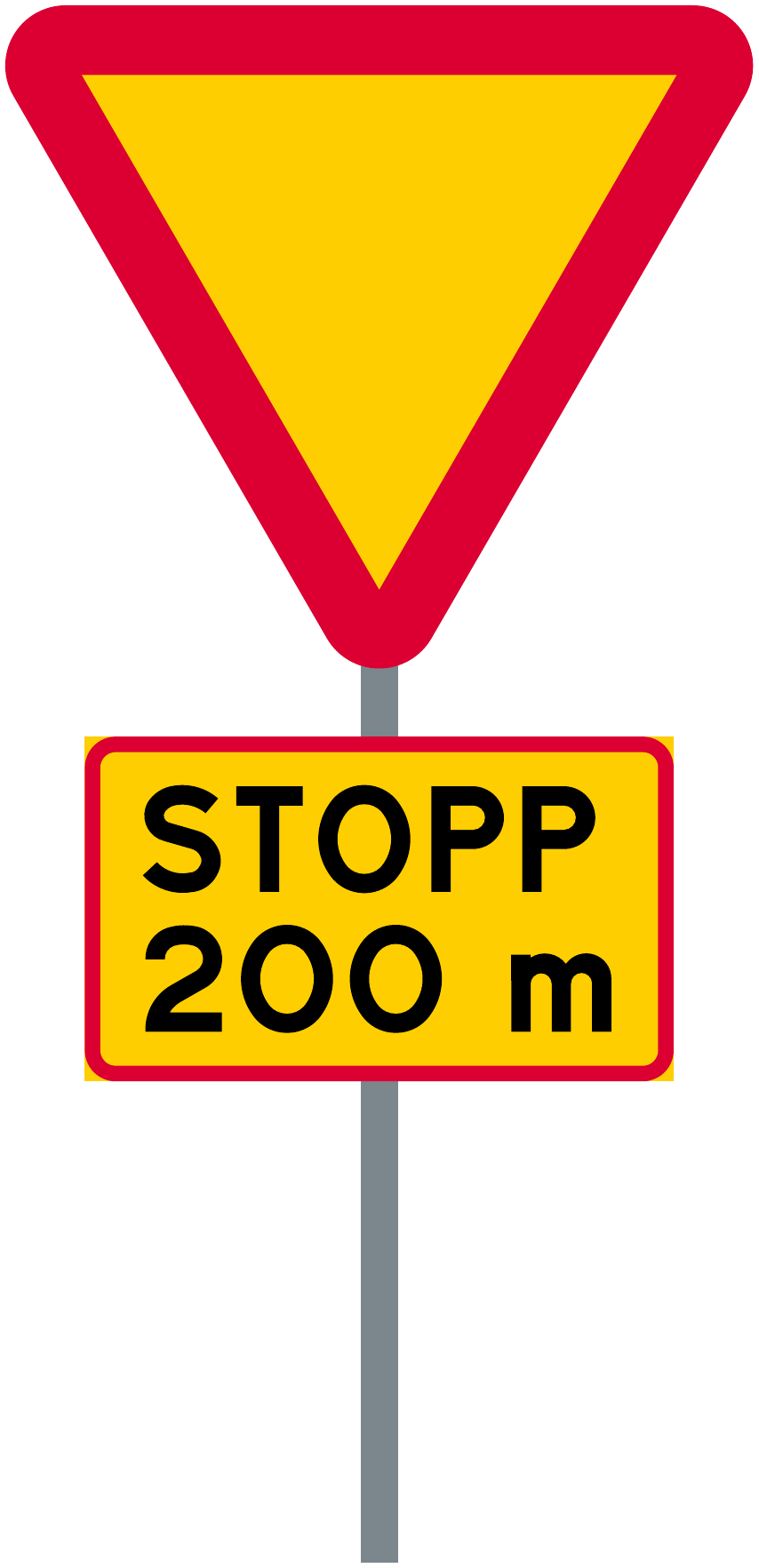
What is true about this combination of signs?

Picture for the question

Explanation

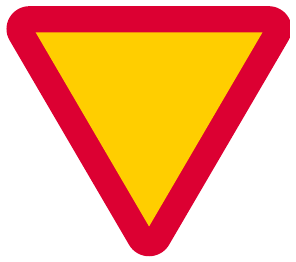
Give way
Give wayB1

The sign indicates that a driver is obliged to give way to a vehicle on the intersecting road or route and that the regulations of Chapter 3, Section 5 of the Swedish Road Traffic Ordinance (1998:1276) apply. The sign can be erected together with the additional panel T2 – distance to – as preparatory information regarding the obligation to give way, or together with the additional panel T3 – stop and give way at specified distance – as preparatory information regarding the obligation to stop. If all approach roads in a junction are obliged to give way, this is indicated with the additional panel T13, all-way-stop-controlled junction.

The give way sign thus has several meanings:

  • Give way sign = “obligation to give way to vehicles on the intersecting road”.
  • Give way sign + Additional panel T3 = “preparatory information regarding the obligation to stop”
  • (same as in the question).

Is it not true that I have an obligation to give way at the sign and am also obliged to stop 200 metres further on?
– No, you are not to do anything at the actual sign; it only tells you that you have an obligation to stop further on.

An example of how these signs work in a real situation:

The signs are posted at an ordinary stretch of road with no intersecting traffic, meaning that the obligation to give way is not applicable. The obligation to stop refers to the junction further down the road on the right.

Question 51

Which sign indicates a ring road or equivalent?

Picture for the question

Explanation

Local loop
ALocal loopF30

The sign indicates a ring road or equivalent. The sign may be supplemented with a designation or similar. No other colour may be used.
World heritage
BWorld heritageI4

The sign indicates world heritage as decided by UNESCO. The sign may be incorporated in a location sign for direction.

Interchange number
CInterchange numberF27

The sign indicates the number of the interchange. The sign may be supplemented with the exit road's designation. No other colour may be used.
Emergency site
DEmergency siteF33

The sign indicates an emergency site during roadworks or similar. No other colour may be used.
Question 52

How is this road sign used?

Picture for the question

Explanation

Level crossing plate
Level crossing plateY4

This device is used to make a level crossing more visible.

Level crossing [...] A crossing on the same level between a road and a railway or tramway line running on a separate embankment
Road Traffic Definitions Act
Question 53

How much higher are the emissions of harmful particles from a diesel engine without a particle filter compared to a diesel engine with one?

Explanation

A particle filter works similarly to the filter of a vacuum cleaner. The dirt gets caught in the filter and out comes air that is almost completely clean.

When choosing a diesel vehicle, one with a particle filter is recommended, as it reduces the amount of harmful particles with more than 95 per cent.
Bilprovningen

“These filters have a long lifespan and can remove up to 90 per cent of the particles, including the smallest ones.” (BIL Sweden) Different cars reduce the particle emissions to different extents. Modern cars sometimes reach 99.9%. We can use the figure 95%:

  1. 100% - 95% = 5% that is still emitted with a particle filter.
  2. The emissions with a particle filter is 5% and without one they are 100%. How many times more
  • particles are emitted by an engine without a particle filter? 100% / 5% = 20 times as many particles.
  • Convert 20 times into a percentage: 20 * 100 = 2,000%

2,000% is more than 1,000%, which makes this percentage the correct alternative. If you do the calculation based on a 90% decrease instead of 95%, the answer will be exactly 1,000 %.

It is perhaps easier to say that the emissions are reduced by 90–99.9%. However, there are indications to suggest that the Swedish Transport Agency will not always use the easiest and most common route in the tests, so turning the question around in this way gives you good practice for the actual test.

Question 54

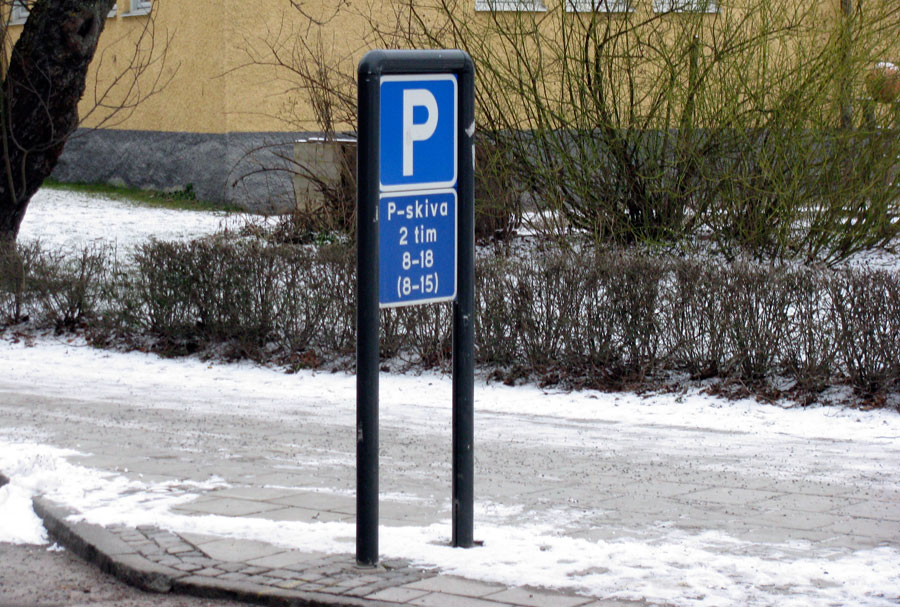
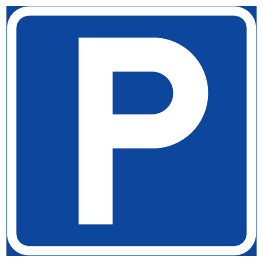
What rule applies to this parking area?

Picture for the question

Explanation

”P-skiva” = parking disc.

Review of the options

  • I am allowed park on a Sunday between 6–17 without using a parking disc.Correct, Sunday is not included on the additional panel, which means that you should just refer to the parking sign, which states that Sundays do not have any time restrictions.
  • I may never park longer than 2 hours at this location.Wrong, you can park for longer periods during times that are not restricted by the additional panel.
  • I am not allowed on a Saturday between 18–21 without using a parking disc.Wrong, you may park since the additional panel only applies until 15:00 on Saturdays.
  • With a parking disc, I am always allowed to park at this location for at most 2 hours. If I do not have a parking disc, I have to pay a fee during the hours indicated on the additional panel.Wrong, you never need to pay a fee. You are not even able to pay a fee!
Parking
ParkingE19

The sign indicates that parking is allowed in a parking area [...] parking is permitted, during weekdays except for weekdays before Sundays and public holidays, for a maximum of 24 hours at a time, unless other information is provided on an additional panel.

Question 55

Which are the two substances primarily produced by a functioning catalytic converter?

Explanation

The catalytic converter “produces carbon dioxide and water.” (Driving Licence Book, 19th Edition, page 224).

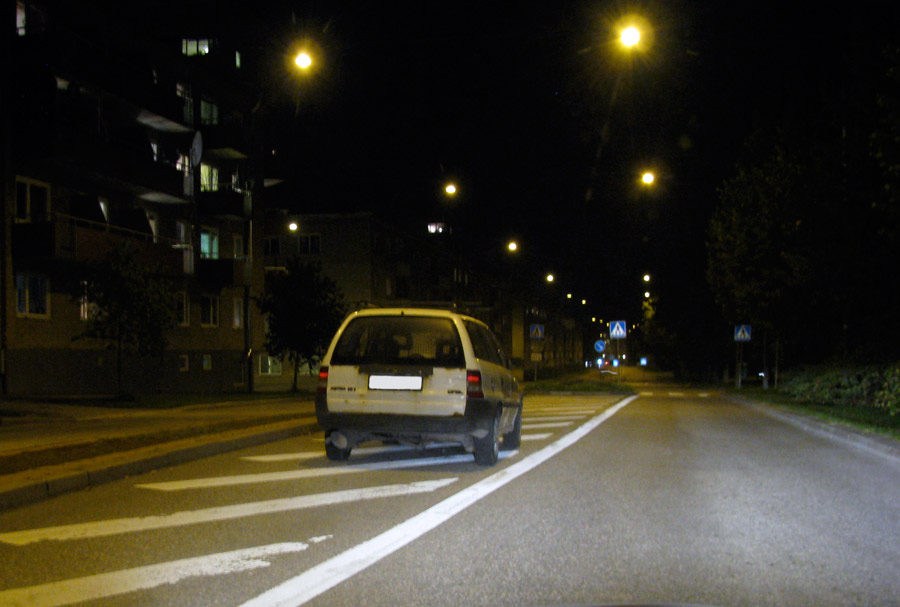
Question 56

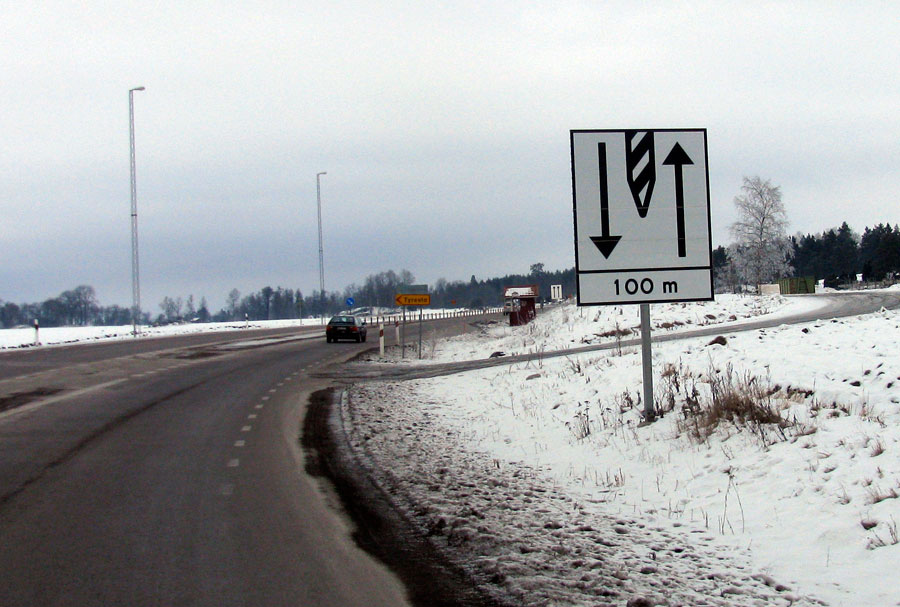
The car on the photo is parked. Which of the following applies?
Picture for the question

Explanation

Obstruction marking
Obstruction markingM9

The marking indicates an area where vehicles may not drive according to Chapter 3, Section 11 of the Road Traffic Ordinance. The marking consists of angled or oblique lines depending on the conditions at the location. Part or all of the area can be painted white.

A vehicle may not stop or park [...] on an obstruction marking.
Swedish Road Traffic Ordinance
Question 57

Which statement is true regarding the fuel consumption per kilometre for a petrol-driven car with a catalytic converter after a cold start?

Explanation

The short distances cause the most pollution per km. […] Petrol consumption and carbon dioxide emissions are 35% higher in the first 5 km, as a cold engine requires a “richer” fuel mix. During the first 5 km, the average car will consume as much as 0.14 litres/km.
Swedish Society for Nature Conservation

Note that the question is asking about the consumption per kilometre, i.e. an average. Over a longer distance, you will normally use more fuel overall, but not in terms of average consumption per kilometre.

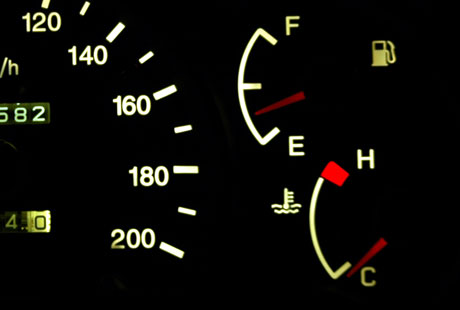
Question 58

How far should you be able to go on the remaining fuel?

Picture for the question

Explanation

This is a matter of making a reasonable assessment, as in many other traffic situation.

The correct answer is “More than 10,000 metres”. For simplicity, let’s say that the car uses 1 litre each 10 km (which is a lot). The tank is filled to approximately 25% (1/4).

If any of the lower ranges were correct, it would mean that the car’s fuel tank (not including the reserve tank) can fit approximately 4 litres, which is completely unreasonable (a regular medium-sized car has a tank of approx. 40 litres; even mopeds usually have a tank larger than 4 litres).

Another way of looking at it: Imagine that the tank contains 60 litres. There is 25% left. 60 * 0.25 or 60/4 = 15 litres. If any other alternative than “More than 10,000 metres” was correct, it would mean that the car consumes more than 1.5 litres/km, which is completely unreasonable.

Question 59

What applies to a home zone?

Explanation

On a pedestrian street and in a home zone, the following applies.
1. Vehicles may not be driven faster than walking speed.
2. Vehicles may not be parked in any place other than specially designated parking spots.
3. Vehicle drivers must give way to pedestrians.
Swedish Road Traffic Ordinance
Question 60

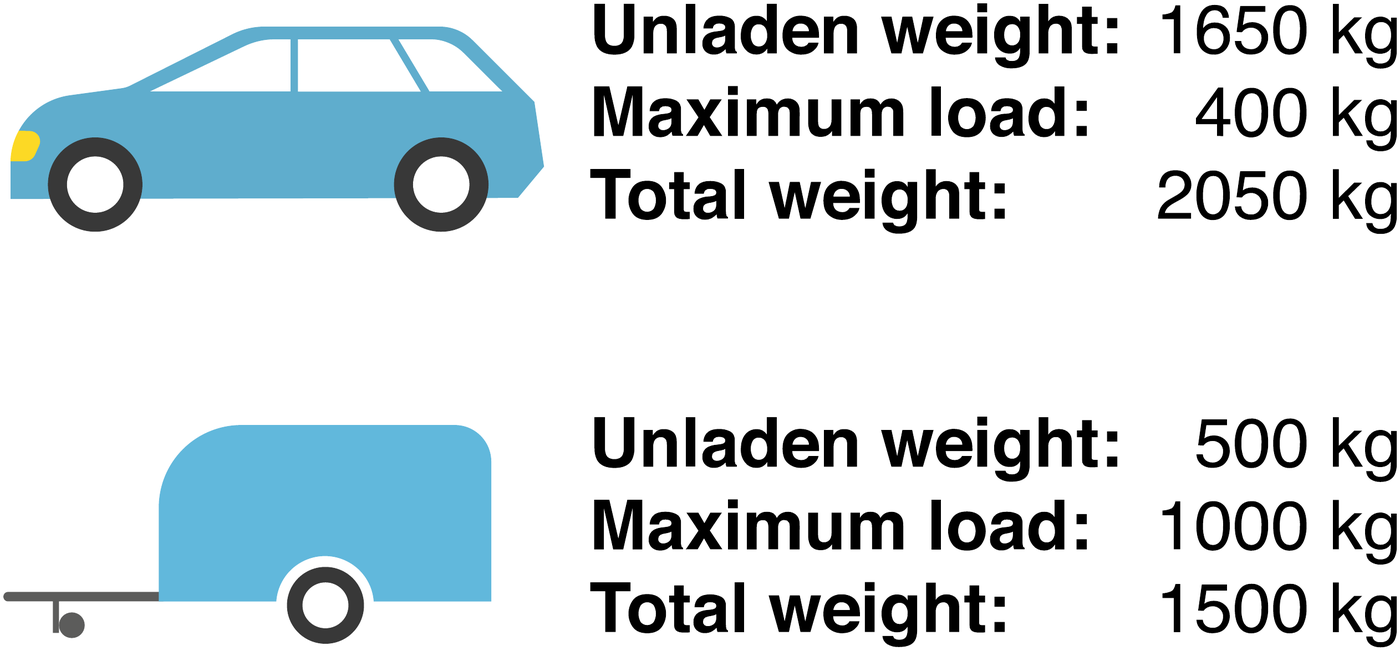
Are you permitted to tow the trailer with this car if you only have a category B licence (non-extended)?

Picture for the question

Explanation

With a regular category B licence, you are only allowed to tow a light trailer. The following counts as a light trailer:

  • Trailer with a maximum total weight of 750 kg.
  • or
  • Trailer where the maximum total weight for car + trailer is 3.5 tonnes.

Does the combined total weight exceed 3.5 tonnes? 2050 kg + 1500 kg = 3550 kg = Over 3.5 tonnes

Question 61

Is it true that the towing car must have studded tyres if the trailer does?

Explanation

If the car has studded tyres, a trailer connected to the car must also have studded tyres when driving in winter conditions. This is true even if the vehicle is exempt from the winter tyre requirement. If the car has non-studded tyres, the trailer may have either studded or non-studded winter tyres.
Swedish Transport Agency

Car Trailer Permitted?

Studded Studded Permitted

Studded Non-studded Not permitted

Non-studded Studded Permitted (same as in the question)

Non-studded Non-studded Permitted

Question 62

What does this signal mean?

Picture for the question

Explanation

Reduce speed
Reduce speedP5

The signal indicates that the road user whom the officer is facing must reduce their speed. When it is dark and visibility is poor, the signal may be highlighted with a white or amber light or a reflective device that reflects white or amber light.

Question 63

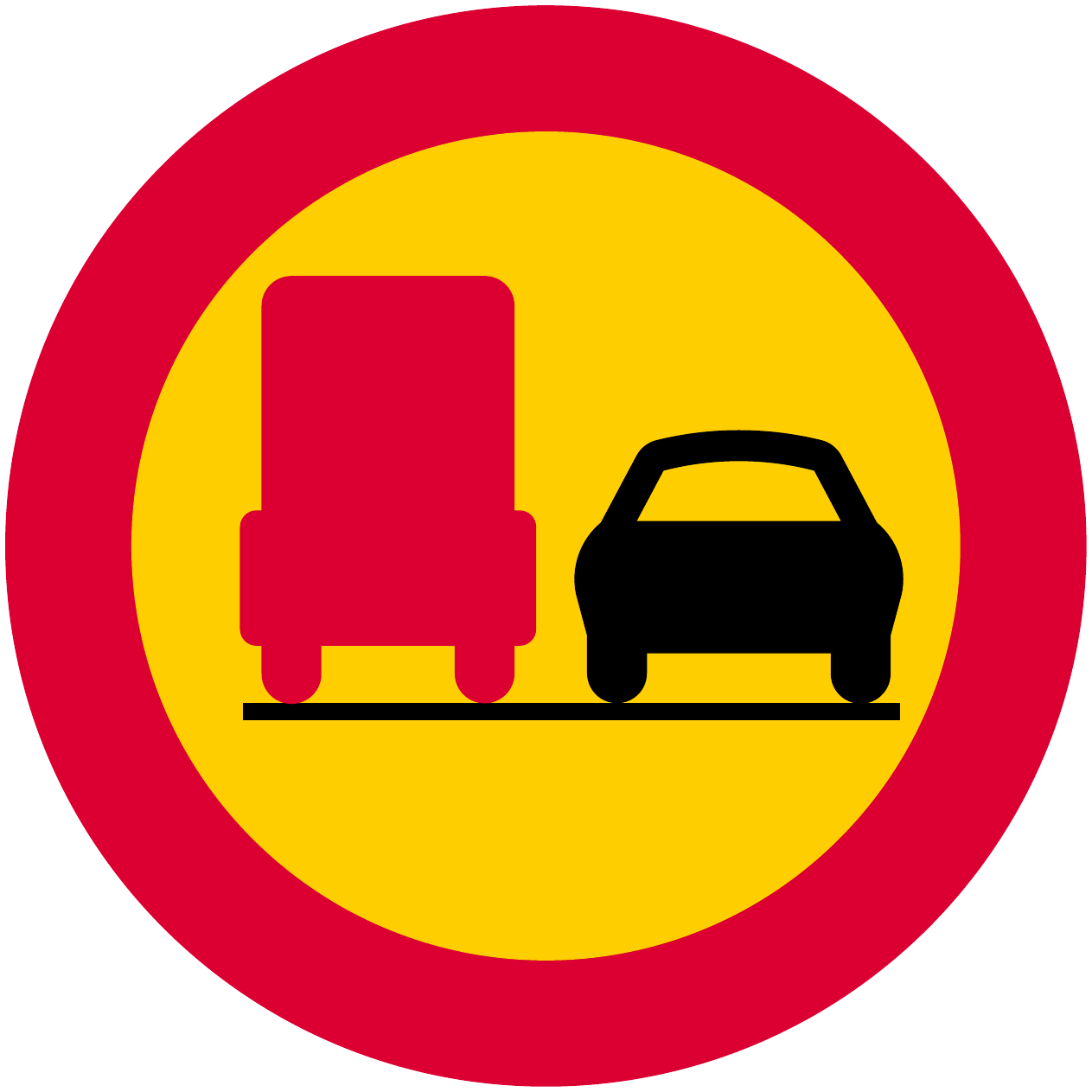
Which statement is true where this road sign applies?

Picture for the question

Explanation

No overtaking with a heavy truck
No overtaking with a heavy truckC29

The sign indicates a prohibition on heavy trucks overtaking motor vehicles other than two-wheeled mopeds and two-wheeled motorcycles without a sidecar. The prohibition applies on the road where the sign is erected and up to the place where sign C30, End of overtaking restriction for heavy trucks, is erected.

Question 64

What does it mean if this lamp lights up on the dashboard?

Picture for the question

Explanation

Brake warning
Driving Licence Book, 19th Edition, page 146

Does it not also mean that the parking brake is on?
– Yes, in some cars, the meanings are combined. But you are only given 3 alternatives, and none of them mention the parking brake.

Question 65

What is the rule when towing a damaged car behind your car?

Explanation

When salvaging or towing a damaged vehicle on the road, the damaged vehicle must be marked if its lights cannot be used in the prescribed manner
Swedish Road Traffic Ordinance
Question 66

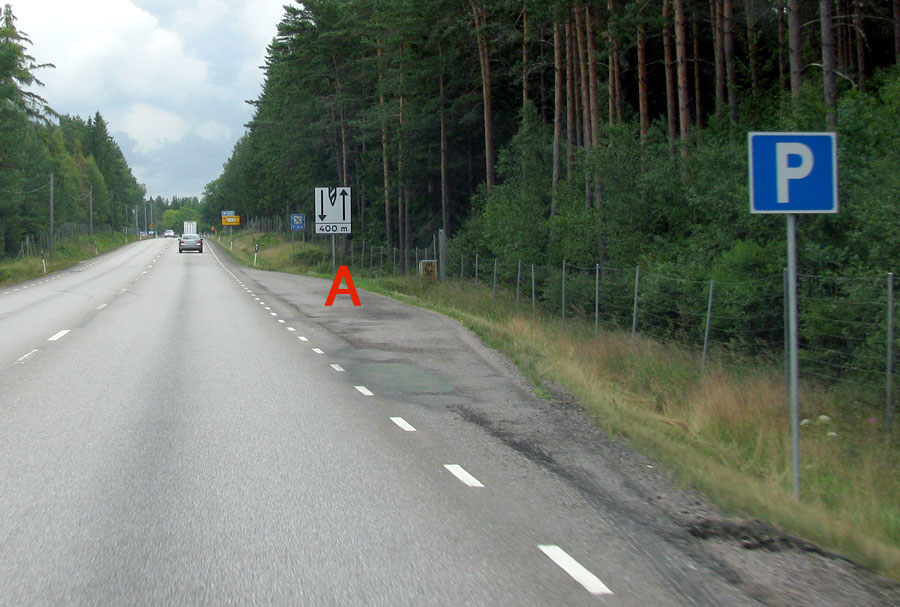
The maximum permitted speed is 70 km/h and your car gets a puncture on the right front tyre. Do you have to put out a warning triangle if you stop at A to change to a temporary spare wheel?

Picture for the question

Explanation

The driver of a vehicle that is to be equipped with a warning triangle shall put out the triangle when the vehicle, as a result of an accident, engine failure or similar situation, has become stationary on the carriageway or hard shoulder where the maximum permitted speed is higher than 50 kilometres an hour and where the vehicle is not allowed to stop or park
Swedish Road Traffic Ordinance

Since the car is allowed to stop and park at A, the requirement for a warning triangle does not apply.

Question 67

You are driving a car with good brakes and new tyres on a dry asphalt road. How many metres is the stopping distance if your speed is 50 km/h and you react in 1.5 seconds?

Explanation

First, consider the calculations of stopping distance, reaction distance and breaking distance.

Reaction distance:

  • remove the zero in the speed * reaction time * 3
  • 5 * 1.5 * 3 = 22.5 (rounded to 23 metres)

Braking distance:

  • remove the zero in the speed * remove the zero in the speed * 0.4
  • 5 * 5 * 0.4 = 10 metres

Stopping distance:

  • reaction distance + braking distance
  • 23 + 10 = 33 (rounded to 30 metres)
Question 68

What is freezing rain?

Explanation

Nationalencyklopedin: “freezing rain, rain drops with a temperature lower than 0 °C. This means that when they hit the ground or an object, they can change from liquid to solid and form an ice layer.”

Question 69

Which statement is true regarding engine braking?

Explanation

The point of engine braking is that you can completely turn off the fuel feed while reducing your speed. Braking less using your foot saves fuel [...] If you let up on the accelerator completely when the engine is running at above 1,500–1,600 rpm, there will be no fuel at all delivered to the engine. Once you are down to 1,200–1,300 rpm, the engine starts taking in fuel again. You should therefore shift down before reaching 1,200–1,300 rpm in order to keep the consumption to zero.
Swedish Transport Administration
Question 70

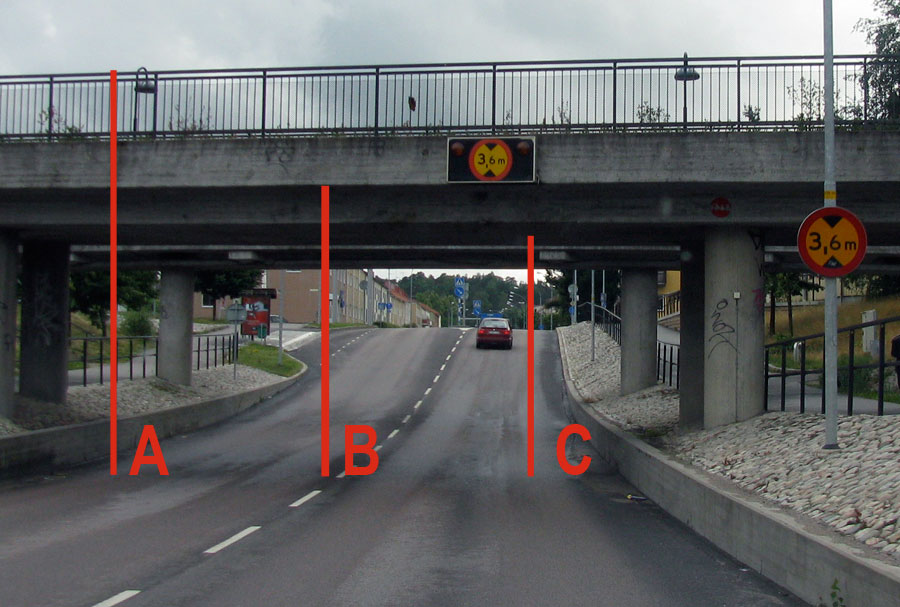
Which line best indicates the measurement that the prohibitory signs specify?

Picture for the question

Explanation

The important thing is that vehicles do not scrape against the bridge. Knowing A and B is not relevant.

No questions to show here.