Driving licence · Theory practice

Practice test 10

70 questions · Pick an answer to see whether you are right. Your answers are saved in this browser.

0of 70 correct
Not started

0 of 70 answered

0Correct
0Incorrect
70Unanswered
14Mistakes allowed

The real test has 70 questions in 50 minutes. You need 56 correct (80%) to pass.

Question 1

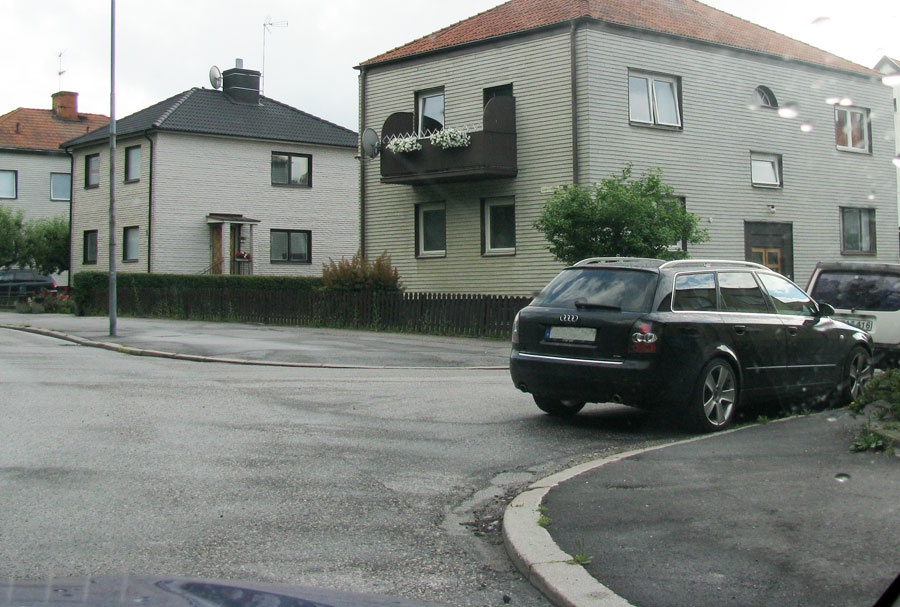
You are driving the car from which the picture is taken. Which of the following is true?
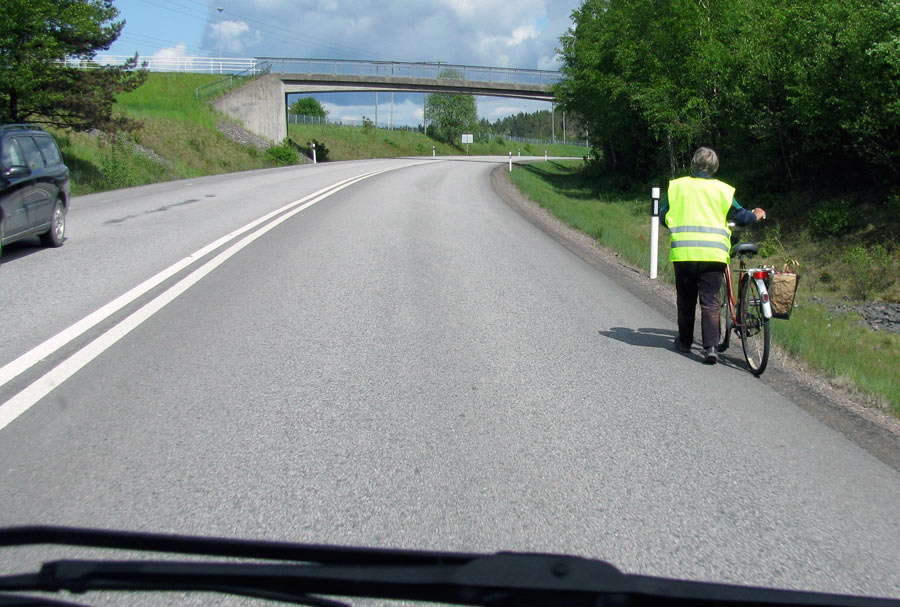
Picture for question 1

Explanation

Reasons why it is appropriate to pass the person immediately:

  • The alternative is to brake and drive at a walking speed, which entails the following negative consequences:
    • Increased risk of being rear-ended.
    • It disturbs the flow of traffic.
  • The person is presumably aware that there may be cars coming.
  • It appears that you can easily pass the person without even crossing the centre line.
Question 2

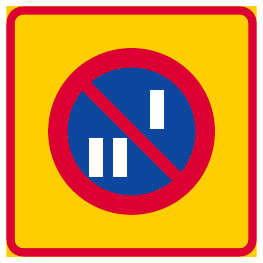
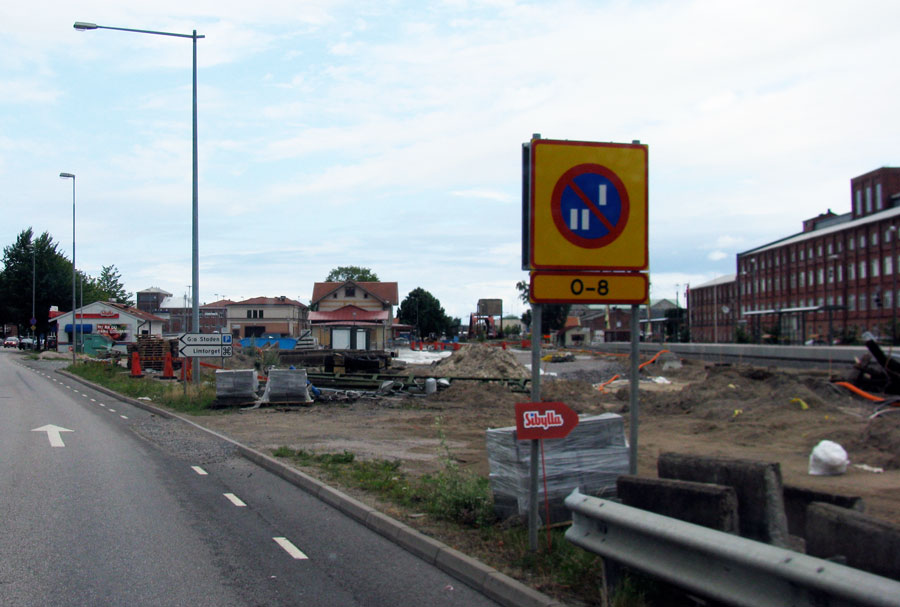
When does the zone sign in the picture cease to apply?

Picture for question 2

Explanation

Zone sign (E20)
Zone signE20

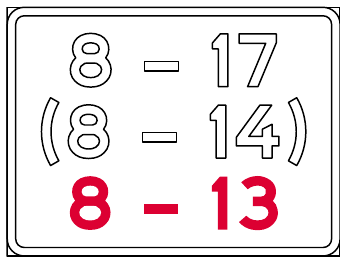
The sign is erected at the entrances to the area and applies up to the point where the sign E21, end of zone, is erected or it is otherwise clearly indicated that the instructions on the sign no longer apply. Within the area, there may be deviations from the instructions on the sign. These deviations are indicated through other road signs and additional panels. The instructions on the sign also apply after such deviation without the sign being repeated.

Question 3

Should you wave over the pedestrians if you stop at a pedestrian crossing?

Explanation

If you wave over a pedestrian, that person may have a false sense of security and think “Okay, the driver sees me, now I can cross safely and start thinking about something else”. What the pedestrian is forgetting is that there may be other drivers that are not so observant. If the pedestrian is not looking and another car does not stop, a problem arises.

Never wave over pedestrians.
Driving Licence Book, 19th Edition, page 50
Question 4

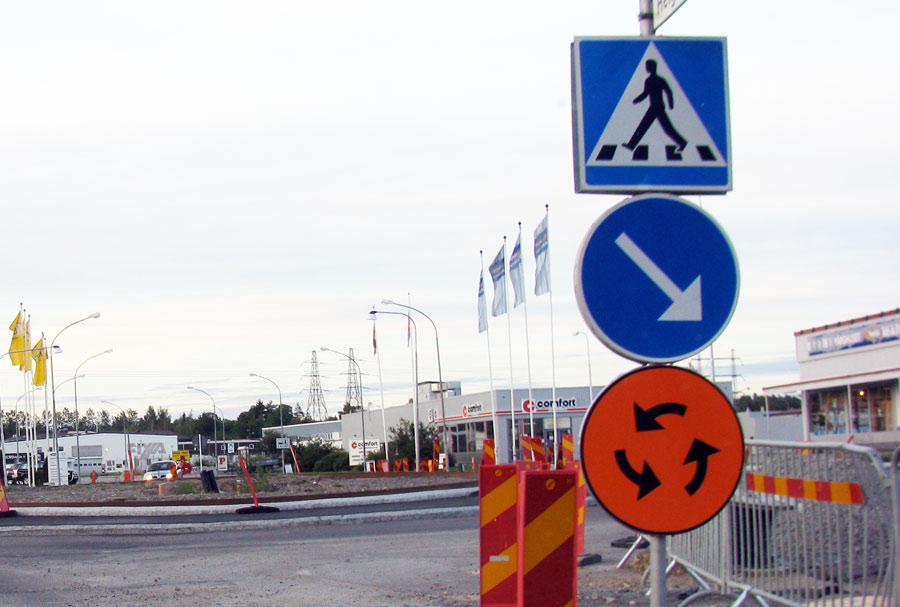
Which road sign takes priority?

Picture for question 4

Explanation

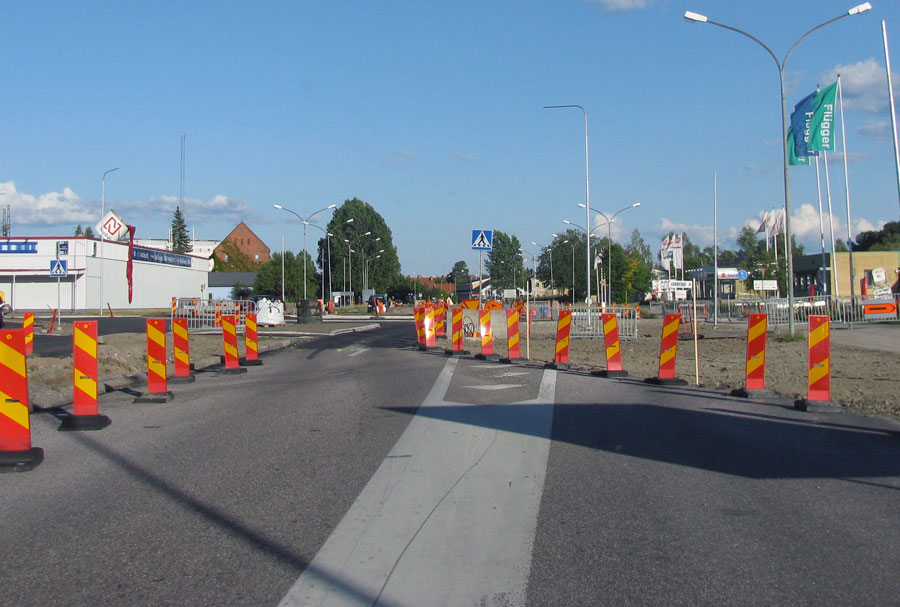
During roadworks, temporary orange signs are erected.

Follow the orange road signs […] They take priority over regular instructions.
Driving Licence Book, 19th Edition, page 83
Question 5

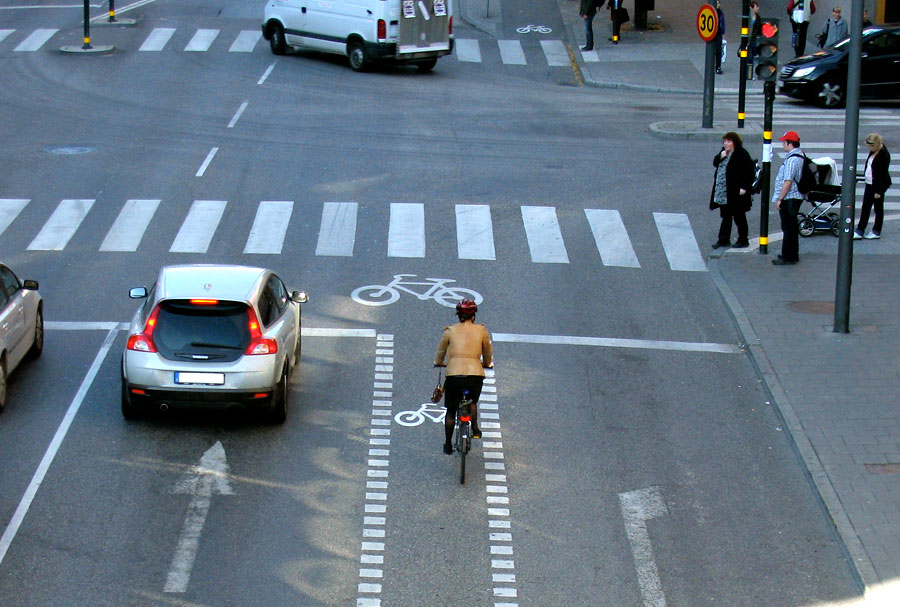
The cyclist in the middle of the photo is turning right. Does she have to stop before the pedestrian crossing?

Picture for question 5

Explanation

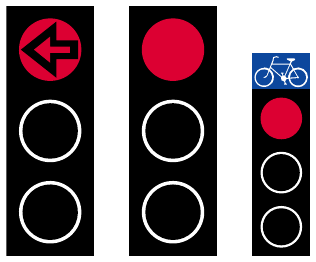
Red (SIG1)
RedSIG1

Stop. A vehicle may not pass the stop line or, in the absence of such, the signal. A signal with an arrow outline only applies to the direction or directions indicated by the arrow.

The red light also applies to the cyclist, since she is on the regular road. The stop line is broken in front of the bicycle lane so that cyclists can get in front of the cars and prepare their continued journey safely (instead of standing wobbling in between the cars).

Why should I know this to drive a car?
It is good to be aware of how other road users may act. If you, for example, are sitting in your car on one of the crossing roads, you do not need to remember to give way to the cyclists, as they are obligated to stop at the red light.

Question 6

Which of these statements about speed is correct?

Explanation

Review of the options

  • It is always recommended to drive at a very low speed.Wrong, “A driver may not drive at an excessively low speed without a valid reason.” (Swedish Road Traffic Ordinance)
  • I have to be able to stop before any foreseeable obstacle.Correct, “The speed may never be greater than what allows the driver to maintain control of the vehicle and stop it […] before any foreseeable obstacle.” (Swedish Road Traffic Ordinance)
  • Where there is ongoing roadworks, I am allowed to drive at a maximum speed of 50 km/h.Wrong, it is common for the maximum speed past a roadwork site on a motorway to be 70 km/h.
  • I do not have to adapt my speed according to the weather.Wrong, “Consideration shall always be given to […] weather and visibility conditions.” (Swedish Road Traffic Ordinance)
Question 7

Why should you take down a roof box when you are not using it?

Explanation

Roof boxes and rails create an unnecessary air resistance and slows the car down. A roof box can increase fuel consumption by more than a decilitre each 10 kilometres.
Swedish Transport Administration
Question 8

Is it true that you are obligated to show particular consideration to some road users?

Explanation

The road user shall show particular consideration to children, elderly, school traffic wardens and people with visible disabilities or illnesses that constitute an obstacle for them in traffic.
Swedish Road Traffic Ordinance

This must not be read as a pass to act ruthlessly towards everyone else, but rather you shall be considerate towards everyone and especially towards these groups.

Question 9

What does the term winter road conditions mean?

Explanation

Winter road conditions are considered to exist when there is snow, ice, slush or frost on some part of the road.
Swedish Transport Agency
Question 10

You increase your speed threefold in a curve. How much does the lateral force increase?

Explanation

The lateral force is the centripetal force. It increases quadratically (to the power of 2) in relation to the speed.

How many times faster is the speed? Answer: 3 times greater speed.

How many times greater is the centripetal force? Answer: 32 = 3 × 3 = 9, i.e. the centripetal force is nine times greater.

Question 11

You have a car made in 2014 and the last inspection was in June 2020. When are you required to inspect it again?

Explanation

On 20 May 2018, the old system with the last digit in the registration number was discontinued.

New inspection rules as of 20 May 2018:

  • A new car must be inspected for the first time no later than 3 years (36 months) after the month when it was first used.
  • The second inspection no later than 2 years (24 months) after the month when the first inspection was made.
  • Then no later than 14 months after the month when the most recent inspection was made.

To simplify, a car older than 5 years must be inspected every year. It is recommended to schedule an inspection the same month every year and treat the 2 extra months as a margin of safety.

Please note that the last day for inspection is always the last day of the month. This is because you start counting the month after the most recent inspection.

Question 12

You want to tow another car. When must the tow cable be marked?

Explanation

The tow cable must be marked “if the distance between the vehicles exceeds 2.0 metres.” (Swedish Road Traffic Ordinance)

Question 13

How fast may a class II moped made in 2015 drive?

Explanation

A class II moped is a vehicle with two, three or four wheels that is constructed for a speed not exceeding 25 km/hour.
Swedish Transport Agency
Question 14

Which statement is true?

Picture for question 14

Explanation

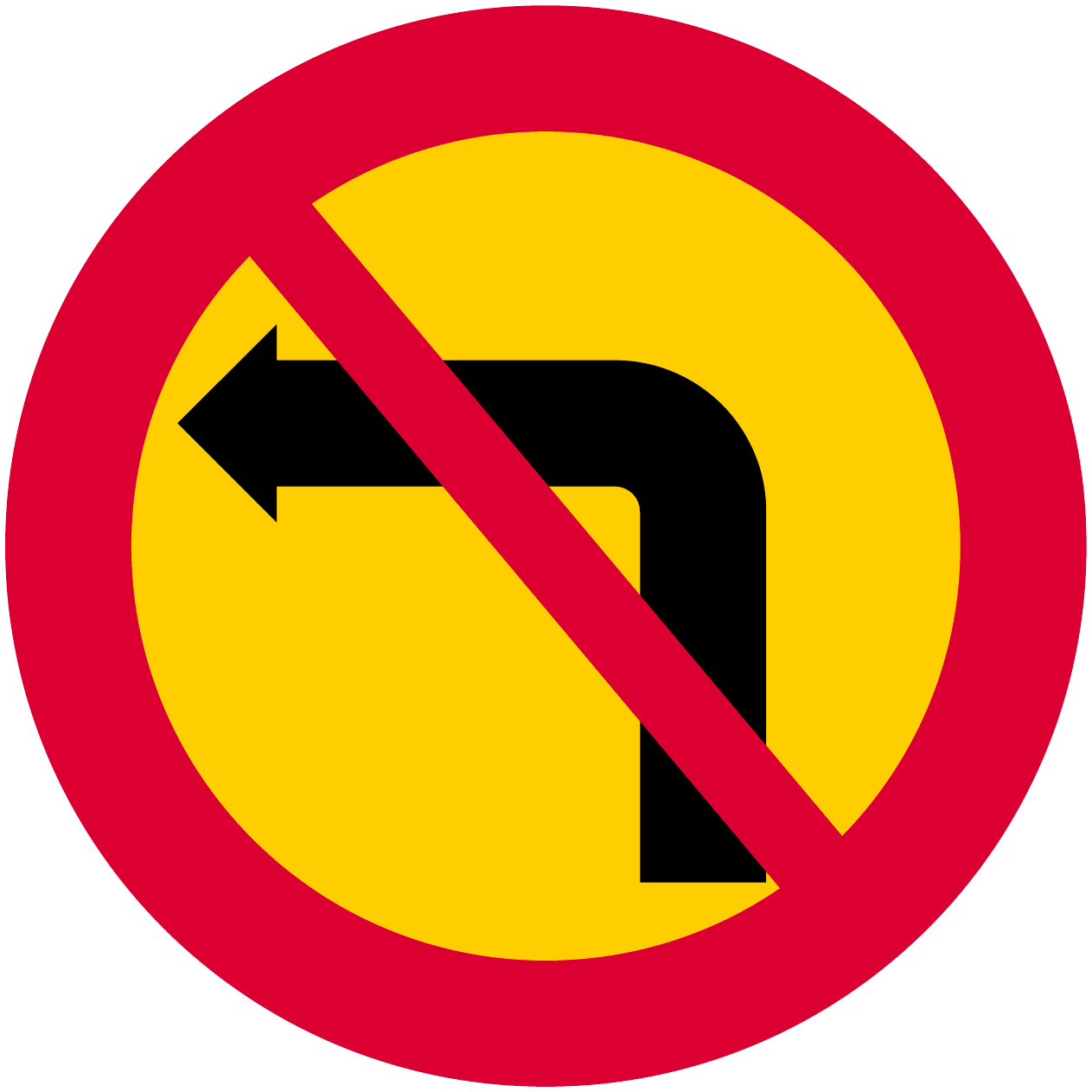
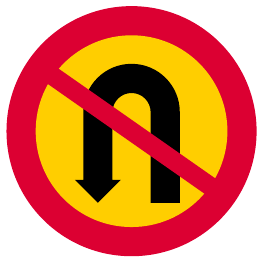
A prohibition of left turns has been deemed not to also entail an automatic prohibition on making a U-turn. […] According to the Court of Appeal […] a left turn and a U-turn must in principle be considered as two separate manoeuvres, which is highlighted by the fact that they are prohibited by different prohibitory signs.
Svea Court of Appeal
No left turn in the junction (C25)
No left turn in the junctionC25

This prohibition applies to the junction or similar location before or in which the sign is erected. The sign may relate to several junctions. In that case the distance is indicated on an additional panel. The symbol is adapted to the conditions of the location.

No U-turn (C26)
No U-turnC26

This prohibition applies to the junction or similar location before or in which the sign is erected. The sign may relate to several junctions. In that case the distance is indicated on an additional panel. The symbol is specific to the conditions at the location.

Question 15

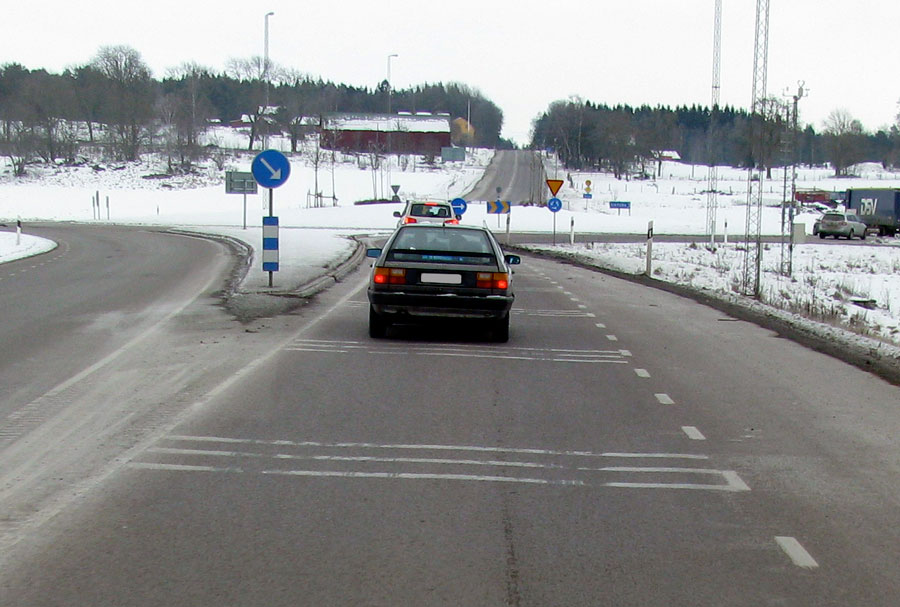
You have ended up on the right side of the obstruction marking. How should you react?

Picture for question 15

Explanation

A vehicle may not with any wheel drive on an obstruction marking or across a solid line. If particular caution is observed, however, exceptions can be made from this rule if […] it is required for the vehicle to be able to pass an obstruction on the road.
Swedish Road Traffic Ordinance
Question 16

What does this road sign mean?

Picture for question 16

Explanation

Local loop (F30)
Local loopF30

The sign indicates a ring road or equivalent. The sign may be supplemented with a designation or similar. No other colour may be used.

Question 17

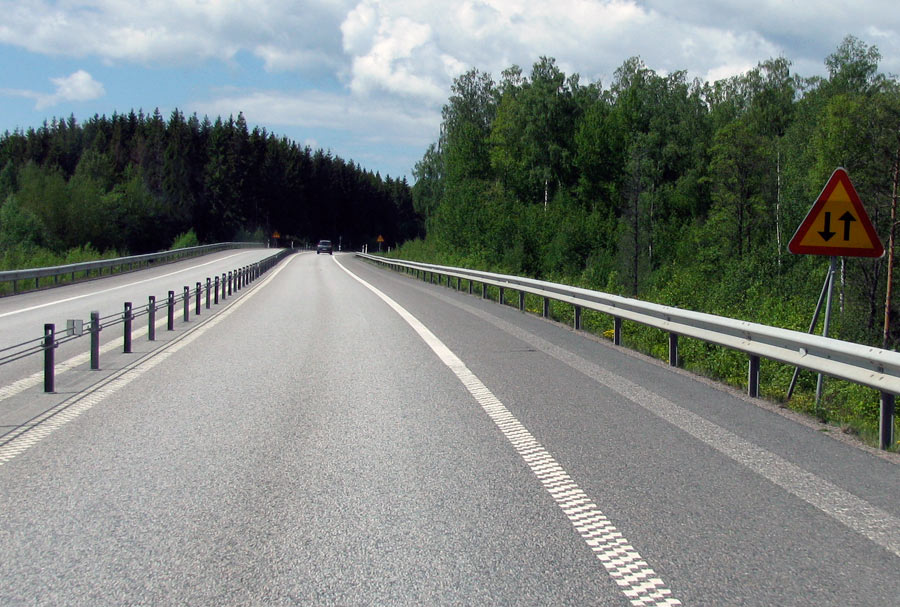
What is about to happen?

Picture for question 17

Explanation

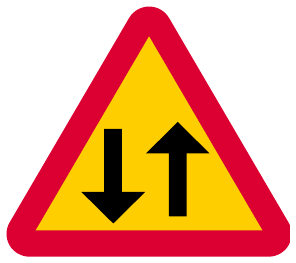
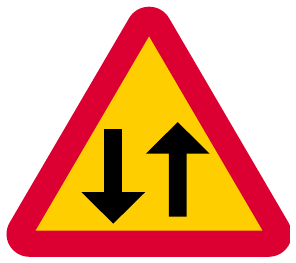
Beware of two-way traffic ahead (A25)
Beware of two-way traffic aheadA25

This sign indicates that a one-way road is turning into a road with traffic in both directions.

But the sign does not mean “End of central barrier”, does it?
The question is not asking the exact meaning of the sign, but what the consequence of the sign will be.

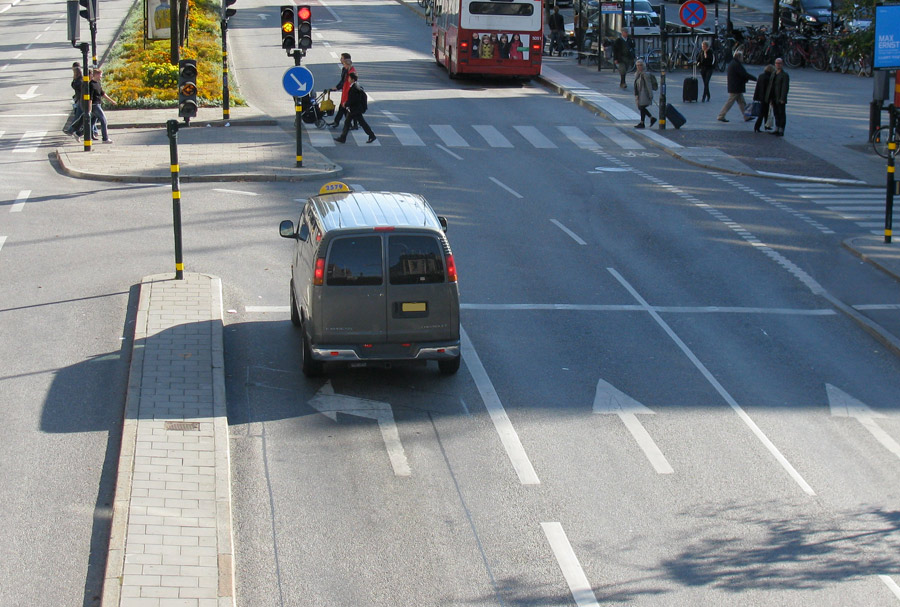
Question 18

The grey car is turning left. Is the driver obligated to use their indicator?

Picture for question 18

Explanation

When a driver intends to pull away from a curb or turn around, turn off, change lanes or move the car sideways in any way not considered insignificant, the driver shall use their indicator to show their intention.
Swedish Road Traffic Ordinance

You are always obligated to indicate a turn, even if there are lane selection arrows. If you do not indicate, you may confuse the other road users around you. Oncoming drivers cannot see the arrows on the road.

Question 19

How much lead does the petrol sold in Sweden today contain?

Explanation

As of 1994, there is no lead at all in the petrol.
Swedish Transport Agency
Question 20

Are all private cars obligated by law to be regularly serviced?

Explanation

The only legal requirement is the roadworthiness test.

However, you are recommended to follow the manufacturer’s service instructions.

Question 21

Can a driving licence be revoked if there are doubts about the licence holder’s sobriety?

Explanation

A driving licence shall be revoked […] if the licence holder is unfit to have a driving licence due to being unreliable in terms of sobriety.
Driving Licence Act
Doubts about sobriety refers primarily to situations where a licence holder has been reported for intoxication, for example having been taken into care in accordance with the Care of Intoxicated Persons Act (1976:511) etc. On the other hand, dependency or abuse of alcohol, narcotics, medications or other drugs also constitutes a medical obstacle to being issued a driving licence, pursuant to the current regulations on medical requirements for driving licences etc. Doubts about sobriety therefore refers to a situation where the licence holder has been reported for intoxication but where this does not indicate a medical obstacle to being issued a driving licence.
The Riksdag
Question 22

What does the term perception mean?

Explanation

Perception, the fundamental function used by all living beings to become aware of relevant aspects of the world around them and to put themselves in relation to it.
Nationalencyklopedin
Question 23

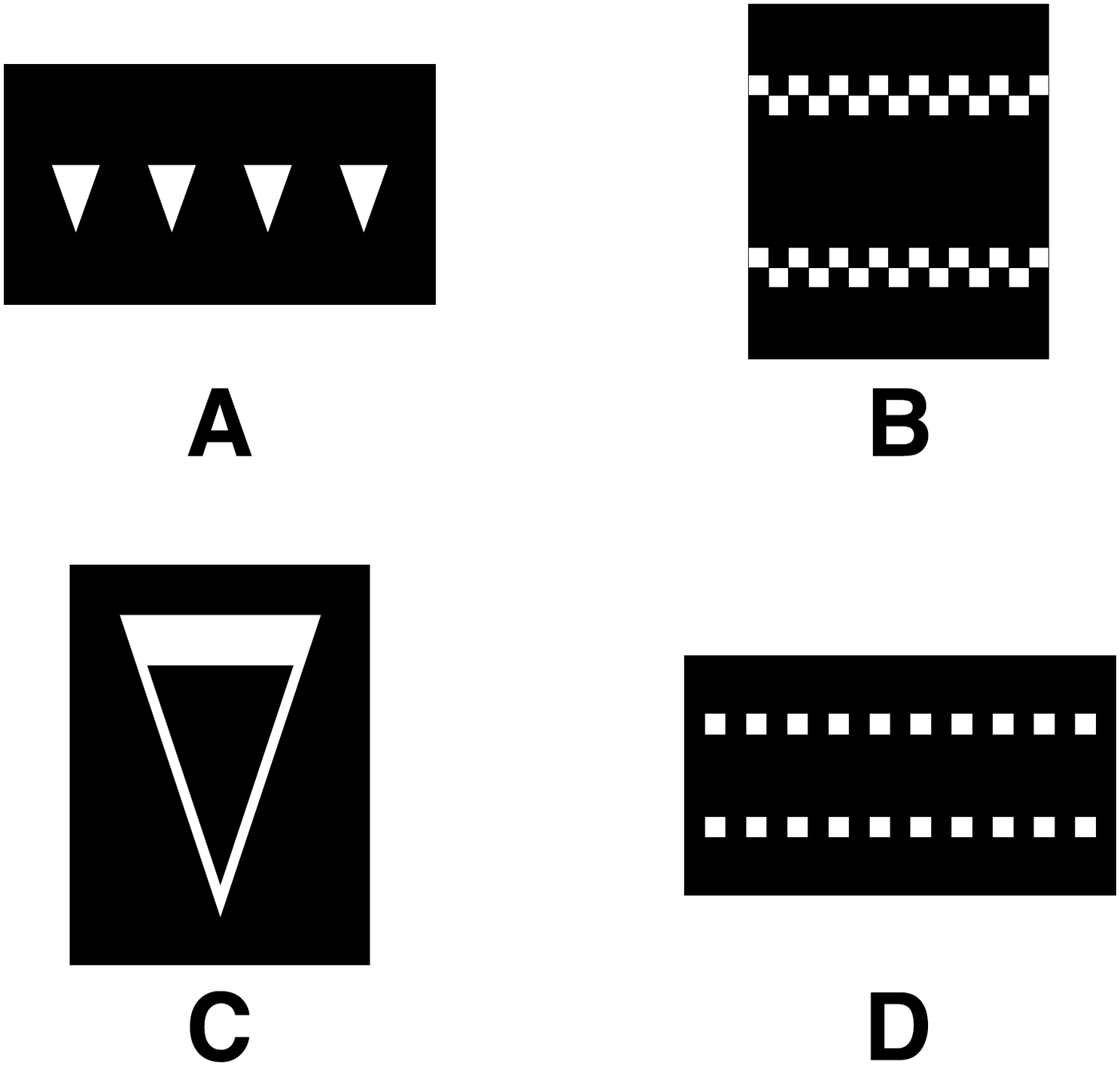
Which sign indicates a speed bump?

Picture for question 23

Explanation

Give way line (M14)
AGive way lineM14

This marking indicates the line that a vehicle should not pass when the driver is observing the obligation to give way.

Speed bump (M17)
BSpeed bumpM17

This marking indicates a speed bump, gutter or similar obstacle.

Preparatory information regarding the obligation to give way or to stop (M18)
CPreparatory information regarding the obligation to give way or to stopM18

This marking indicates that there is an obligation to give way or to stop further down the road.

Bicycle passage or bicycle crossing (M16)
DBicycle passage or bicycle crossingM16
Question 24

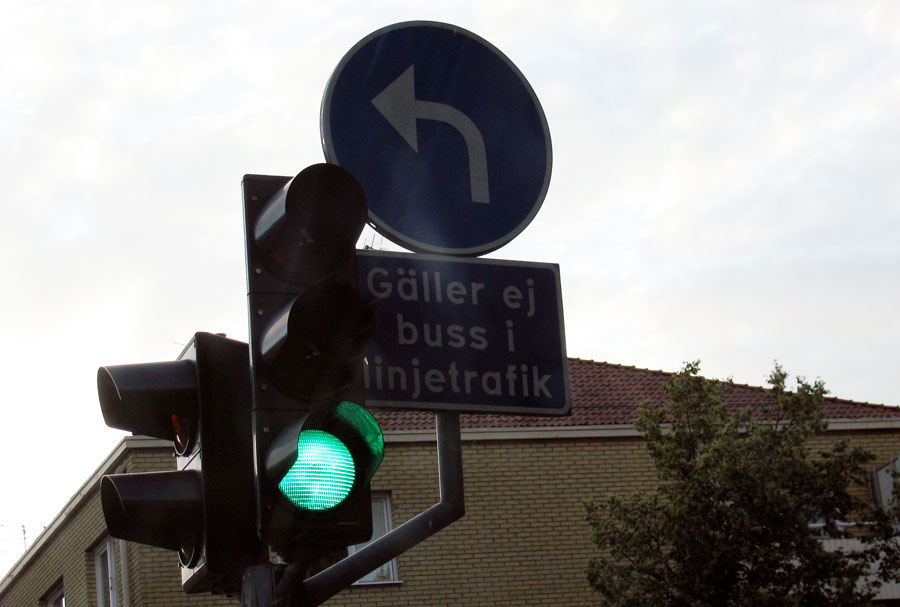
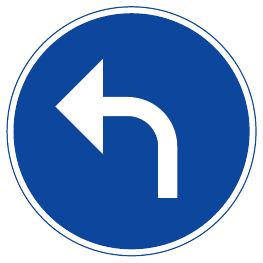
Is a bus in regular service allowed to turn left?

Picture for question 24

Explanation

Direction to be followed (D1)
Direction to be followedD1

The signs indicate that the vehicle may only be driven in the direction of the arrow or, in the case of two arrows, in either arrow’s direction. The symbol is adapted to the conditions of the location.

The signs are to be interpreted as: “A bus in regular service is free to choose route. All other must however turn left.”

Note: The situation in the picture consists of a junction where the road straight on leads to a quieter street with residential buildings and a bus stop. The smaller street is a shortcut, so in order to prevent everyone from taking this route, it has been decided that all vehicles apart from buses must take the detour to the left on the major road. This information is not relevant for being able to answer the question, but it may help you understand the reason for the sign.

Question 25

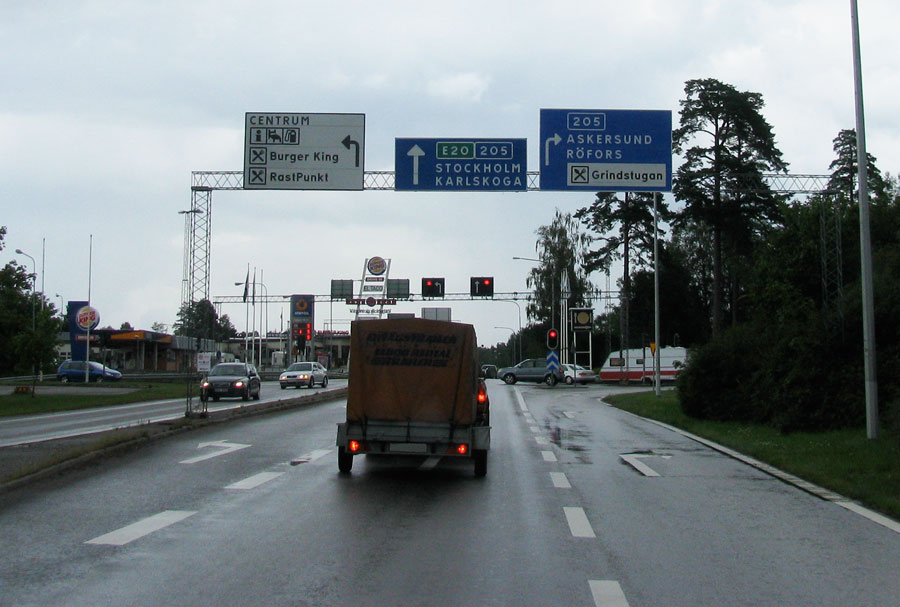
You are in the middle lane and heading towards Askersund. Are you allowed to change to the right lane?

Picture for question 25

Explanation

Since the lines are not solid, you may cross them. Line width does not matter.

Question 26

Which statement is true regarding a correctly used engine heater?

Explanation

Each time you start your car cold, it increases both fuel consumption and emissions. Using an engine heater, you can save up to 1 dl of fuel every time you drive. The emissions during a journey of 6 km are reduced by 50–80 per cent if you have used a heater.
Swedish Transport Administration
Question 27

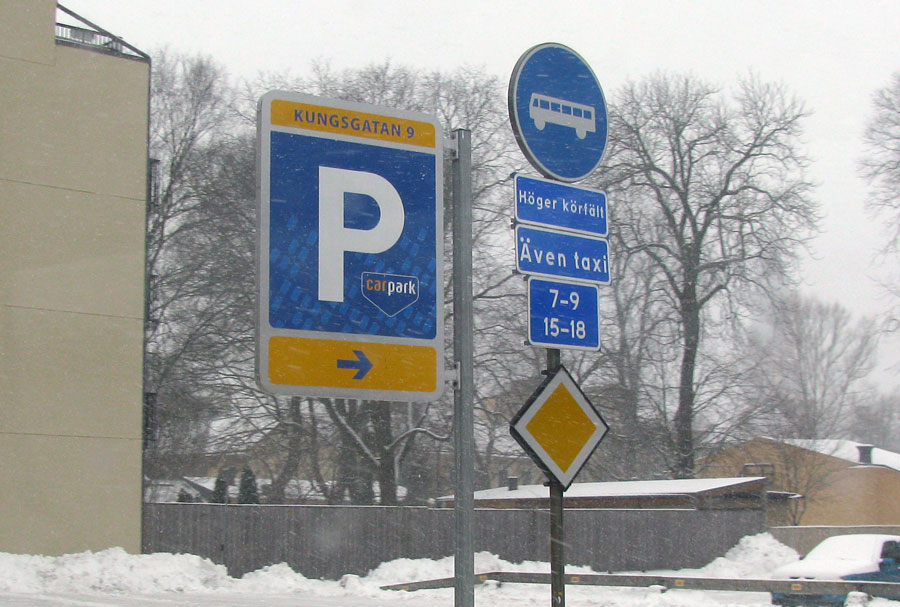
What do these road signs mean?

Picture for question 27

Explanation

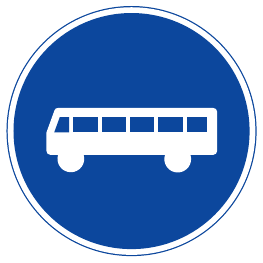
Reserved lane or carriageway for vehicles operating a regular service, etc. (D10)
Reserved lane or carriageway for vehicles operating a regular service, etc.D10

The sign also indicates that vehicles specified in Chapter 8, Section 2 of the Road Traffic Ordinance (1998:1276) are permitted to use the lane or carriageway, unless otherwise stated on an additional panel. If other vehicles are permitted to use the lane or carriageway, this is indicated through an additional panel.

Time indication (T6)
Time indicationT6

The panel indicates when the directions on the road sign apply.

An additional panel underneath two or more road signs posted one on top of the other applies to all of these signs.
Traffic Sign Ordinance
Question 28

Which statement is true regarding the claim form?

Explanation

The form is mainly of interest to the insurance companies. The same information stated in the form can be noted down on a regular piece of paper. The form is just a template that makes it easier.

Question 29

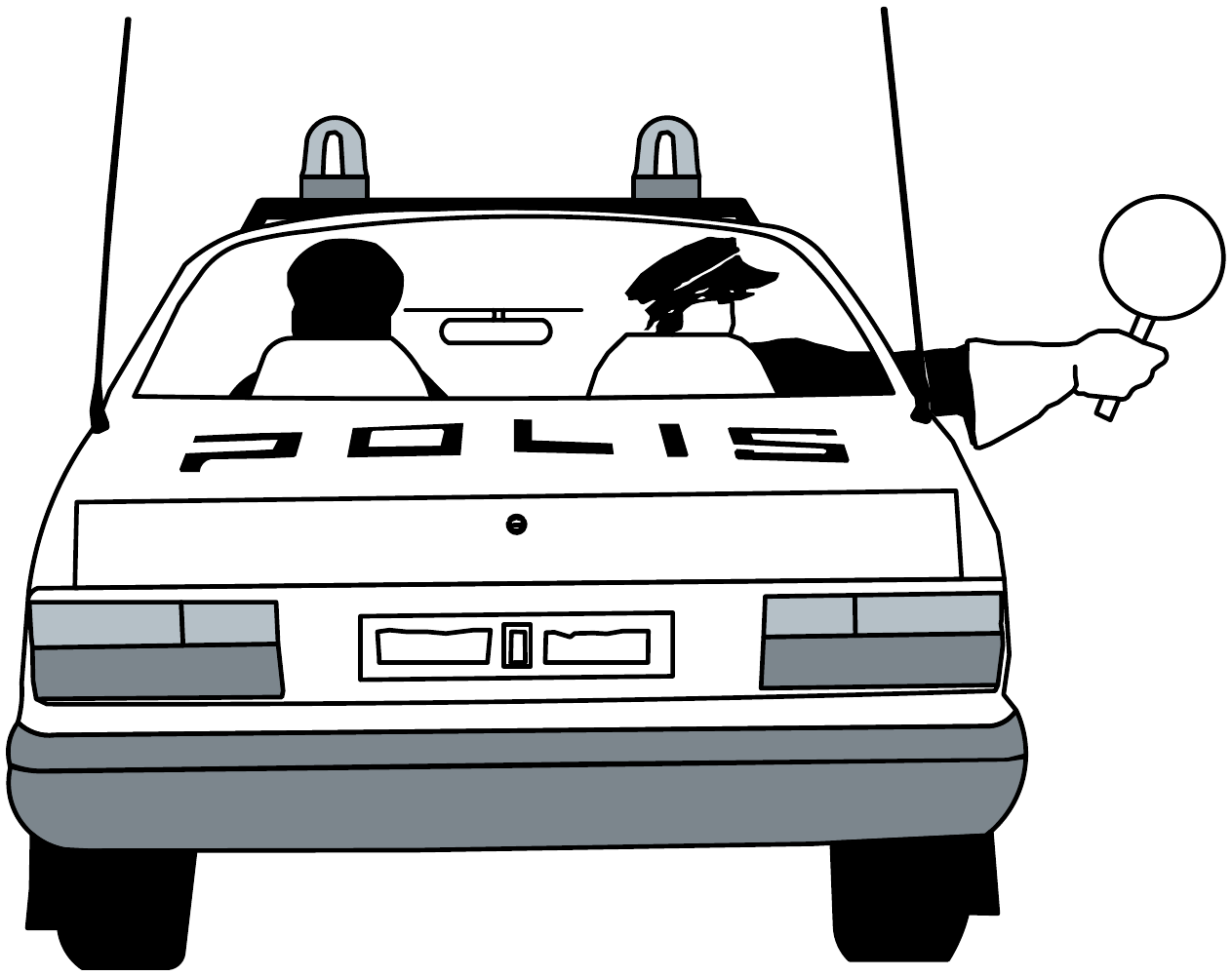
You are driving behind the police car and see this sign. What should you do?

Picture for question 29

Explanation

Follow and stop behind the police vehicle (P10)
Follow and stop behind the police vehicleP10

The signal indicates that the driver of the vehicle behind the police vehicle is to pull over to the side of the road and stop. The signal may be given using a stop paddle.

The police officers decide where you should stop. You do not know what they want. Perhaps inspect the tyres of your car. In that case, it would be inappropriate to stop right on the hard shoulder (due to the risk of being hit by another car).

Question 30

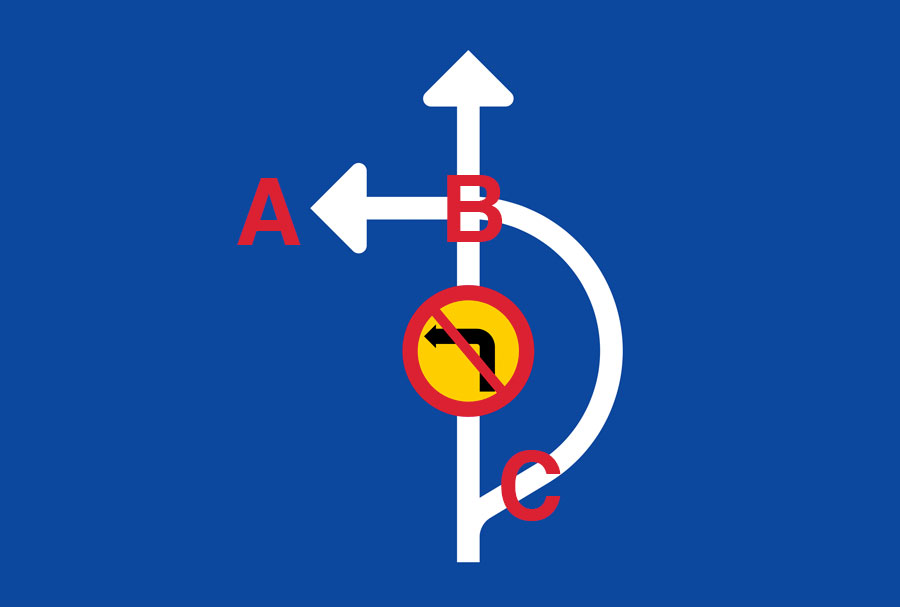
You are going to A. Which statement is true?

Picture for question 30

Explanation

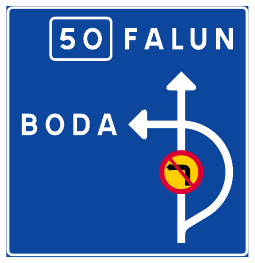
This is an example of a so-called Spanish turn.

Direction sign when junction turn is prohibited (F2)
Direction sign when junction turn is prohibitedF2

The sign provides preparatory information indicating that it is prohibited to turn in a junction, but that another direction can be chosen.

Question 31

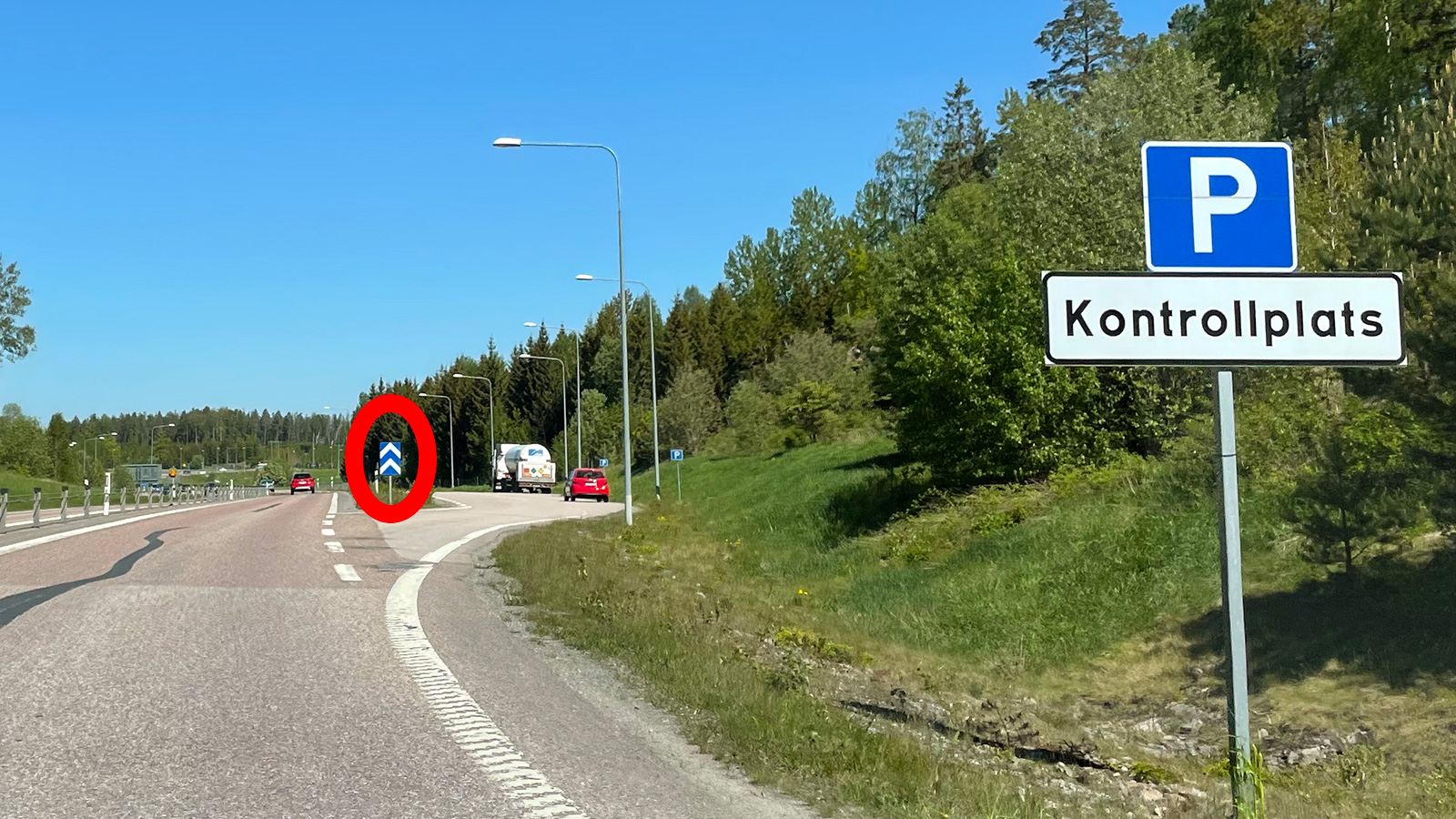
What does the circled sign mean?

Picture for question 31

Explanation

Kontrollplats
checkpoint
Exit plate (X4)
Exit plateX4

The device indicates the dividing point between a main carriageway and an exit road where there is a deceleration lane.

Question 32

The air pressure in your tyres is 50% above the recommended value. What is true?

Explanation

[…] you should not have more than 10–15 per cent above the recommended pressure. […] If you increase the pressure an extreme amount, you reach a point where the tyre starts to bulge out, and the surface touching the road is reduced. The traction is reduced and the wear increases heavily. If the air pressure is too high, there is also an impact on your comfort – the car starts to feel bumpy and rough.
Swedish Transport Administration
Question 33

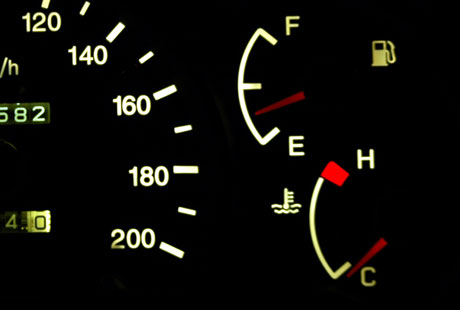
How far should you be able to go on the remaining fuel?

Picture for question 33

Explanation

This is a matter of making a reasonable assessment, as in many other traffic situations.

The correct answer is “More than 10,000 metres”. For simplicity, let’s say that the car uses 1 litre each 10 km (which is a lot). The tank is filled to approximately 25% (1/4).

If any of the lower ranges were correct, it would mean that the car’s fuel tank (not including the reserve tank) can fit approximately 4 litres, which is completely unreasonable (a regular medium-sized car has a tank of approx. 40 litres; even mopeds usually have a tank larger than 4 litres).

Another way of looking at it: Imagine that the tank contains 60 litres. There is 25% left. 60 × 0.25 or 60 / 4 = 15 litres. If any other alternative than “More than 10,000 metres” was correct, it would mean that the car consumes more than 1.5 litres/km, which is completely unreasonable.

Question 34

Are you obligated to address a remark from a roadworthiness test that does not require a follow-up test?

Explanation

What does a remark that does not entail a follow-up test mean?
The problem must be rectified as soon as possible. The vehicle must not be used more than is necessary in order to rectify the problem. If a previously noted problem remains at the next inspection, it will result in a remark with a requirement for a follow-up test.
Bilprovningen

Things that do not need to be rectified will not lead to a remark.

Question 35

What does a mandatory stop entail?

Explanation

A driver who is obliged to stop or is stopping at a traffic signal shall stop at the stop line. In the absence of a stop line, the driver shall stop right before the signal or before driving onto the intersecting road, route or track area.
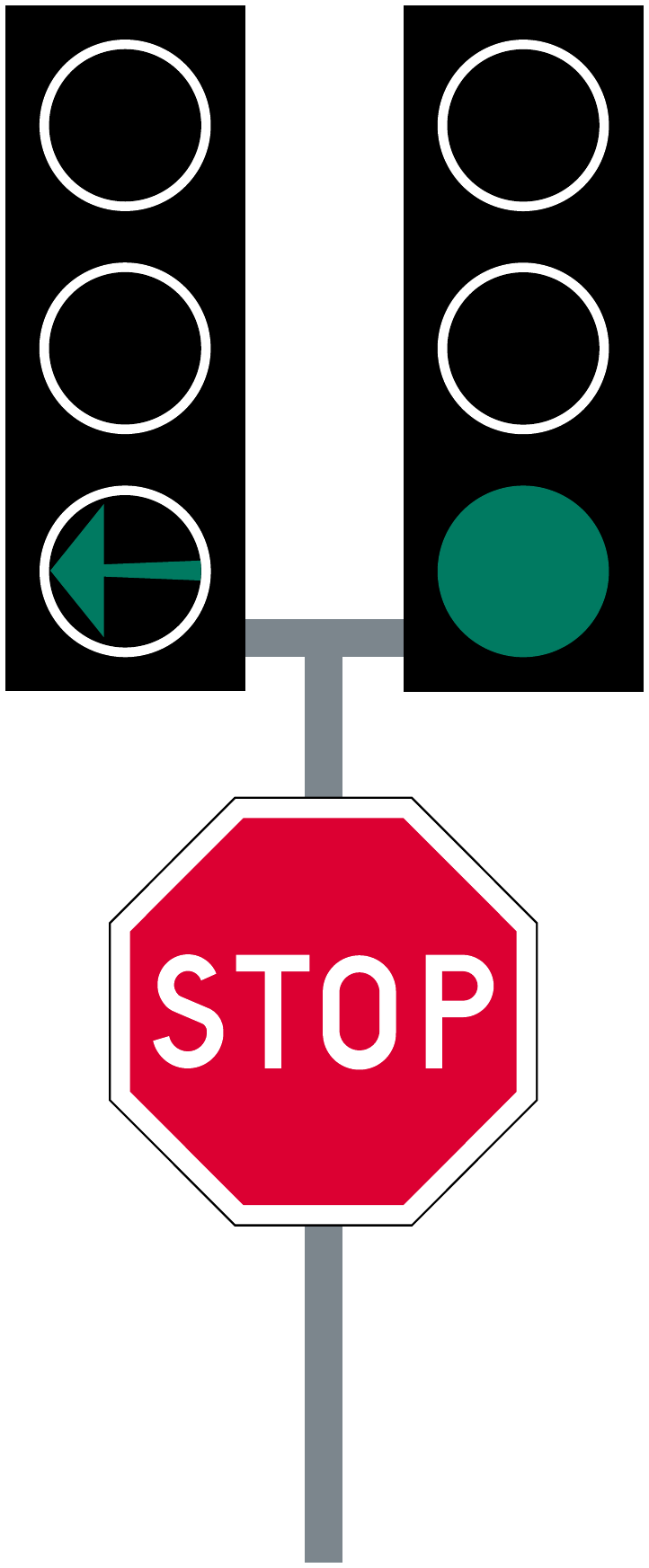
Swedish Road Traffic Ordinance

You are obligated to stop in the other alternatives too, but this is not referred to as a “mandatory stop”.

Question 36

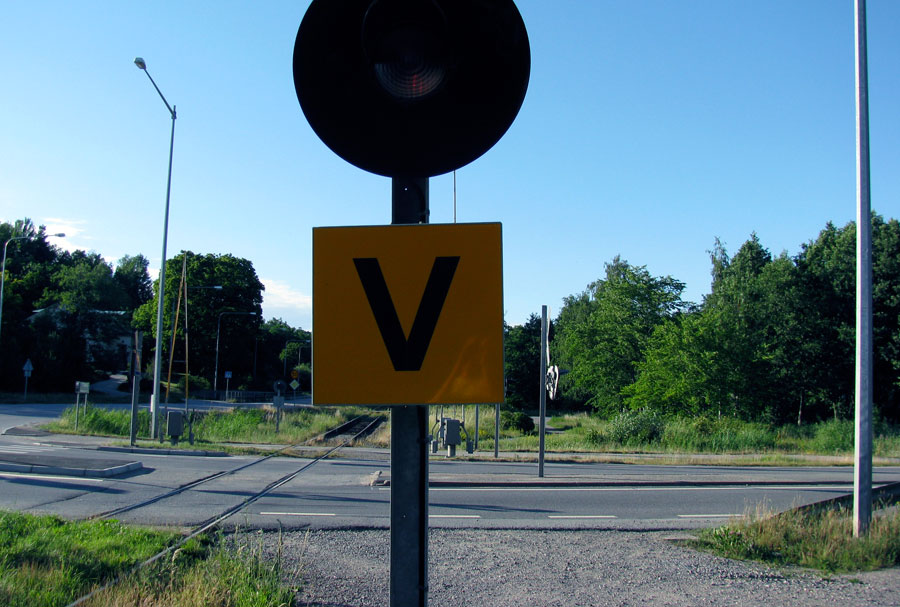
You are driving a car on the gravel road and see this sign. How should you interpret it?

Picture for question 36

Explanation

The sign only applies to train drivers (see the railway on the left). There is no road sign like the one in the picture.

Question 37

What is the function of the two transverse lines on the ground?

Picture for question 37

Explanation

When you drive over the lines, they will make a noise. Should you be inattentive and tired, the idea is that the sound will rouse you.

Question 38

Which measure is most realistic to focus on according to Vision Zero?

Explanation

At the same time as measures are to be taken to prevent accidents, the road transport system must be designed with consideration to the insight that people make mistakes and that traffic accidents can therefore not be completely avoided. There is no such thing as a perfect person. Vision Zero accepts that accidents occur, but not that they result in serious personal injury.
Swedish Transport Administration

A mistake is something that by definition is not intentional. Even a traffic instructor with twenty years of experience can make a mistake. Comparative case: There is a global food shortage. An easy solution would be to teach people not to eat food. However, this is impossible since it is in people’s nature to eat. The solution is instead to develop better methods for producing food.

Question 39

Which statement is true regarding children in traffic?

Explanation

Review of the options

  • Children have more sensitive and better hearing than adults.The type of hearing that is important in traffic (for example, judging distance) is less developed in children.
  • Children have difficulty judging distance correctly.Yes, their senses are not fully developed.
  • Children are often easier to see than adults since they have colourful clothes on.Children are often more difficult to see due to them being small (a child can be entirely hidden by a parked car).
Question 40

You are turning left. All the roads crossing yours are empty. Which of the following is true?

Picture for question 40

Explanation

Traffic signals always take priority over stop signs:

  1. Police signals
  2. Traffic signals
  3. Road signs
  4. Rules (such as the right-hand rule)

As the traffic signal ranks higher than a road sign, you do not have to stop at the sign when the traffic signal is working. The stop sign has been posted to regulate traffic when the traffic signal is broken.

Question 41

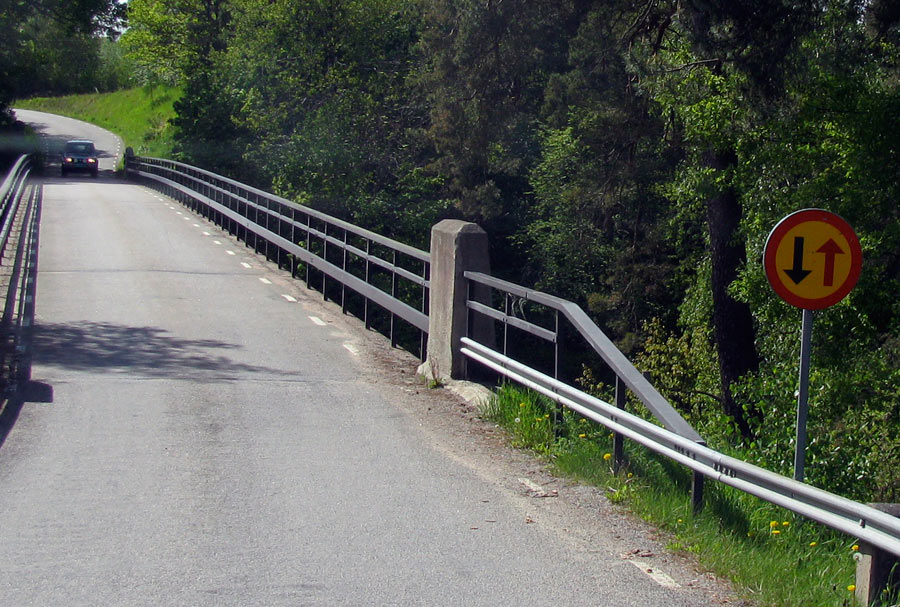
You are driving the car from which the picture is taken and intend to go across the bridge. What rule applies?

Picture for question 41

Explanation

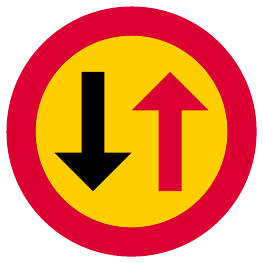
Priority for oncoming vehicles (B6)
Priority for oncoming vehiclesB6
Question 42

What is the maximum total weight of a light lorry?

Explanation

Light lorry […] total weight not exceeding 3.5 tonnes.
Act on road traffic definitions
Question 43

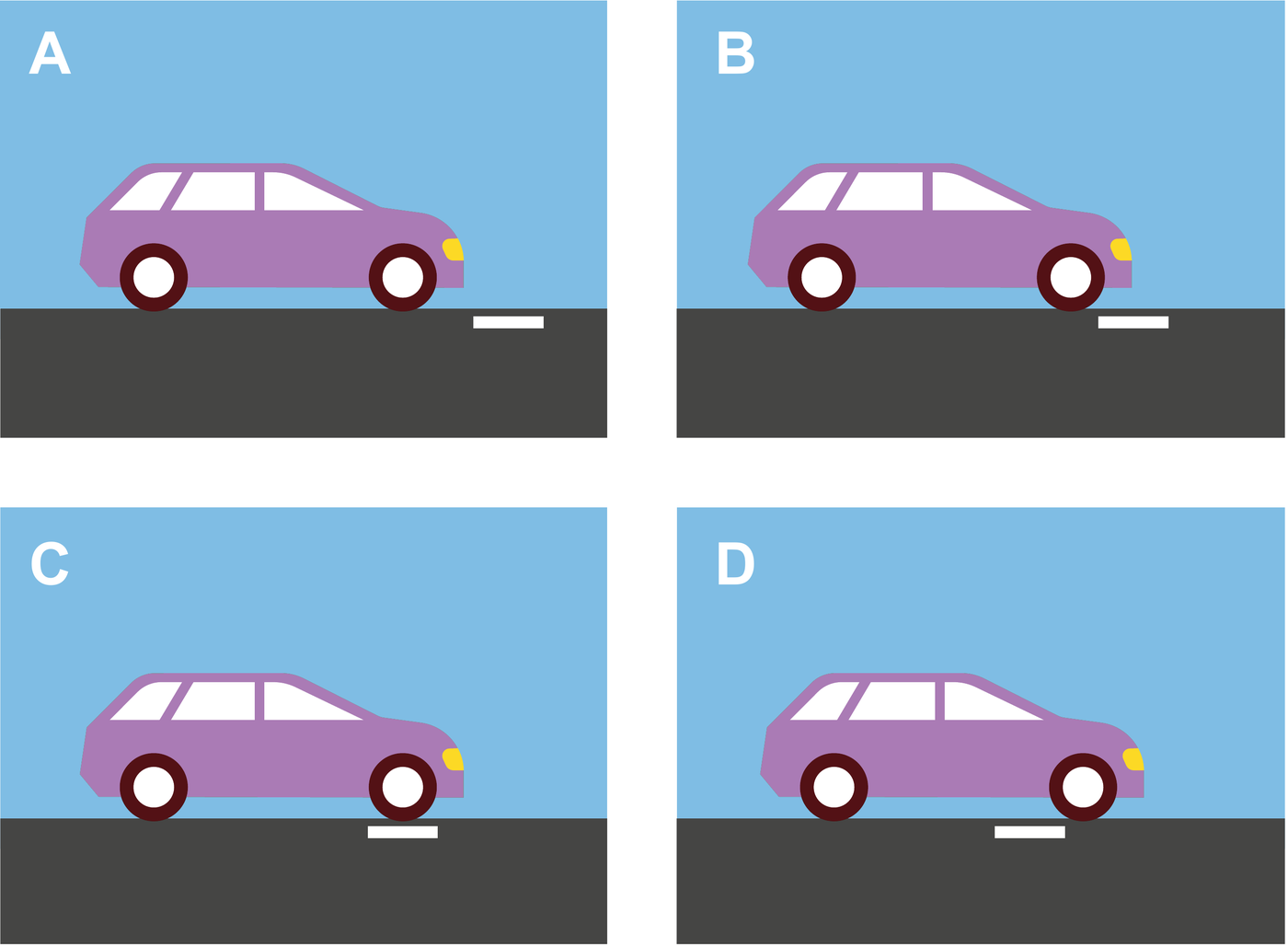
How should you position the front wheels in relation to the stop line when you observe an obligation to stop?

Picture for question 43

Explanation

The stop line is placed so that you are able to stop right before it. However, you may not stop on it or past it. Stopping too far before is not good since it may limit your range of visibility.

Question 44

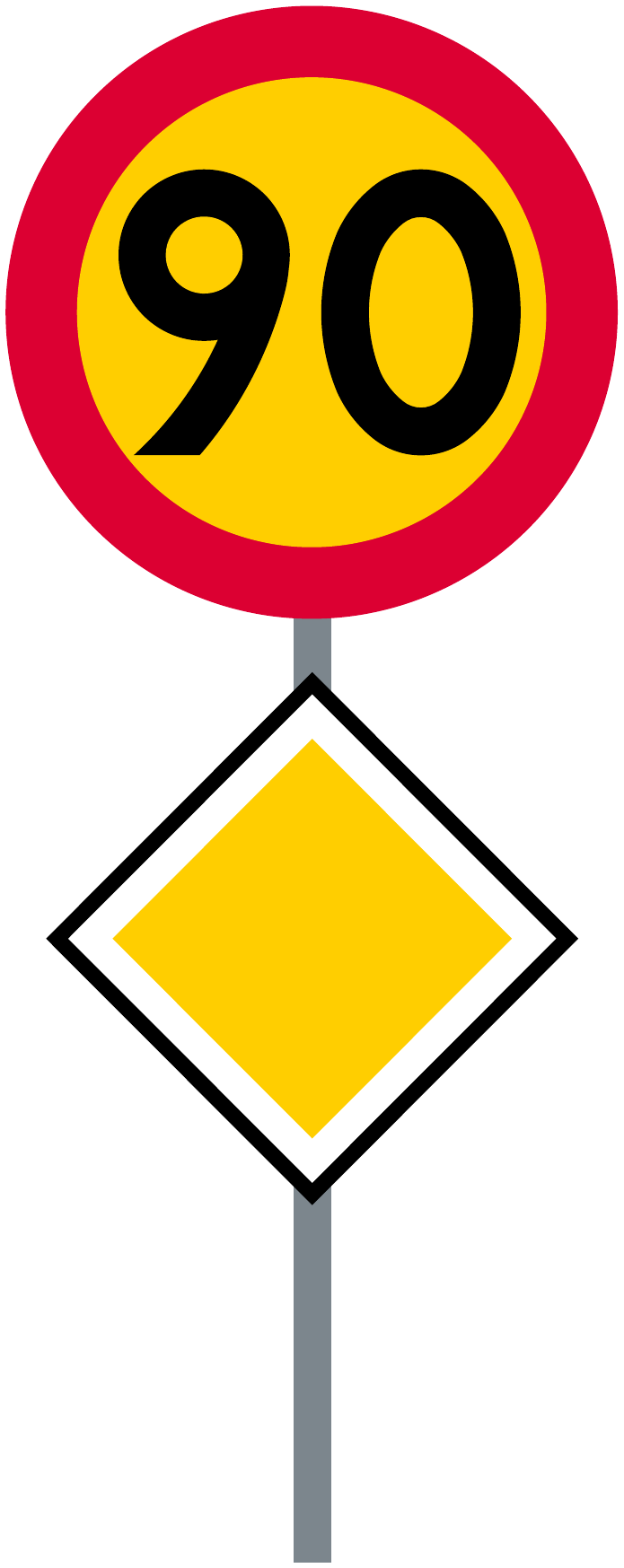
What is the maximum speed for a heavy lorry on a road with this combination of signs?

Picture for question 44

Explanation

A heavy lorry is permitted to drive at a maximum speed of 90 km/h on motorways and clearways and a maximum 80 km/h on all other roads.

Since the sign does not indicate that this is a motorway or clearway, the applicable speed is 80 km/h.

Question 45

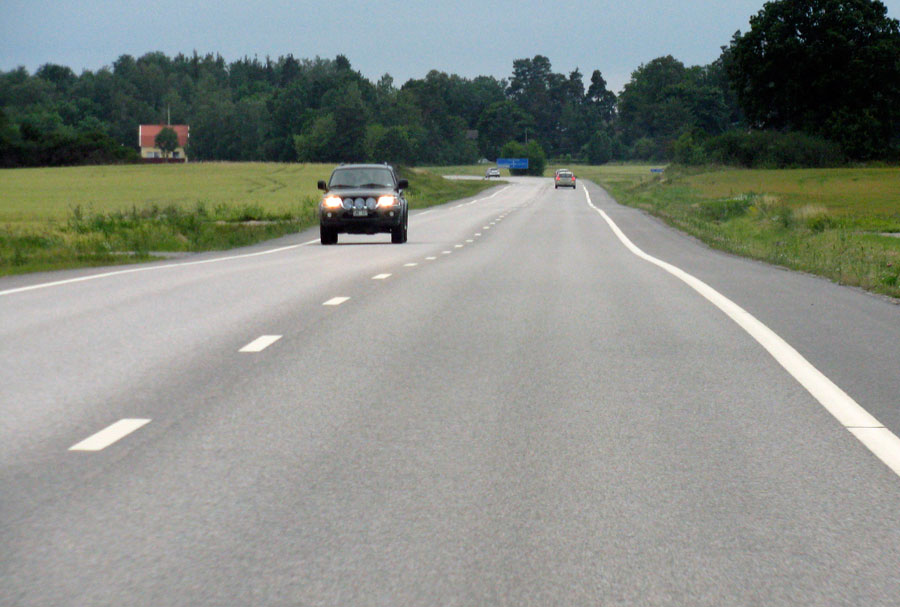
How should you position the car when you are driving on a country road void of traffic in the dark?

Picture for question 45

Explanation

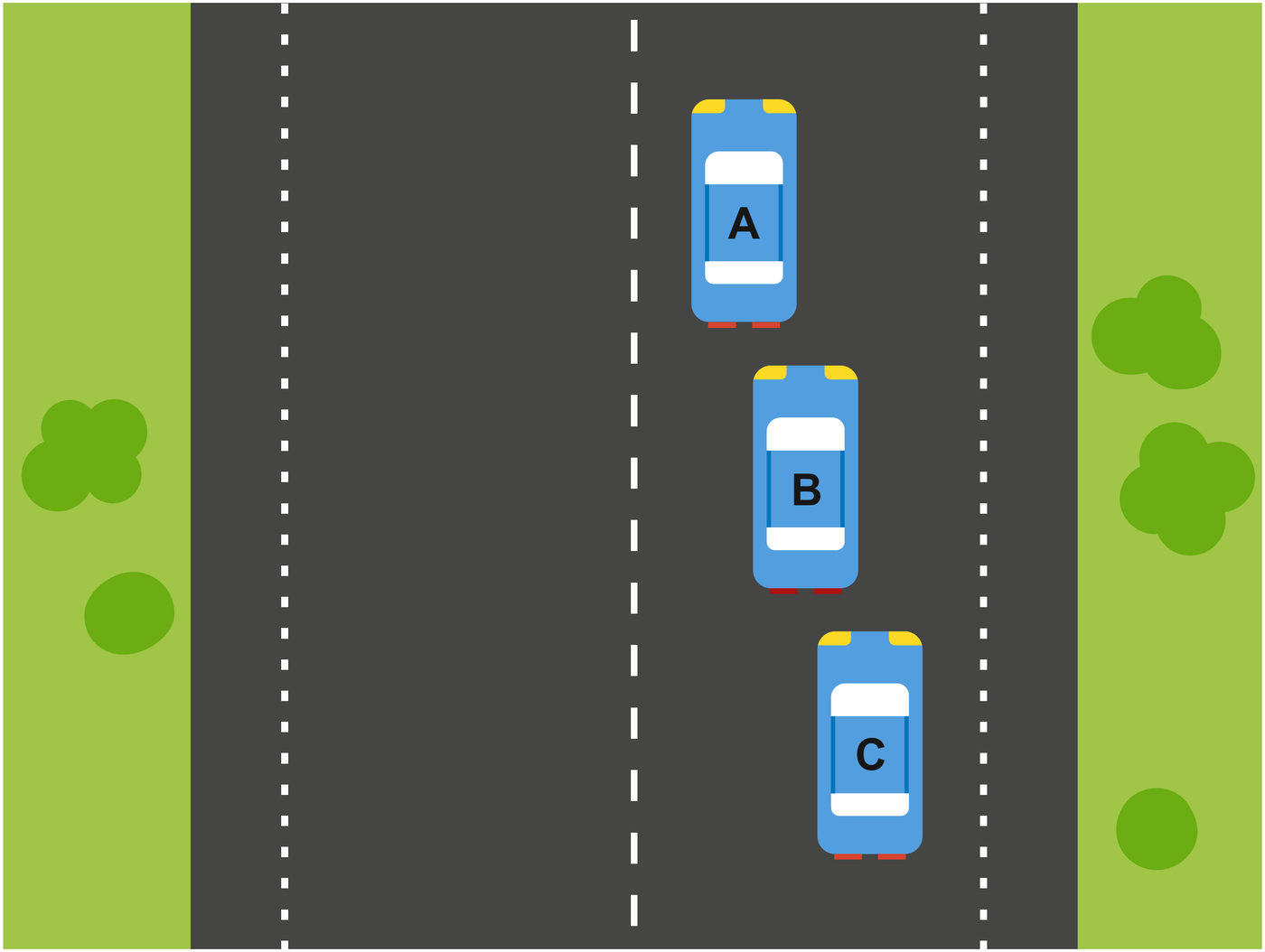
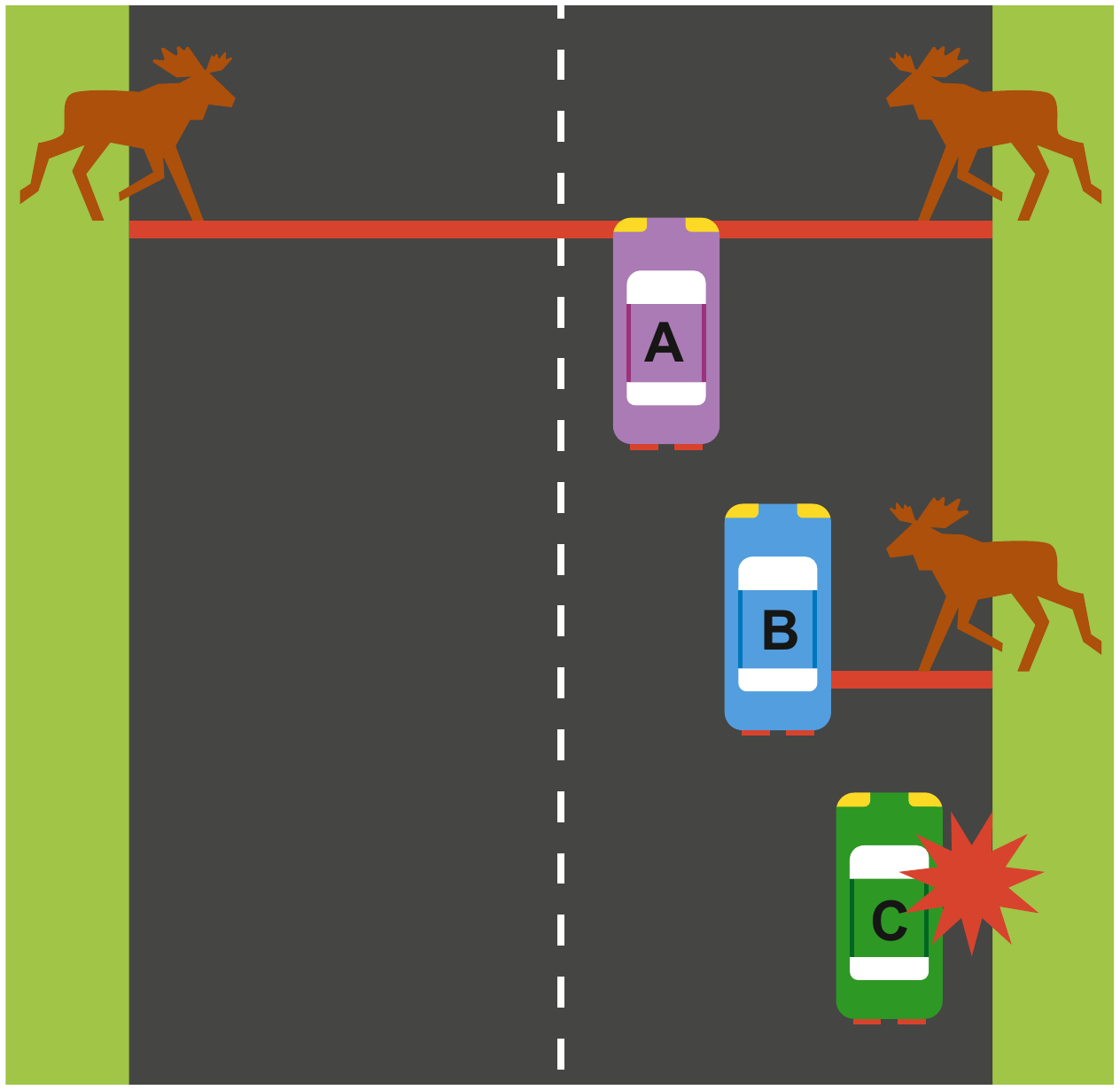
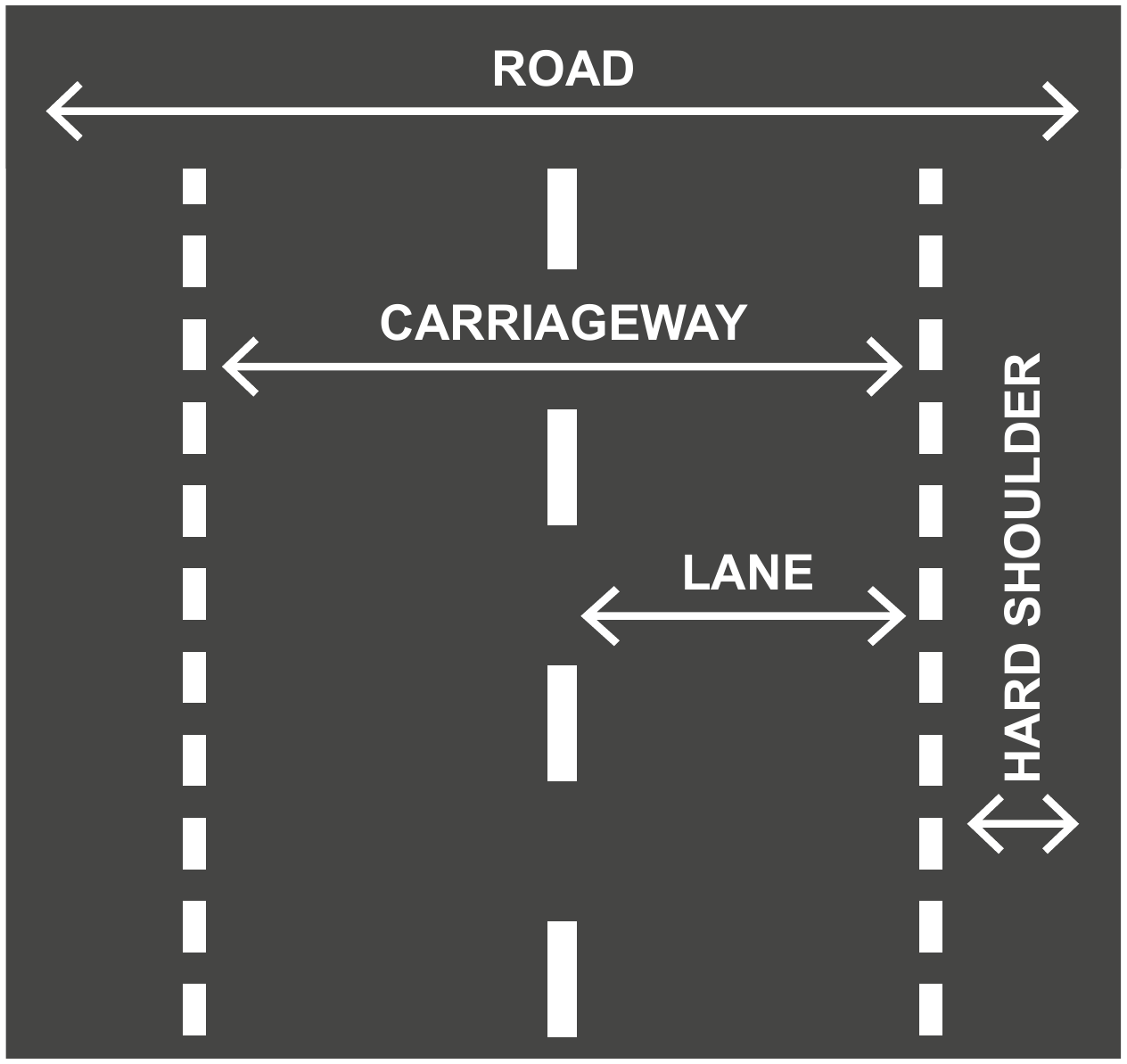
In the dark it is better to drive closer to the middle of the road (keep left in the lane), since it is more difficult to see what is happening along the edges, for example, if an animal jumps out.

If you encounter an oncoming car, however, you should move a little to the right to reduce the risk of a head-on collision.

Illustration

Note: Keeping left in the lane often more or less means the same position as driving close to the middle of the carriageway. See the definitions:

Illustration
Question 46

The black car has stopped to unload items. Is it permitted to stop here for this purpose?

Picture for question 46

Explanation

A vehicle may not stop […] in a junction or within a distance of ten metres from an intersecting carriageway’s nearest outer edge.
Swedish Road Traffic Ordinance

What is “stopping” according to the law?

Stopping a vehicle means bringing it to a standstill in a way which:
  • is not done to avoid danger
  • is not the result of traffic conditions, or
  • does not constitute parking.
Swedish Transport Agency

Unloading the car is not included in the exceptions = it is always prohibited to unload the car where stopping is not allowed.

Question 47

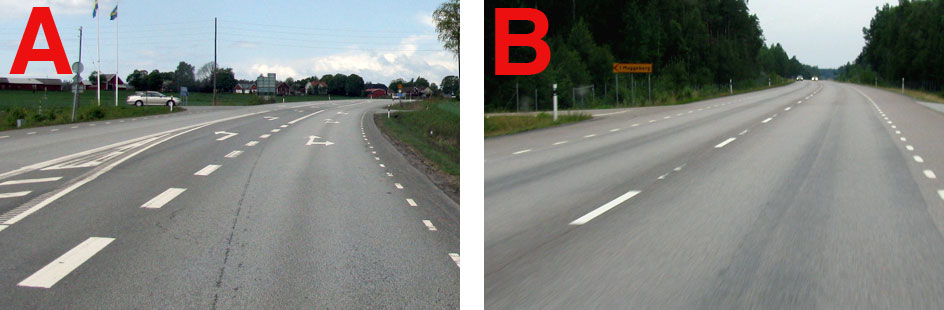
You are driving the vehicle from which the picture is taken and intend to turn left. Which statement is true regarding the risk of a rear-end collision?

Picture for question 47

Explanation

A has a separate lane for turning traffic, which reduces the risk of rear-end collisions (the traffic continuing straight remains on the right).

Question 48

Which alternative describes a way of conserving fuel?

Explanation

Heavy traffic means that you cannot plan your driving. It leads to more braking and tempo changes. Each time the traffic flow forces you to stop, change gears, slow down or accelerate, your fuel consumption increases compared to if you were driving along at your own pace.

Question 49

Approximately how many wildlife accidents occur in Sweden each year?

Explanation

In 2019 there were 64,930 wildlife accidents according to the National Wildlife Accident Council.

Question 50

Is it possible to reduce the soot and particle emissions of a diesel vehicle?

Explanation

The emissions can be reduced, for example with the help of purification techniques such as particle filters.
Swedish Transport Administration
Question 51

Which alternative is true when it comes to slippery road conditions in summer?

Explanation

The summer […] On hot sunny days, the tar in the asphalt may rise to the surface and make it slippery.
Driving Licence Book, 19th Edition, page 168
Question 52

Which body part can suffer from a whiplash injury during a collision?

Question 53

Which road conditions are the most treacherous?

Explanation

The tricky part here is the word “treacherous”. Defined in Nationalencyklopedin as: “more complex or dangerous than it appears to be.”

Review of the options

  • When the road is in obviously poor condition.The risk is not hidden or more dangerous than it appears to be = not treacherous.
  • At the start of the icy period.You think you have a good grip when you do not = the risk is hidden = treacherous.
  • In the middle of winter, after several days of snow.The risk is not hidden or more dangerous than it appears to be = not treacherous.
Question 54

Is it true that you always have to use winter tyres in winter road conditions?

Explanation

When driving a private car […] you are required to have winter tyres […] 1 December–31 March, in case of winter conditions.
Swedish Transport Agency

This means that there is no legal requirement to have winter tyres in case of ice and snow on 1 April. The wording “in case of winter road conditions” is only applicable in the period 1 December–31 March. Otherwise, it would say something like: “requirement for winter tyres during the period 1 December–31 March or in case of winter road conditions”.

Question 55

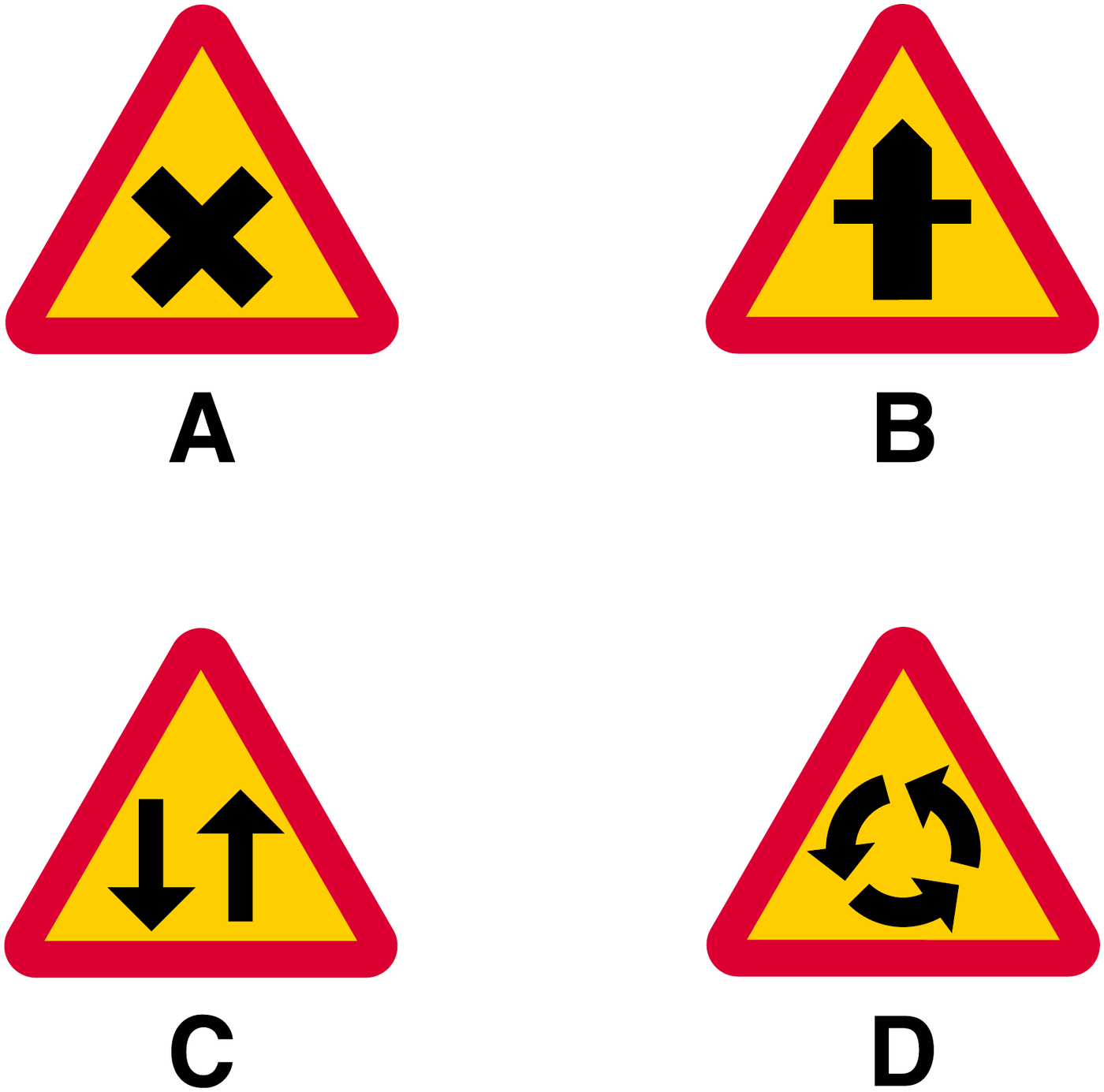
Which sign indicates that the right-hand rule applies?

Picture for question 55

Explanation

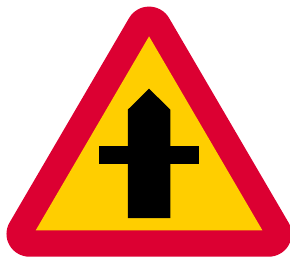
Junction (A28)
AJunctionA28

The sign indicates a junction where the provisions of Chapter 3, Section 18 of the Road Traffic Ordinance (1998:1276) apply.

Warning for a junction where road users on a connecting road are obliged to give way or stop (A29)
BWarning for a junction where road users on a connecting road are obliged to give way or stopA29

The sign indicates a junction where drivers of vehicles on connecting roads are obliged to give way or stop. The symbol is adapted to the conditions of the location.

Beware of two-way traffic ahead (A25)
CBeware of two-way traffic aheadA25

This sign indicates that a one-way road is turning into a road with traffic in both directions.

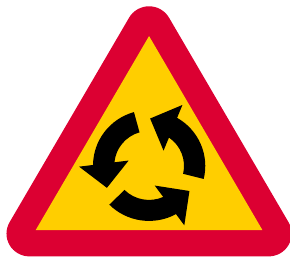
Roundabout ahead (A30)
DRoundabout aheadA30
Question 56

Which alternative is true?

Picture for question 56

Explanation

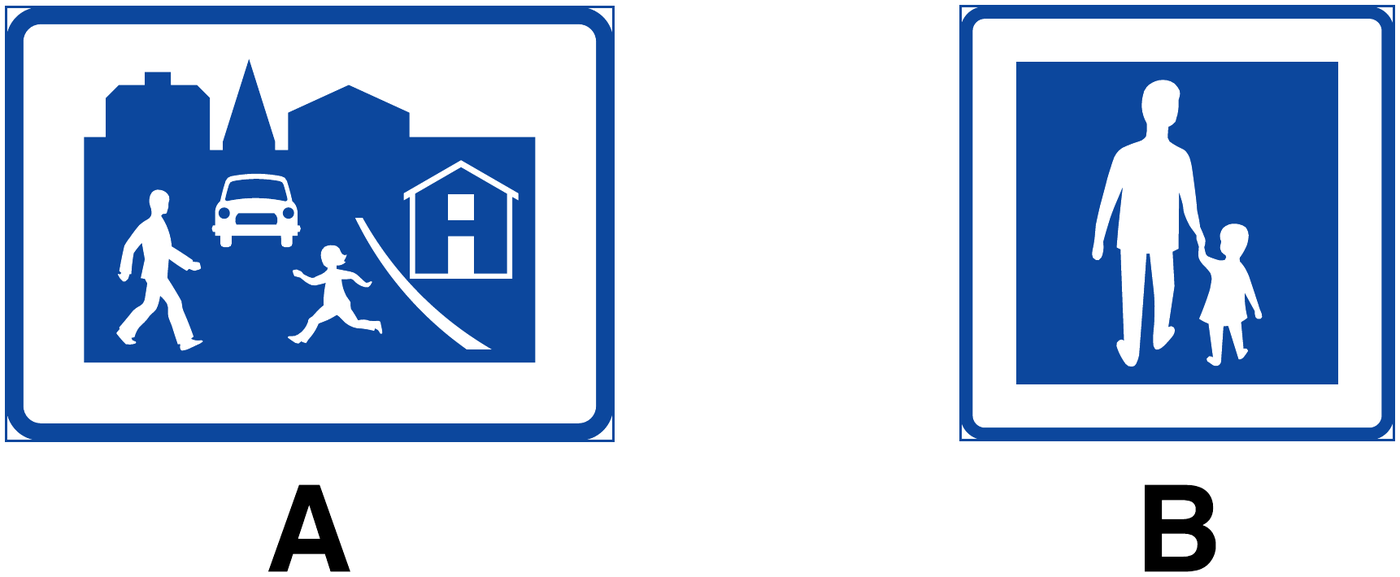
On a pedestrian street and in a home zone, the following applies. […] Vehicles may not be driven faster than walking speed.
Swedish Road Traffic Ordinance
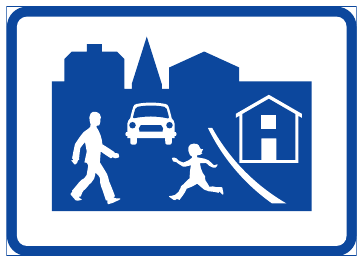
Home zone (E9)
AHome zoneE9
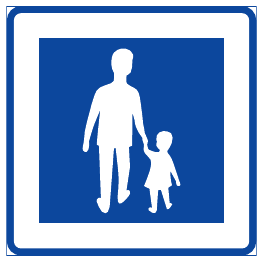
Pedestrian street (E7)
BPedestrian streetE7

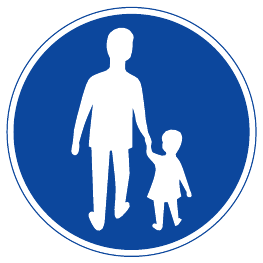
Note the difference between Pedestrian street (as used in the question) and Foot path (the sign below it).

Foot path (D5)
Foot pathD5

This sign indicates a path intended for pedestrians only.

Where Foot path (D5) has been posted, you are not allowed to drive.

Question 57

What do you think about the black car’s positioning on the road?

Picture for question 57

Explanation

Since it is daylight and the surrounding area is relatively open, it is good to drive close to the right edge. The cars behind can then more easily and safely overtake, while at the same time the margins for the oncoming vehicles are increased.

Question 58

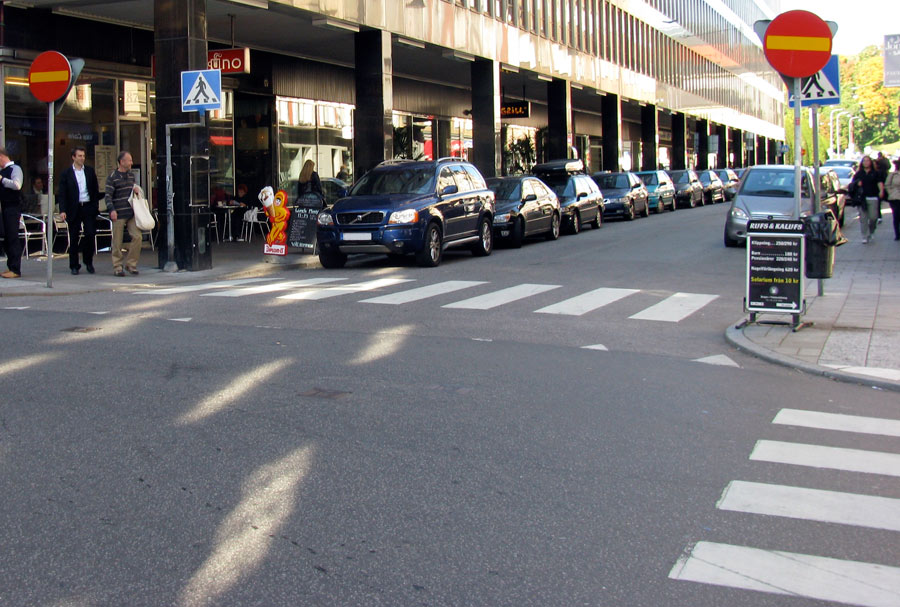
Are you allowed to reverse into the street ahead in order to park?

Picture for question 58

Explanation

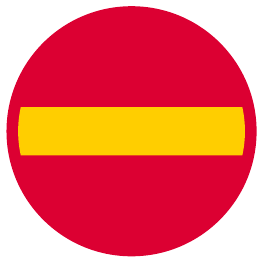
No entry (C1)
No entryC1

There are no exceptions for reversing.

Question 59

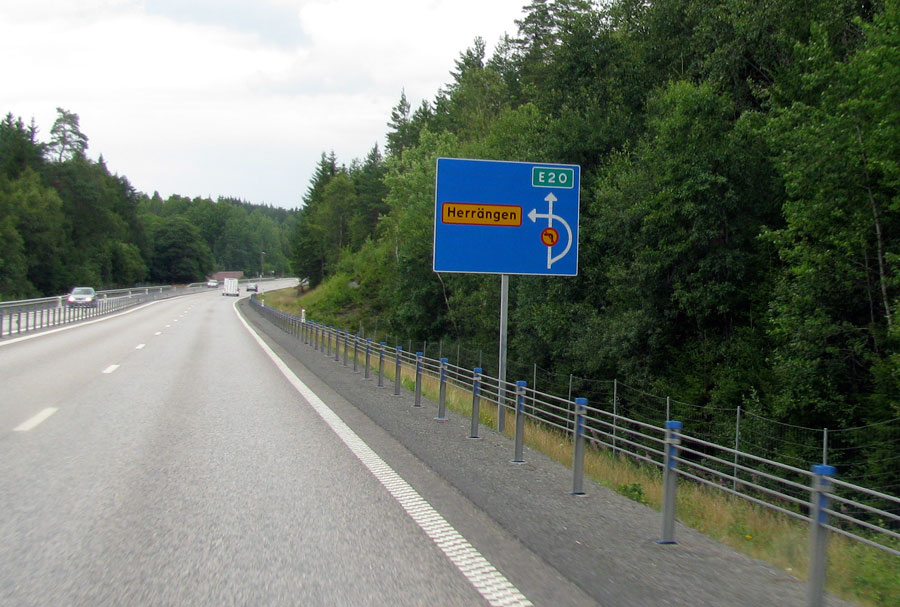
You are driving the car from which the picture is taken. May you turn off towards Herrängen in some way?

Picture for question 59

Explanation

This is a so-called Spanish turn, which means that you are allowed to turn off towards Herrängen, but that you must take the detour to the right and then cross the road. It is viewed as the safest option to cross the road rather than to make a left turn.

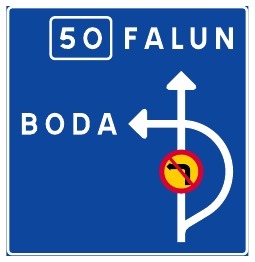
The following sign is probably erected beforehand:

Direction sign when junction turn is prohibited (F2)
Direction sign when junction turn is prohibitedF2

The sign provides preparatory information indicating that it is prohibited to turn in a junction, but that another direction can be chosen.

Question 60

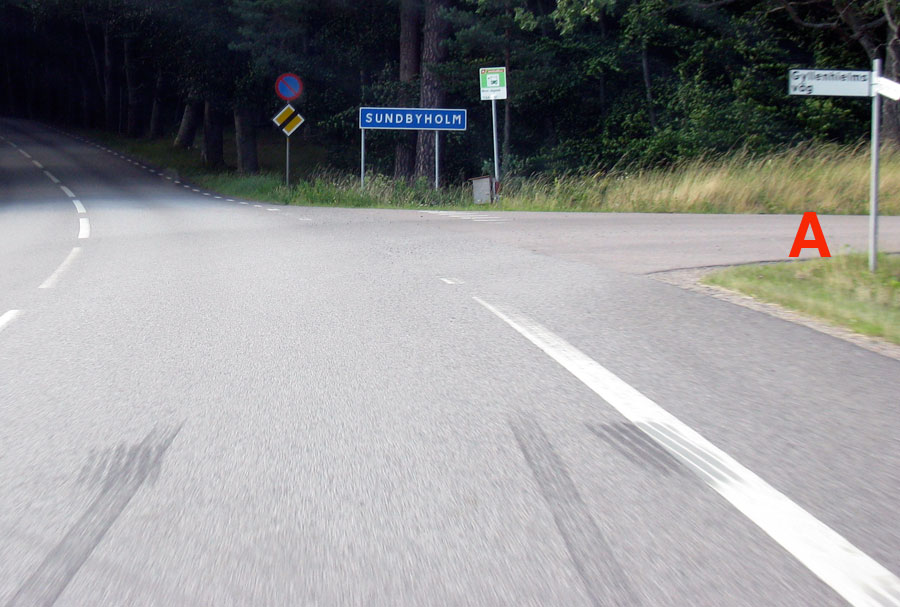
Is it true that the priority road ends before the junction with A?

Picture for question 60

Explanation

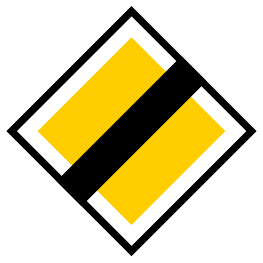
End of priority road (B5)
End of priority roadB5

Priority road signs are usually posted after a junction, but this does not matter in this case, as the question is asking whether the priority road ends. It only ends after the sign. As additional proof of this, there is a give way line at A:

Give way line (M14)
Give way lineM14

This marking indicates the line that a vehicle should not pass when the driver is observing the obligation to give way.

Question 61

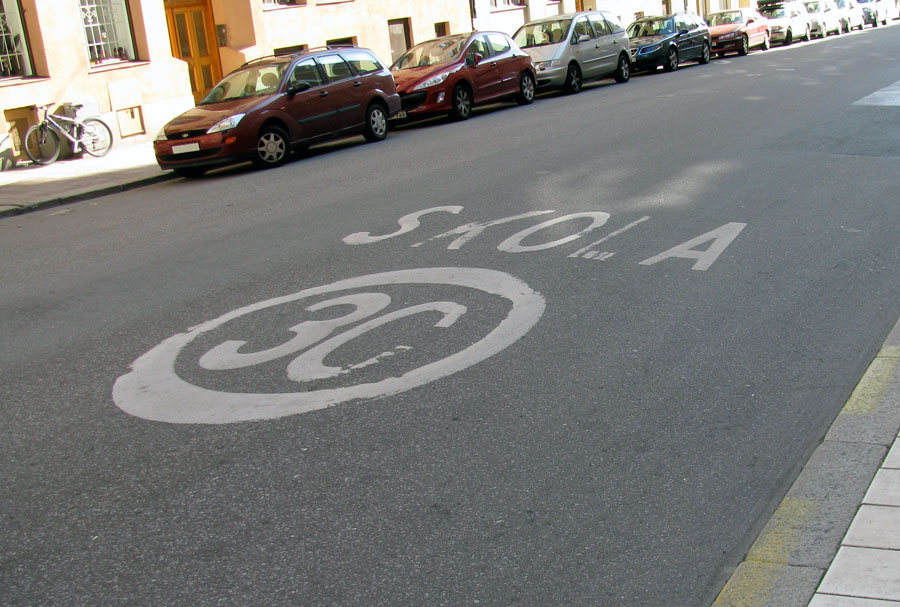
What do the road markings indicate?

Picture for question 61

Explanation

Skola
school
Information (M34)
InformationM34

The marking provides information, warning or instruction of importance to the road user.

Speed (M29)
SpeedM29

The marking indicates the maximum permitted speed.

The road markings themselves do not indicate that they only apply during certain times. If you only see the road markings, assume that they apply all days and times.

Question 62

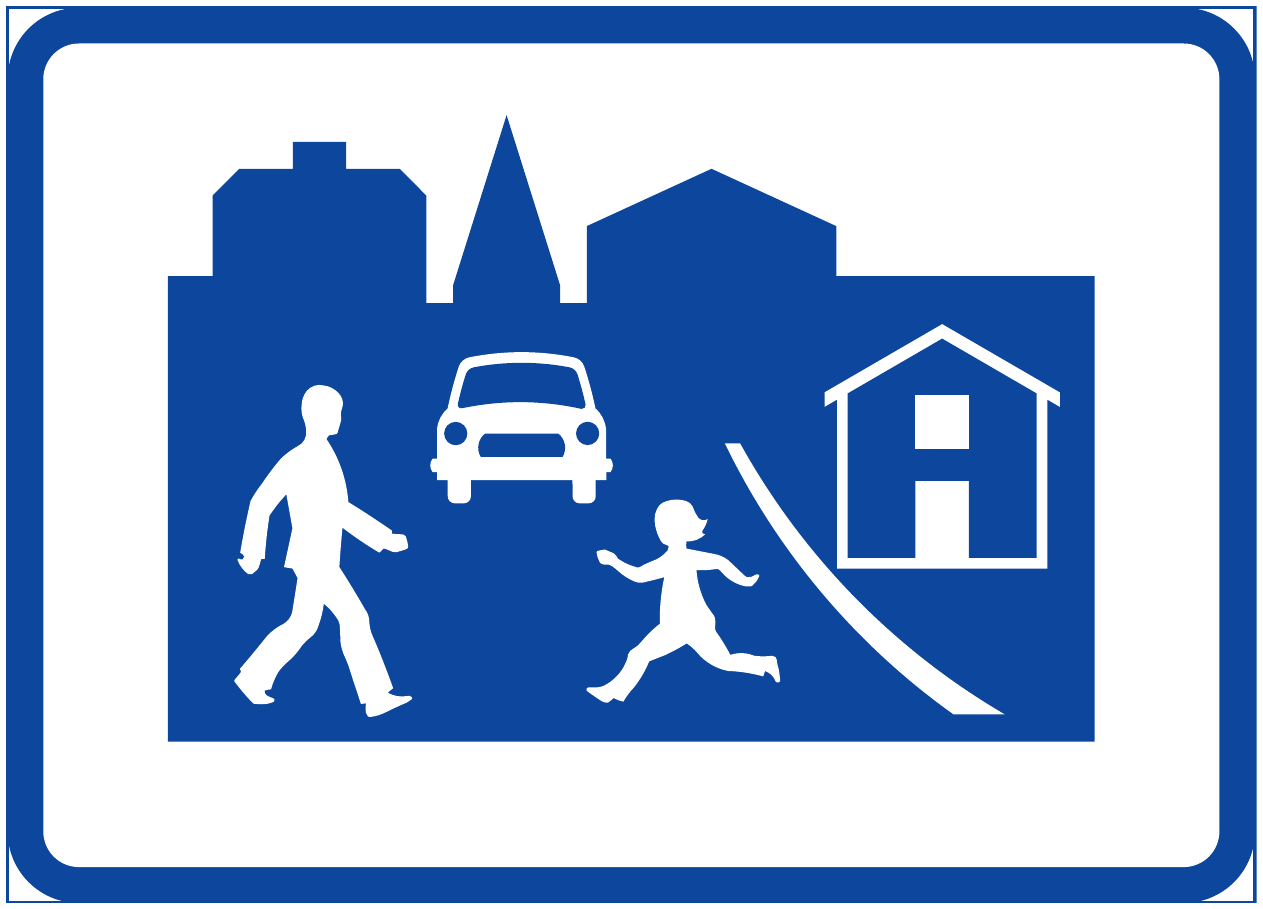
What rule applies within home zones?

Picture for question 62

Explanation

On a pedestrian street and in a home zone, the following applies.
  1. Vehicles may not be driven faster than walking speed.
  2. Vehicles may not be parked in any place other than specially designated parking spots.
  3. Vehicle drivers must give way to pedestrians.
Swedish Road Traffic Ordinance
Question 63

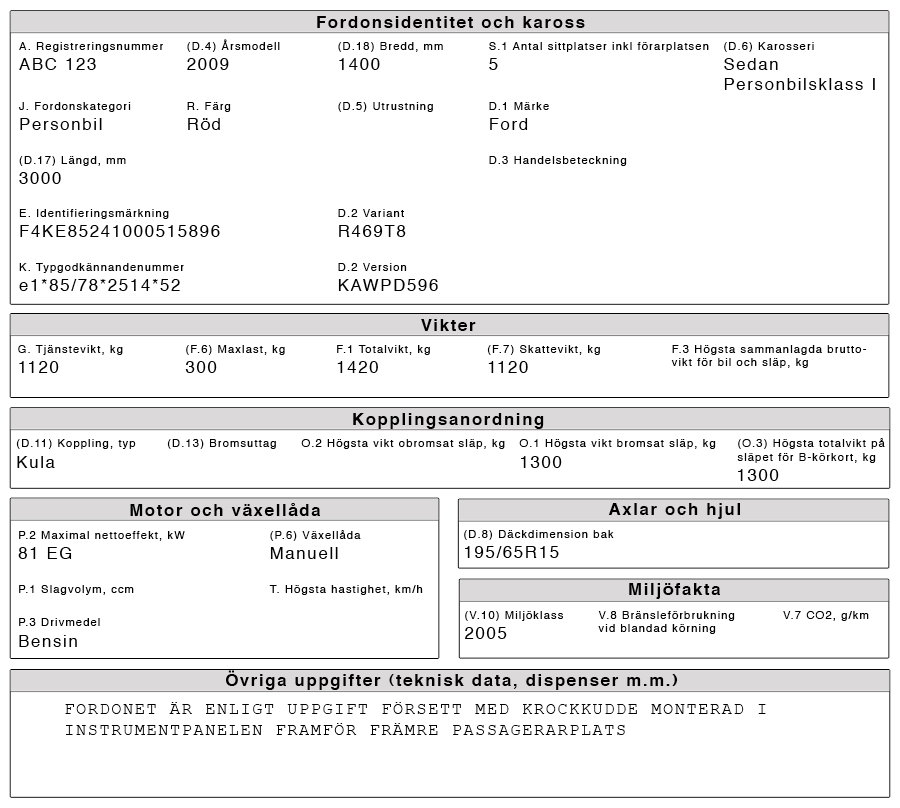
What is the maximum number of passengers you may bring in the car?

Picture for question 63

Explanation

The registration certificate states that there are 5 seats (S.1). This includes the driver’s seat.

In other words, the car may carry 1 driver and 4 passengers.

A person travelling with a means of transportation that they are not driving.
Nationalencyklopedin, on passengers
Question 64

How long before departure should you preheat the engine if the outside temperature is −20 °C?

Explanation

Connect the heater for one and a half hours if the temperature is below −15°.
Swedish Transport Administration
Question 65

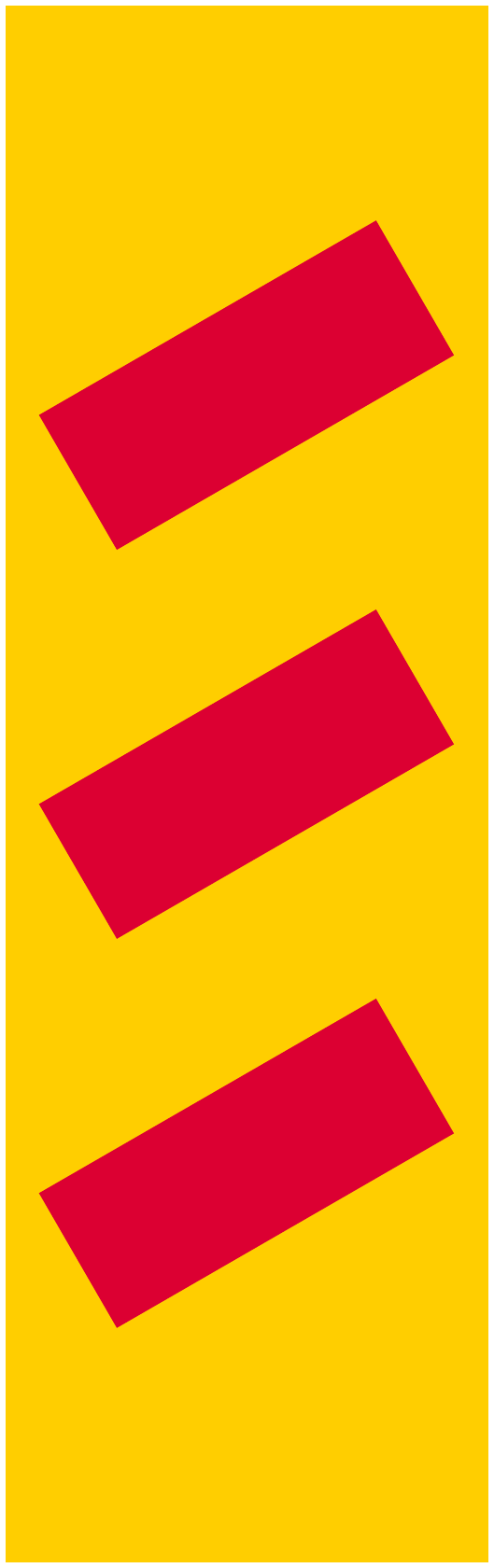
What does this road sign mean?

Picture for question 65

Explanation

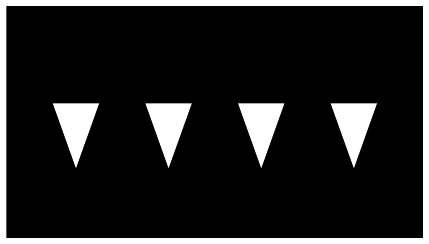
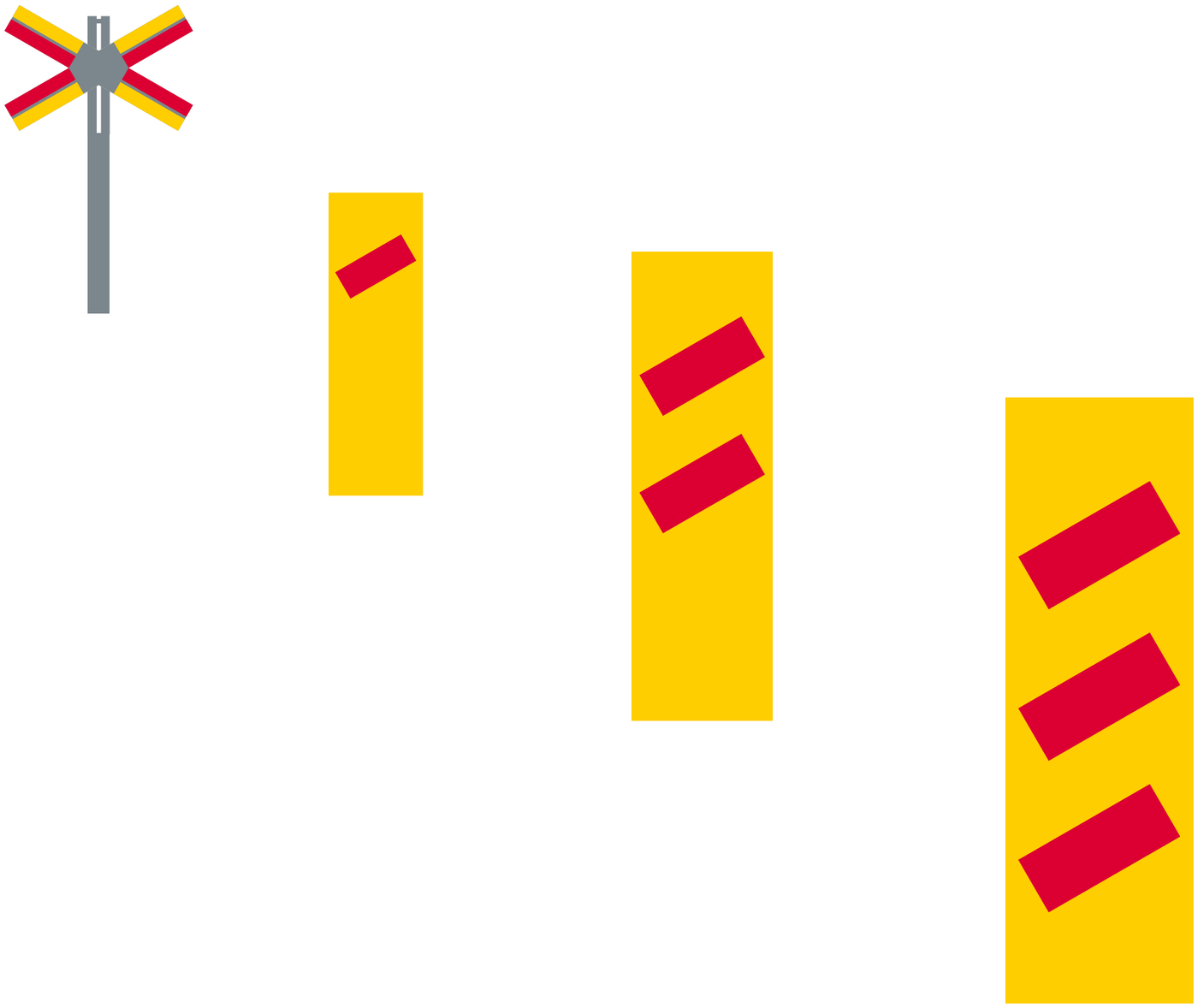
Distance to level crossing (A38)
Distance to level crossingA38

The signs indicate the distance to a level crossing in a three-bar system. The sign with the three bars is, except for in densely populated areas, erected under one of the following signs; A35, Level crossing with gates, A36, Level crossing without gates, or A37, Junction with tramway line. The sign with two bars indicates that it is two-thirds the distance to the level crossing and the sign with one bar indicates the last third of the distance.
Illustration
Question 66

Is it true that a vehicle registration plate, or number plate, always has three letters and three digits?

Explanation

Since 2019, the last character on a number plate can be a letter. Example: ABC 12A.
Also, there are personalised number plates:

The number plate shall have no less than two and no more than seven characters with a blank space counting as one character. The combination of characters may consist of digits or letters – or of both digits and letters. You may use all the letters of the alphabet.
Swedish Transport Agency

Also note that if the number plate is personalised, the car still has its original vehicle registration number (e.g. ABC 123).

Question 67

What does this road sign mean?

Picture for question 67

Explanation

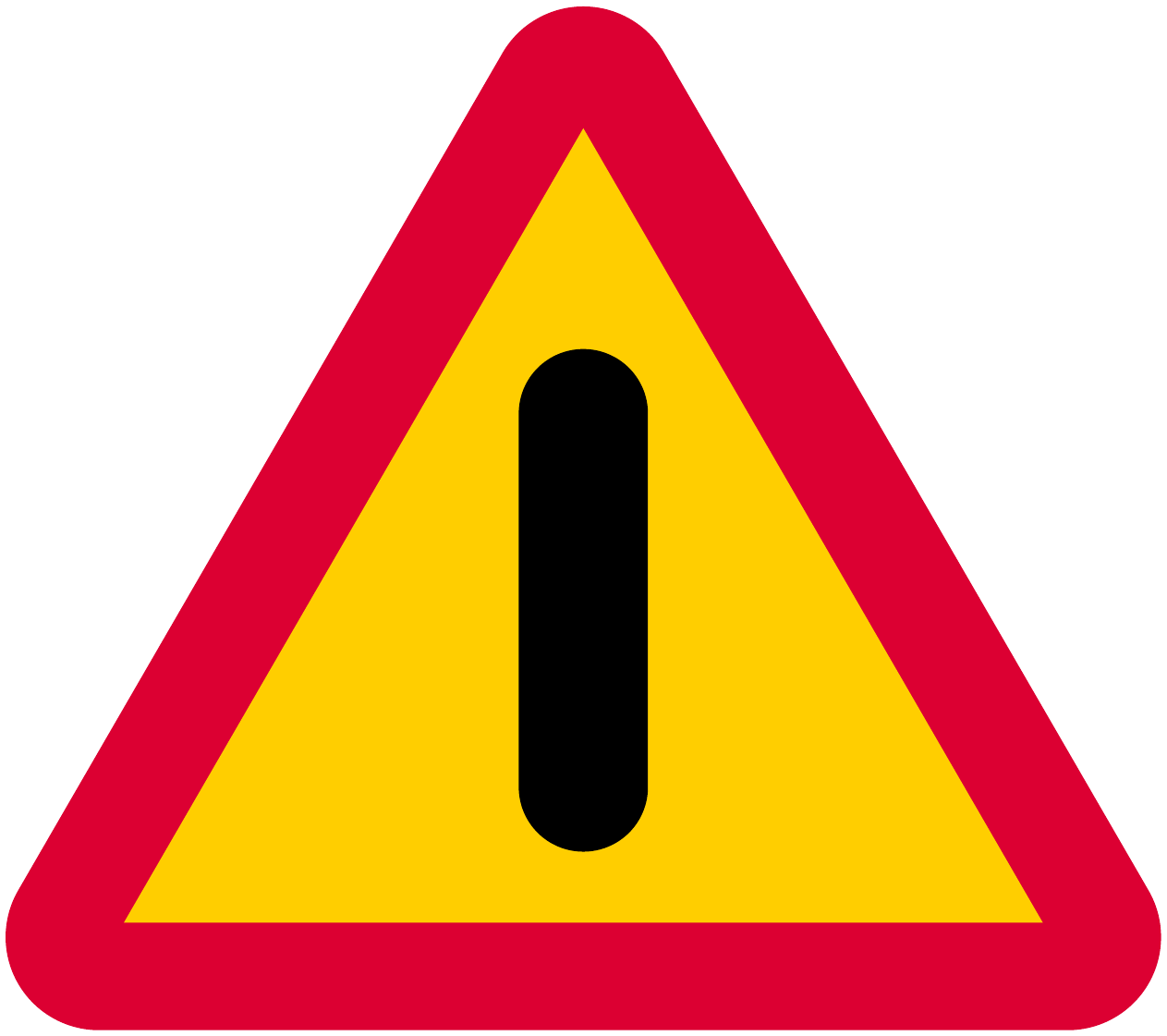
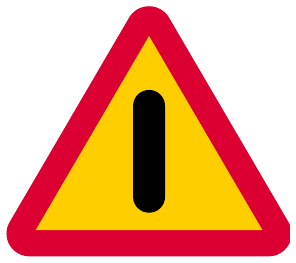
Other dangers (A40)
Other dangersA40

The sign indicates dangers other than such that can be indicated with some other warning sign. The nature of the danger is specified on an additional panel.

Question 68

What does this road sign mean?

Picture for question 68

Explanation

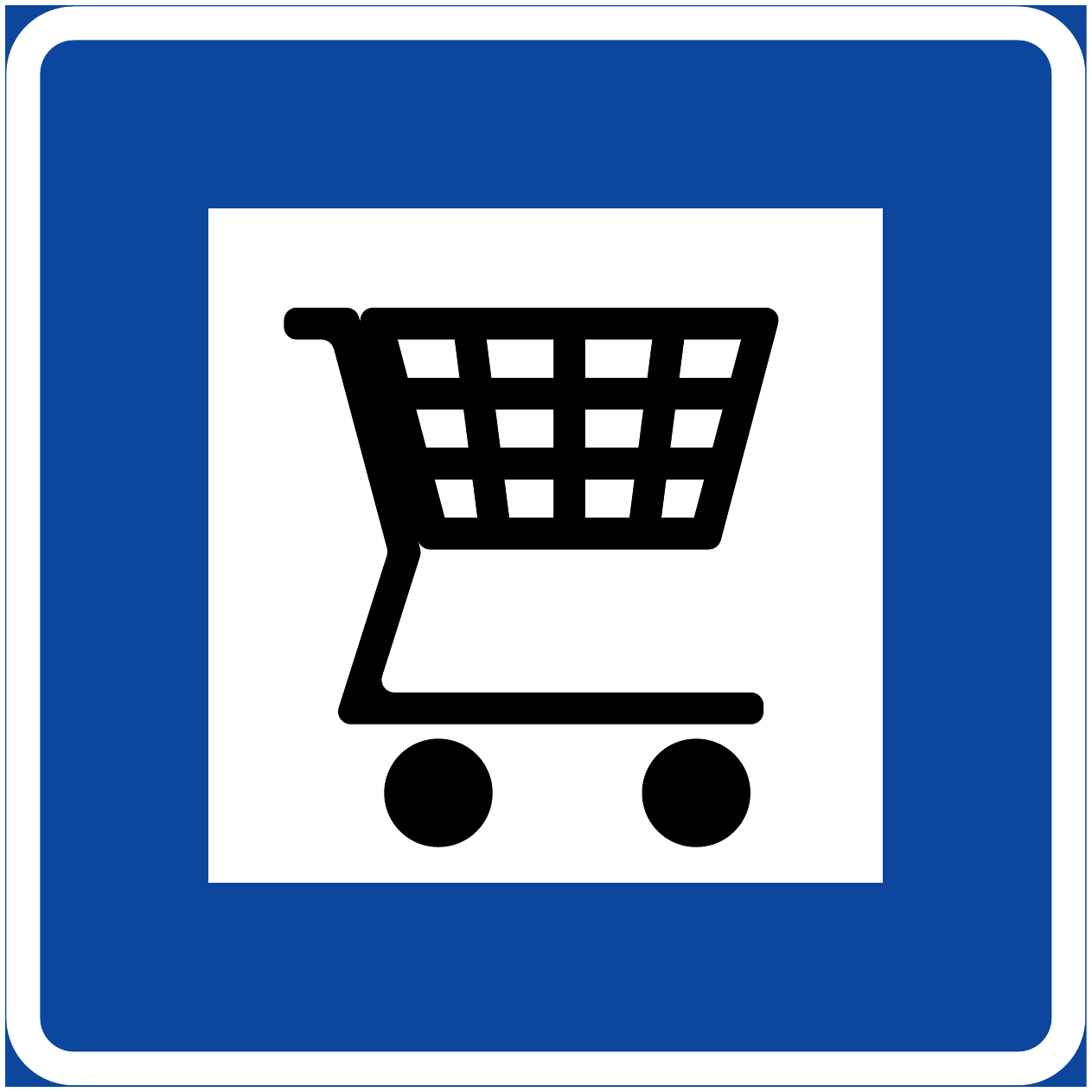
Commercial area (G10)
Commercial areaG10

The sign indicates an area for commerce.

Question 69

In how many per cent of the fatal single-vehicle accidents is the driver intoxicated?

Explanation

Half of the fatal single-vehicle accidents are linked to alcohol.
Swedish Transport Administration
Question 70

Is it true that a person’s gender and body weight have an impact on how intoxicated they will get from a certain amount of alcohol?

Explanation

A number of factors come into play: how much you weigh, your health, whether you are a man or a woman.
Driving Licence Book, 19th Edition, page 210
Women are often smaller than men, which means they have a lower tolerance of alcohol as the alcohol is distributed over a smaller body volume. But even if a man and a woman weigh the same, the woman will have a lower alcohol tolerance than the man. Part of the explanation for this is that the man’s body has a lower proportion of fatty tissue and a higher proportion of water.
The Swedish Council for Information on Alcohol and Other Drugs

No questions to show here.