Swedish driving licence · Theory practice

Theory test 16

29 August 2021 · 14:28 · 70 questions

0%correct
Not started

0 of 70 correct

Pick an answer to check it. 56 of 70 correct (80%) is needed to pass.

0Answered
0Correct
0Incorrect
56Needed to pass

The real test has 70 questions in 50 minutes, about 43 seconds per question.

0 / 70
Question 1

What level of auditory acuity do you need to be issued with a category B licence?

Explanation

There is no hearing requirement. Did you have to take a hearing test in connection to the application for a learner’s permit?

The only requirement made is on your vision.
Question 2

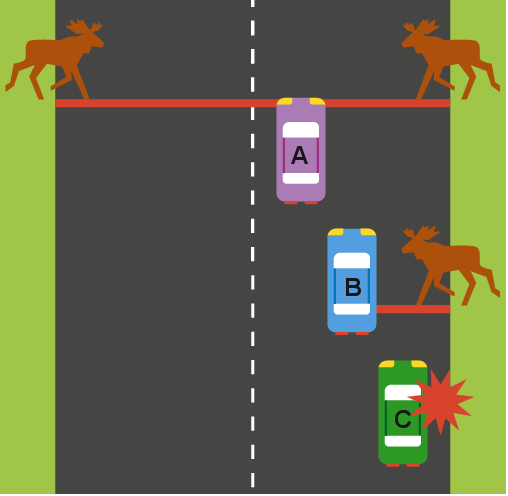
Approximately how many wildlife accidents occur in Sweden each year?

Explanation

In 2019 there were 64,930 wildlife accidents according to National Wildlife Accident Council.

Question 3

The picture is taken from the car you are driving. How should you act if you want to turn right?

Picture for question 3

Explanation

The problem is that the traffic signal appears to be not working (otherwise there would be some colour showing). It is then the road sign that applies. Stopping and waiting for the signal to start working may take several days!

The last option sounds good, but you are indirectly saying that you can drive out without stopping first, which is wrong.

Question 4

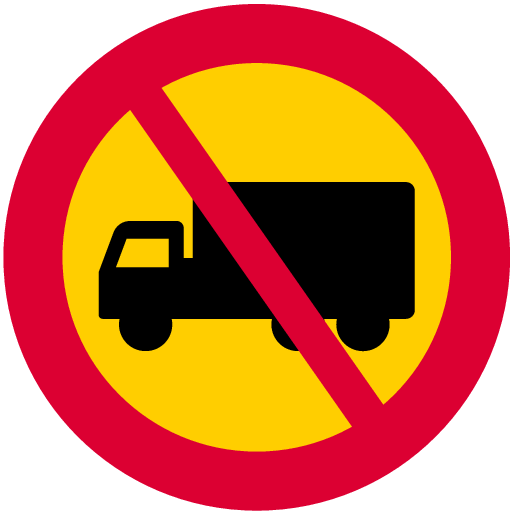
What does this road sign mean?

Picture for question 4

Explanation

No heavy trucks
No heavy trucks

“If the prohibition also applies to light trucks, this is indicated on an additional panel.”

In many cases, light trucks do not weigh more than a heavy car with a trailer. It is therefore only in exceptional cases that the sign also refers to light trucks.

Question 5

Where can the obligatory roadworthiness test be carried out?

Explanation

As of 1 July 2010, Bilprovningen no longer has a monopoly on car inspections. This means that the obligatory inspection can be carried out by the approved inspection company of your choice.

Question 6

What is a flying overtake?

Explanation

“A flying overtake [...] means that you pass a vehicle at high speed that you already decided to overtake from a long distance behind.”

Du och jag i trafiken [You and me in traffic], 28th Edition, page 250
Question 7

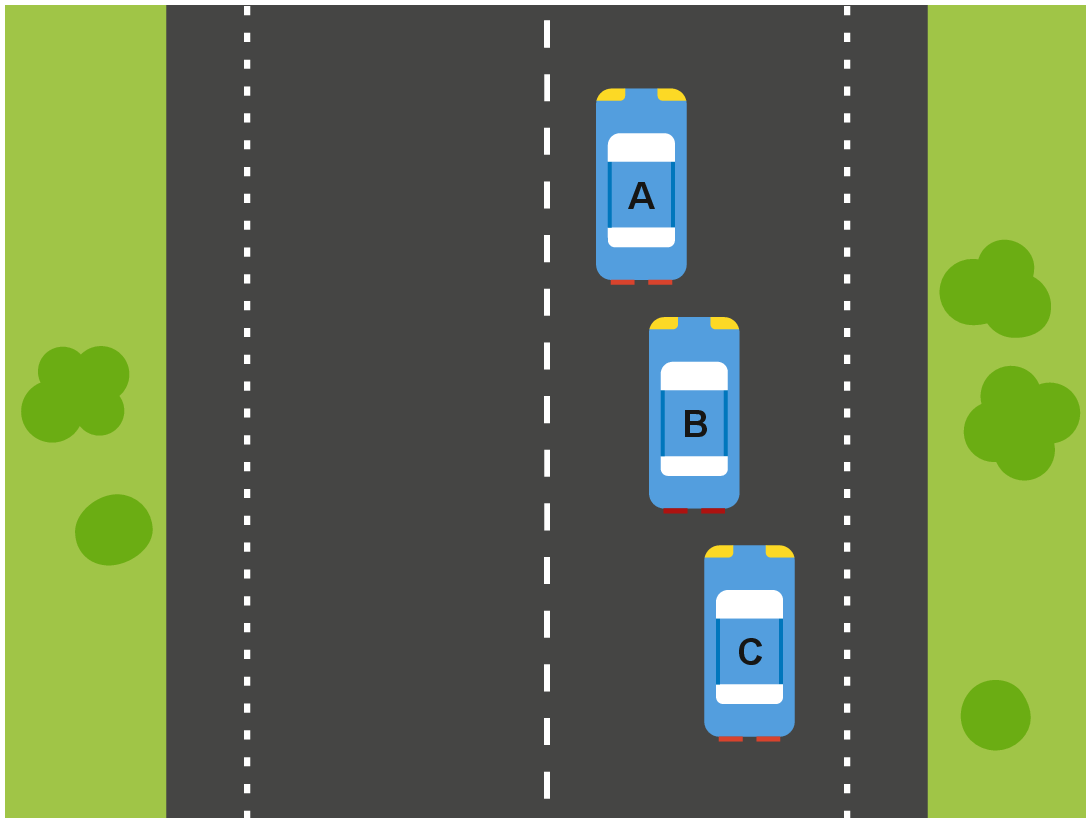
You are driving in lane A. Can you move into B in order to, for example, overtake?

Picture for question 7

Explanation

Warning line and solid line (M11)
Warning line and solid lineM11

“This marking is used where it is not permitted for a vehicle on the side of the solid line to change lanes. The marking can also be used to indicate an oncoming solid line on the side where there is a warning line.”

Since the line is not solid on your side, you can cross it.

But when I change back, I then have to cross the solid line?

– Yes, but there is an exception for this. You may cross the solid line if “in the direction the vehicle is travelling there is a broken line immediately to the right of the solid line.” (Swedish Road Traffic Ordinance)

Note “in the direction the vehicle is travelling”. Despite the fact that you are over in the oncoming, the broken line still runs to the right of the right of the solid line when viewed from your perspective.

Question 8

Can coffee reduce tiredness?

Explanation

“In this study, coffee was shown to to have a slightly better effect on alertness and driving than a short nap – it took 30 minutes to kick in and the effect was clearly visible for another hour. The maximum effect is likely obtained by combining the two methods (Reyner and Horne, 1999). A number of other studies have shown that 100–200 mg caffeine (2–3 cups of coffee) would consistently improve the alertness in sleepy test subjects (Lumley et. al., 1987; Lorist et. al., 1994).”

Institute for Psychosocial Medicine and Karolinska Institutet/Swedish Transport Administration

Some people are taught that coffee is very bad and of no use. This is not true. Coffee often gives a kick that keeps the tiredness away for a while. However, the best thing is always to sleep longer.

Question 9

What is the first thing you should do if you arrive at the scene of an accident?

Explanation

“Begin by surveying the scene of the accident and prioritising what should be done first.”

Driving Licence Book, 19th Edition, page 257

What are the alternatives to surveying first?

  • Warn first – if it is a desolate road and the car in the accident is not dangerously positioned, you surely do not need to warn anyone? You therefore assess (survey) whether you need to warn anyone as your first action.
  • Call 112 first – the person answering will ask where the accident has occurred and how the injuries look. It is thus better to have these answers ready so that you do not say that three people are injured when it is actually seven.
  • Help/live-saving measures first – if you immediately attend to the first person you see, you maybe miss others with much more serious injuries. It is therefore best to survey the scene first.

This is general advice. Situations can of course arise where it is more appropriate to follow another order. As the question is generally posed (there are no special circumstances), you should assume that the general recommendations are correct.

Question 10

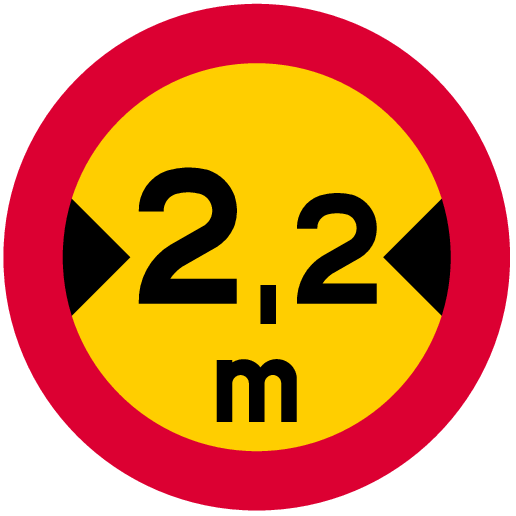
What does this road sign mean?

Picture for question 10

Explanation

Restricted vehicle width (C16)
Restricted vehicle widthC16

“The sign indicates that traffic with vehicles over a certain width is prohibited. The greatest permitted width is indicated on the sign.”

Question 11

Approximately how many people are seriously injured in Swedish traffic each year?

Explanation

Year Seriously injured

2017 2,235

2018 2,195

2019 1,951

Note that there is a similar question that asks for the total number of injured.

Question 12

What is the function of a belt tensioner?

Question 13

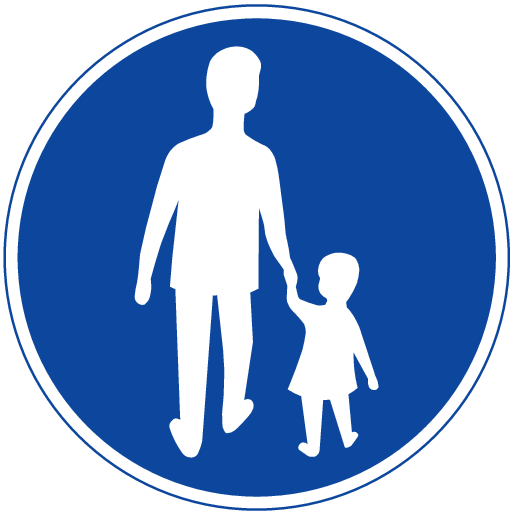
You are driving a heavy cargo for a friend. Before you reach their house, you see this sign. What rule applies?

Picture for question 13

Explanation

Foot path (D5)
Foot pathD5

“This sign indicates a path intended for pedestrians only.”

Note that D5 does not signify the same thing as E7. Pedestrian street:

Pedestrian street (E7)
Pedestrian streetE7

“The sign indicates that the provisions of Chapter 8, Section 1 of the Road Traffic Ordinance (1998:1276) apply. Any prohibition on driving vehicles that are permitted on a pedestrian street according to Chapter 8, Section 1, second paragraph of the Road Traffic Ordinance is indicated using an additional panel.”

Where E7 is posted, you are normally allowed to enter in order to unload cargo.

Question 14

Could it be acceptable to travel 9 people in a private car?

Explanation

“A private car [...] A car equipped with no more than eight seats in addition to the driver’s seat.”

Act on road traffic definitions

8 passengers + 1 driver = 9 people travelling.

Question 15

You are driving on a country road and want to use a parking space further ahead. Which of the following statements is true?

Explanation

“A driver who intends to stop or quickly reduce their speed shall indicate their intention using the brake lights. […] This indication shall be given in good time before the intended manoeuvre and be clearly visible and unmistakable. The indicating shall stop as soon as the manoeuvre is completed.”

Swedish Road Traffic Ordinance
Question 16

What is true regarding trailers and parking brakes?

Explanation

“On trailers with an unladen weight of over 400 kg, there must also be a parking brake.”

Driving Licence Book, 19th Edition, page 247
Question 17

Can you be charged with aggravated drunk driving even if your blood alcohol was under the legal limit?

Explanation

“You can be charged with aggravated drunk driving even if the alcohol concentration in your blood is less than 1.0 per mille. The reason for this may be that your driving has entailed a significant risk of causing an accident, or that an accident has occurred.”

Driving Licence Book, 19th Edition, page 209
Question 18

Which is the most important reason for banning studded tyres?

Explanation

All the alternatives are true to some extent. However, the “most important reason”, which is what the question is asking for, is the health aspect:

“The dangerous aspect is the impact on health [...] Particles in the outdoor air has a negative impact on our health. They irritate the airways and contribute to deteriorating different lung diseases, such as asthma and chronic obstructive pulmonary disease (COPD). […] If we reduce the proportion of studded tyres, it increases the conditions for a better air quality, health and quality of life. It probably also leads to lower medical costs.”

Swedish Transport Administration

“The background to the proposal is that the studded tyres, according to the government, increases the wear on the roads and thereby releases particles that are then inhaled by humans. This can in turn be linked to cardiovascular disease and other health issues linked to the airways.”

MHF
Question 19

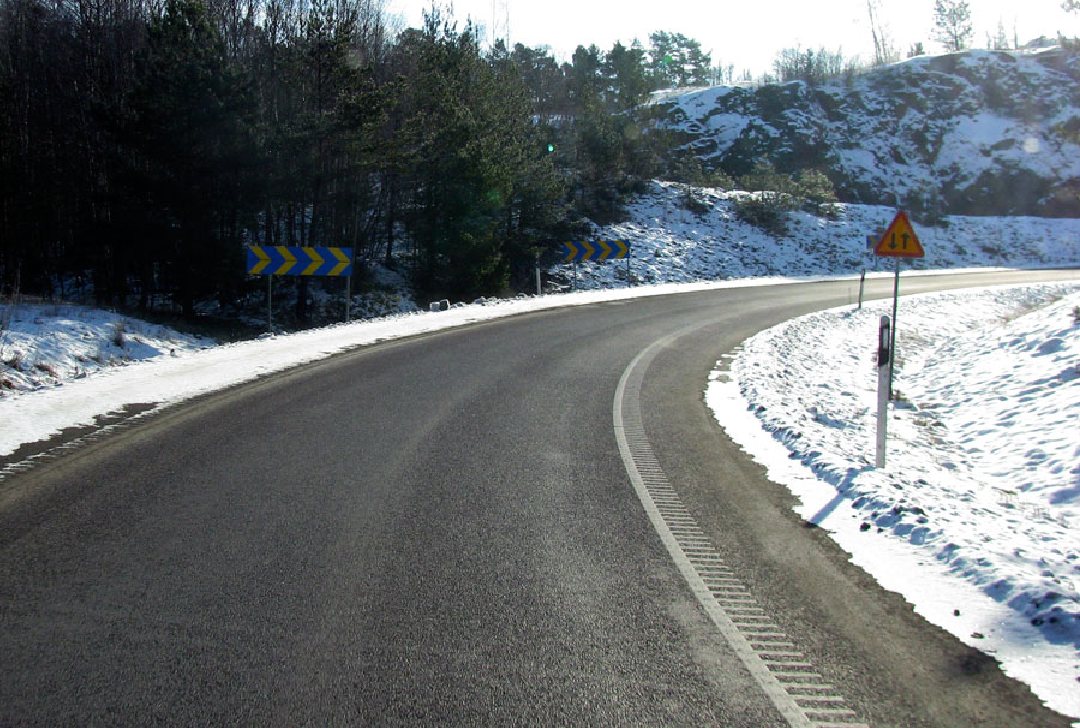
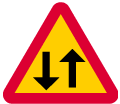
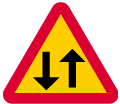
What does the warning sign on the right indicate to be beware of?

Picture for question 19

Explanation

Beware of two-way traffic ahead (A25)
Beware of two-way traffic aheadA25

“This sign indicates that a one-way road is turning into a road with traffic in both directions.”

Question 20

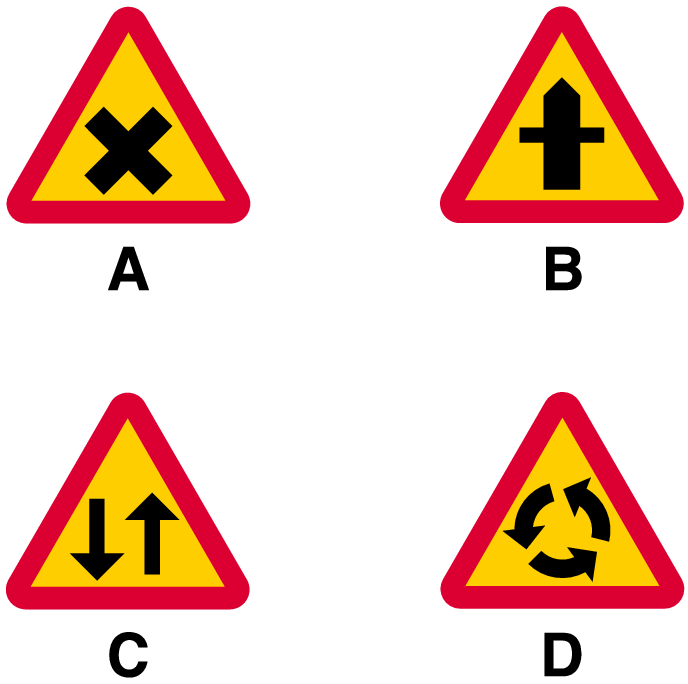
Which of these signs warns you of a junction?

Picture for question 20

Explanation

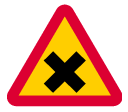
A: Junction (A28)
AJunctionA28

“The sign indicates a junction where the provisions of Chapter 3, Section 18 of the Road Traffic Ordinance (1998:1276) apply.”

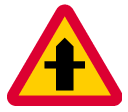
B: Warning for a junction where road users on a connecting road are obliged to give way or stop (A29)
BWarning for a junction where road users on a connecting road are obliged to give way or stopA29

“The sign indicates a junction where drivers of vehicles on connecting roads are obliged to give way or stop. The symbol is adapted to the conditions of the location.”

C: Beware of two-way traffic ahead (A25)
CBeware of two-way traffic aheadA25

“This sign indicates that a one-way road is turning into a road with traffic in both directions.”

D: Roundabout ahead (A30)
DRoundabout aheadA30
Question 21

When are these markings used?

Picture for question 21

Explanation

Give way line (M14)
Give way lineM14

“This marking indicates the line that a vehicle should not pass when the driver is observing the obligation to give way.”

Question 22

Which statement is true regarding catalytic converters?

Explanation

“The catalytic converter turns [...] into mainly carbon dioxide and water. The carbon dioxide emissions is a problem that can currently only be solved through a reduced fuel consumption.”

Driving Licence Book, 19th Edition, page 225
Question 23

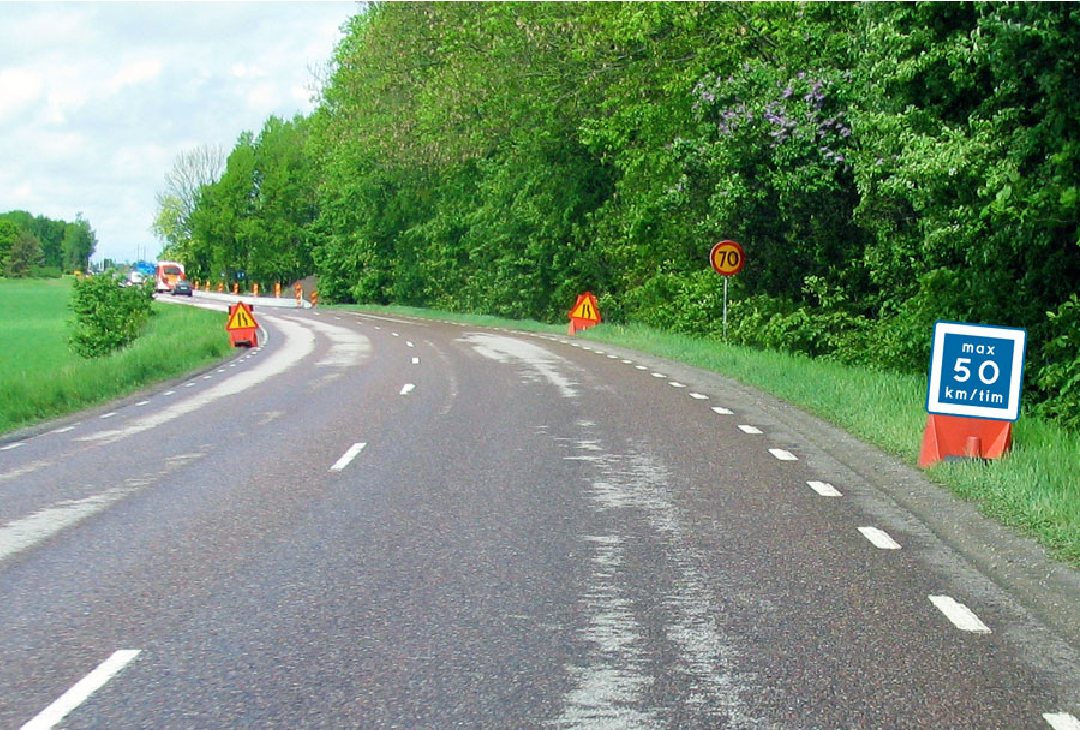
Which is the maximum permitted speed after the signs indicating a road narrowing from both sides?

Picture for question 23

Explanation

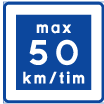
Recommended lower speed (E11)
Recommended lower speedE11

“The sign indicates a stretch of road or an area where specific measures have been taken or where conditions are such that it is advisable to drive at a lower speed than the maximum permitted speed. The recommended lower speed is indicated on the sign.”

In the quote above, note the wording “lower speed than the maximum permitted speed”. This means that the maximum permitted speed is determined by the regular speed sign, i.e. 70 km/h in this case.

But do I not have to drive slower than 70 km/h if, for example, there are road workers near the road?

– Yes, however, “the maximum permitted speed” (which is the subject of the question) should be interpreted as “how fast are you allowed to drive at the very most under perfect conditions”. This particular question does not relate to making an assessment, but simply to understanding the sign.

Question 24

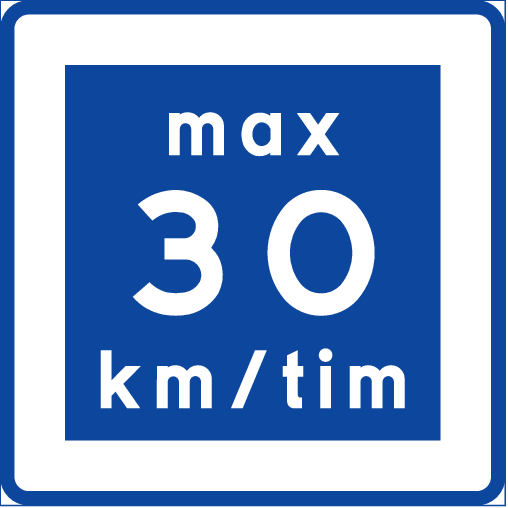
Is it permitted to drive 40 km/h within an area where this sign is placed?

Picture for question 24

Explanation

Recommended lower speed (E11)
Recommended lower speedE11

“The sign indicates a stretch of road or an area where specific measures have been taken or where conditions are such that it is advisable to drive at a lower speed than the maximum permitted speed. The recommended lower speed is indicated on the sign.”

Note the words “advisable” and “recommended”. These words signify that this action is not compulsory. If it would have been compulsory to stay under 30 km/h, what then is the difference between this sign and a regular round speed sign (C31)? Nothing in that case, which would mean that E11 is completely unnecessary.

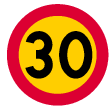
Speed limit (C31)
Speed limitC31

“The sign indicates that it is prohibited to drive a vehicle faster than the speed indicated on the sign.”

Therefore:

  • E11 (square blue/white) = it is not advisable to drive faster, but you may do so (but not faster than the road’s regular speed limit).
  • C31 (round yellow/red/black) = it is illegal to drive faster.
Question 25

When reversing, you have hit and damaged a bicycle in a bicycle stand. What should you do?

Explanation

“If there has been damage to property and there is no-one around to receive information, the road user shall promptly notify the person who suffered the damage or the police.”

Swedish Road Traffic Ordinance
Question 26

What increases the risk of aquaplaning?

Explanation

Review of the options:

  • Even and smooth road.
    – Lowers the risk, since no deep collection of water can build up on a smooth road.
  • Narrow tyres.
    – Lowers the risk: the narrower the tyres, the smaller the surface that can lift the car on top of the water.
  • Low speed.
    – Lowers the risk, as the tyres have more time to sink down into the water. High speed is required for water skiing, and the same is true for aquaplaning.
  • Worn tyres.
    – Increases the risk, as the pattern of a warn tyre does not divert the water effectively.
Question 27

You are driving on a country road under no particular circumstances. How should you act when being overtaken?

Explanation

“When a driver travelling on a road becomes aware that someone is intending to overtake them on the left, they shall keep as far to the right as possible.”

Swedish Road Traffic Ordinance

Reducing your speed is something you should only do in exceptional cases. If you reduce your speed at every overtaking, you will disrupt the flow of traffic and also increase your emissions, as you have to accelerate to the right speed again each time.

Question 28

Which alternative does not describe economic driving?

Explanation

Hard braking means that you “waste” the speed you have built. It is better to adapt your driving so that you do not have to brake hard.

Question 29

What type of accident results in most fatalities?

Explanation

Accident type Number of deaths (2019)

Head-on 47

Overtaking 3

Catching up (from behind) 10

Turning off 9

Junction 16

Single vehicle – highest death rate 59

Bicycle and moped 11

Pedestrians 25

Roe deer and deer 1

Moose 6

Reindeer 0

Rail/tracks 4

Other issues 32

TOTAL 223

Question 30

What is the maximum total width of a vehicle driving on a public road?

Explanation

“If [...] the vehicle’s width, including load, exceeds 260 centimetres, [...] the vehicle or a vehicle coupled to this may only be driven on a private road.”

Swedish Road Traffic Ordinance
Question 31

What does this signal mean?

Picture for question 31

Explanation

Red cross (SIG12)
Red crossSIG12

“The lane and where applicable the hard shoulder by the lane may not be used for traffic.”

Question 32

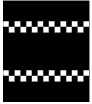
You are driving on a two-way road. Where would you see this verge post?

Picture for question 32

Explanation

“Along a two-way road, verge posts for each direction shall display rectangular reflectors on the right side of the road and round reflectors on the left side.”

Swedish Transport Administration

On the right side, there is a post with rectangular reflectors.

Question 33

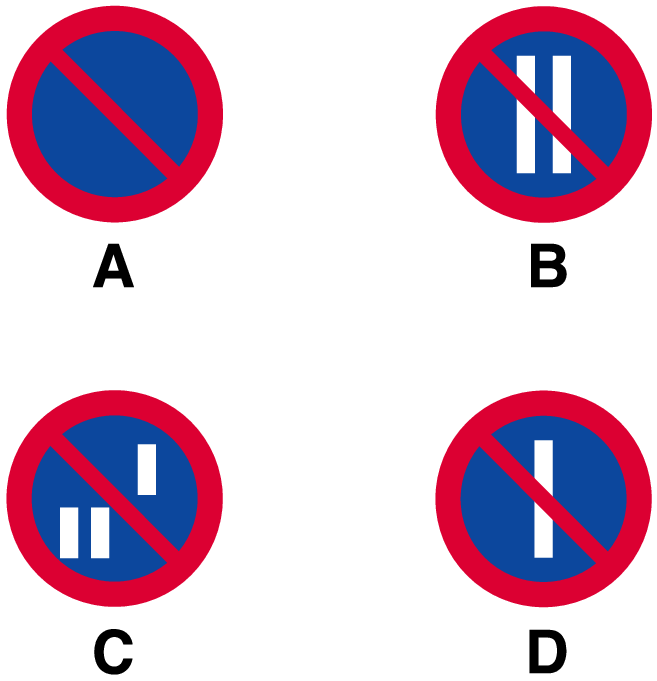
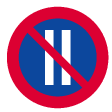
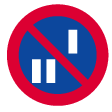
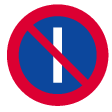
Which of these signs indicate a parking prohibition?

Picture for question 33

Explanation

A: Vehicle parking is prohibited (C35)
AVehicle parking is prohibitedC35

“The sign indicates it is prohibited to park a vehicle. The directions apply on the side of the road where the sign is posted.”

B: Vehicle parking is prohibited on even-numbered dates (C37)
BVehicle parking is prohibited on even-numbered datesC37

“The more detailed provisions relating to sign C35, Vehicle parking is prohibited, also apply to this sign.”

C: Date parking (C38)
CDate parkingC38

“The sign indicates that it is prohibited to park vehicles on days with even-numbered dates on the side of the road that has even-numbered addresses and on days with odd-numbered dates on the side of the road that has odd-numbered addresses. The more detailed provisions relating to sign C35, Vehicle parking is prohibited, also apply to this sign.”

D: Vehicle parking is prohibited on odd-numbered dates (C36)
DVehicle parking is prohibited on odd-numbered datesC36

“The more detailed provisions relating to sign C35, Vehicle parking is prohibited, also apply to this sign.”

Question 34

Can you be sure that your blood alcohol level is low enough to drive by using your own breathalyser?

Explanation

“A breathalyser can tell you your blood alcohol level, but many of the most common devices on the market give an incorrect result. This has been shown in laboratory tests of eight common consumer models.”

Testfakta

Nearly half the breathalysers tested by MHF failed: http://www.mhf.se/sv-SE/sakrare-i-trafiken/bast-pa-alkolas-alkomatare/alkomatare/

Question 35

Is there any situation where you may station your car two metres before a pedestrian crossing?

Explanation

If you are giving way to someone crossing, you may of course remain stationary close to the pedestrian crossing. This is perhaps one of the most common traffic situations. Another example is if you need to remain stationary before a pedestrian crossing to avoid danger.

The prohibition in this regard refers to parking, not being stationary.

Is this not an unnecessary catch question?

– No, it is important to be aware of this in order to be a good and safe driver. For example, if the traffic situation requires you to remain stationary in your car before a pedestrian crossing, as a safe driver, you can calmly stay where you are to analyse the situation. A driver who is not aware of this rule may panic and think “I have to move my car because I’m not allowed to stand here!” Such a driver may make an unexpected manoeuvre to get away from the crossing and thereby make the situation worse.

Question 36

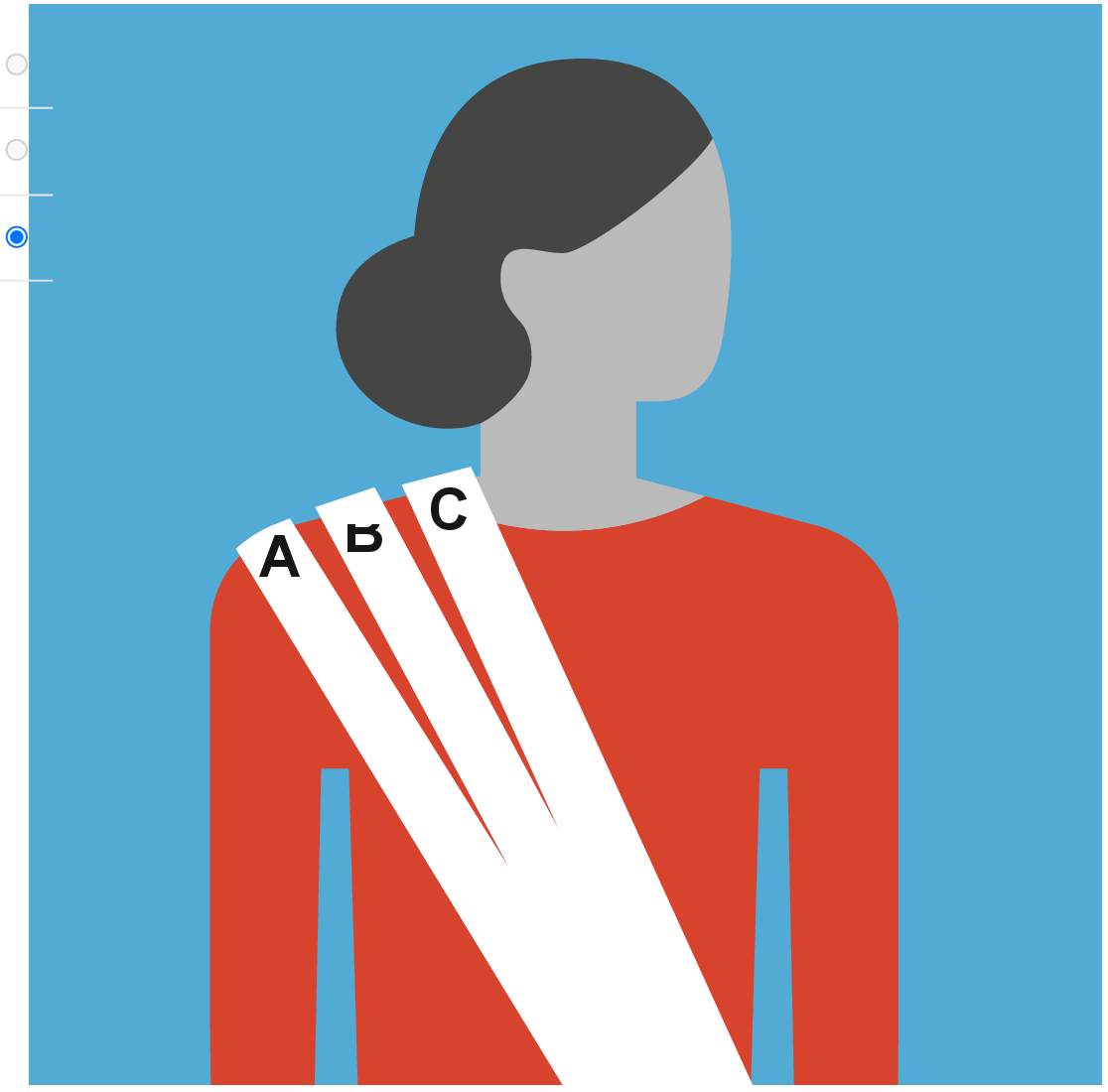
How should the seat belt be positioned?

Picture for question 36

Explanation

“The diagonal strap is to go across the chest, as close to the neck as possible.”

NTF

When the belt is placed close to the neck, it creates the best protection and reduces the risk of injury.

Question 37

You are driving the car from which the picture is taken and intend to turn right. Are you allowed to pass the stationary cars?

Picture for question 37

Explanation

Normally it is prohibited to overtake on the right side. However, there are exceptions:

“In the following cases, it is not considered overtaking when a vehicle in one lane passes a vehicle in another lane: 1. if the carriageway has two or several lanes in the same direction and there is heavy queue formation in all lanes, 2. if the carriageway is divided into lanes for different destinations that are marked with lane assignment signs, or 3. or if the vehicles were in separate lanes in conjunction with a junction.”

Swedish Road Traffic Ordinance
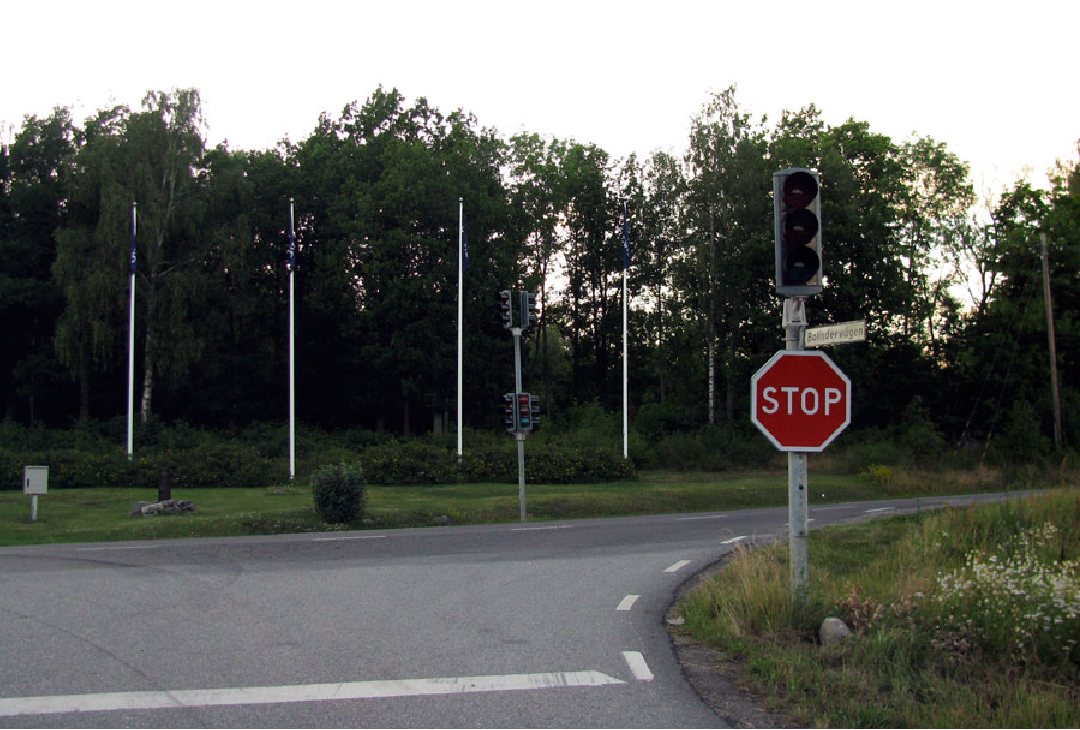
Question 38

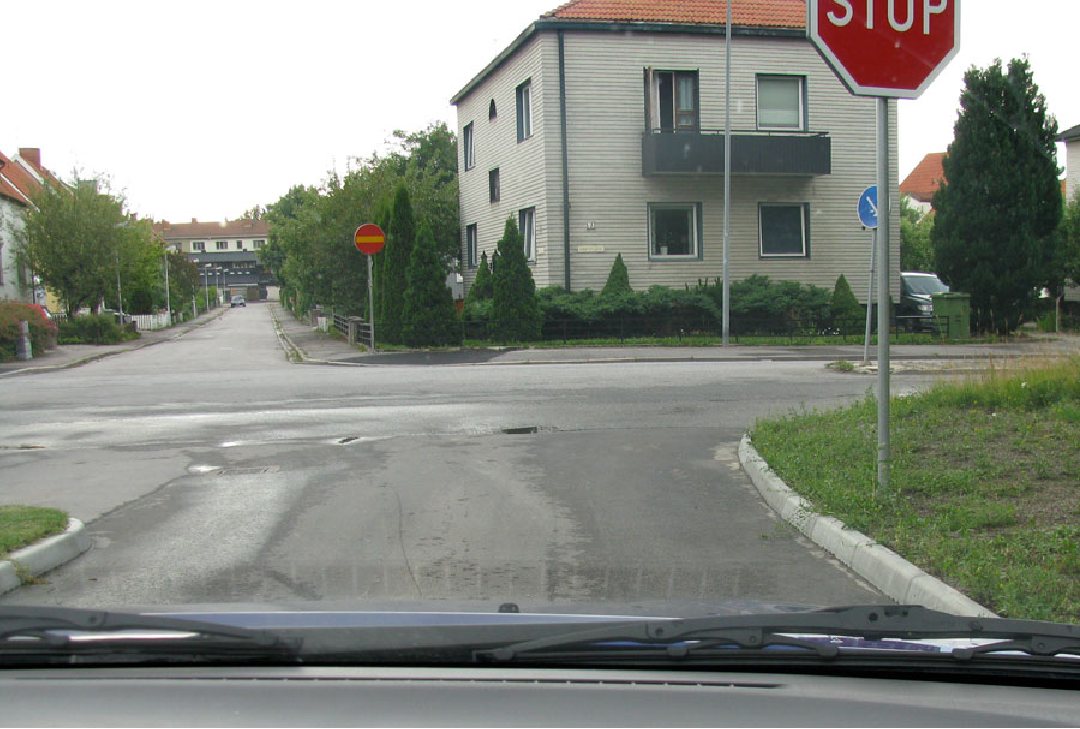
Is there an occasion on which you can ignore the stop sign and also drive into the street straight ahead?

Picture for question 38

Explanation

Sometimes you receive several messages simultaneously in traffic. You then must choose which to adhere to. This is the order you should follow:

  1. Police signals
  2. Traffic signals
  3. Road signs
  4. Rules (the right hand rule)

Police signals thus take priority over the stop sign and prohibition sign.

Question 39

The road conditions are as in the photo. Suddenly, an obstacle appears 40 metres down the road, which causes you to brake quickly. Approximately how long will your reaction distance be if your reaction time is 1 second and you are driving at 70 km/h?

Picture for question 39

Explanation

First, consider the calculations of stopping distance, reaction distance and breaking distance.

Reaction distance:

  • remove the zero in the speed * reaction time * 3
  • 7 * 1 * 3 = 21 rounded to 20 metres

The image and the condition of the road are actually irrelevant to the answer. These factors only come into play when estimating the braking distance. The distance to the obstacle is also irrelevant.

Why does the question contain unnecessary information?

– It shows whether you really know what you are doing and that you are certain. Also not that there are very few questions that try to trick you like this.

Question 40

Is defensive driving good?

Explanation

Driving defensively makes for safer traffic. Examples of defensive driving:

  • Take no unnecessary risks.
  • Make sure to have wide safety margins.
  • Stay vigilant.
  • Do not stress, make sure you have plenty of time.
  • Be prepared for unexpected things to happen.
  • Analyse the situation before doing anything else.
  • Think ahead and imagine what could happen.
  • Drive smoothly and brake in good time.
Question 41

What does an inexperienced driver primarily focus on in traffic?

Explanation

“Inexperienced drivers will often fix their gaze on stationary objects.”

Driving Licence Book, 19th Edition, page 197
Question 42

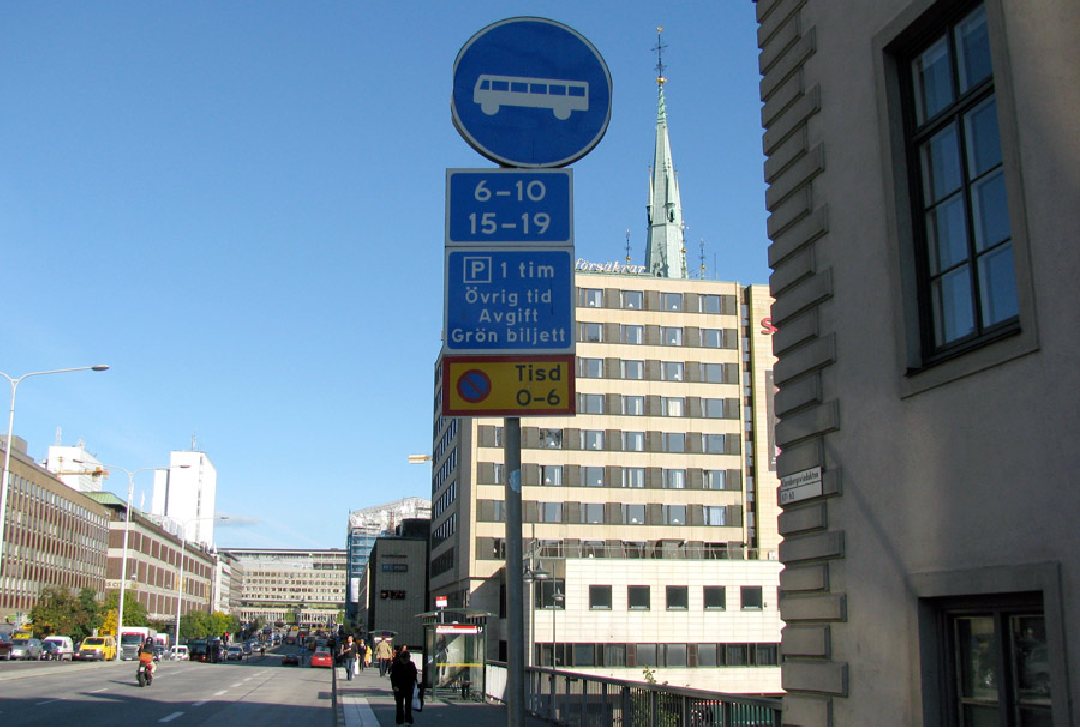
It is 14:30 on a Tuesday. Which option is true?

Picture for question 42

Explanation

”1 tim” = 1 hour

”Övrig tid” = Other times

”Avgift” = Fee

”Grön biljett” = Green ticket

”Tisd” = Tuesday

According to the additional panel, the public transport lane comes into use at 15:00. In other words, it does not stop you from parking.

The parking prohibition on Tuesdays starts at midnight and is then in force until 06:00 on Tuesday morning. In other words, there is no parking prohibition now in the afternoon.

The sign indicating the times along with the additional panel with the P symbol is to be interpreted like this: Parking is permitted (a fee is payable, the ticket you buy is green) for a maximum of one hour, provided that the time is not 06:00–10:00 or 15:00–19:00.

In other words, parking is permitted for one hour according to the sign. However, as the time is 14:30, you can only park for 30 minutes, because at 15:00 the public transport lane comes into use.

Question 43

Is it true that road signs normally takes priority over traffic signals?

Explanation

The opposite is true:

  1. Police signals
  2. Traffic signals
  3. Road signs
  4. Rules (the right-hand rule such as)
Question 44

What is true when it comes to roundabouts?

Explanation

“There is no requirement to signal when entering [...] You are to signal when changing lanes or otherwise moving sideways. […] When you exit the roundabout, you are to signal to the right.”

Swedish Transport Agency
Question 45

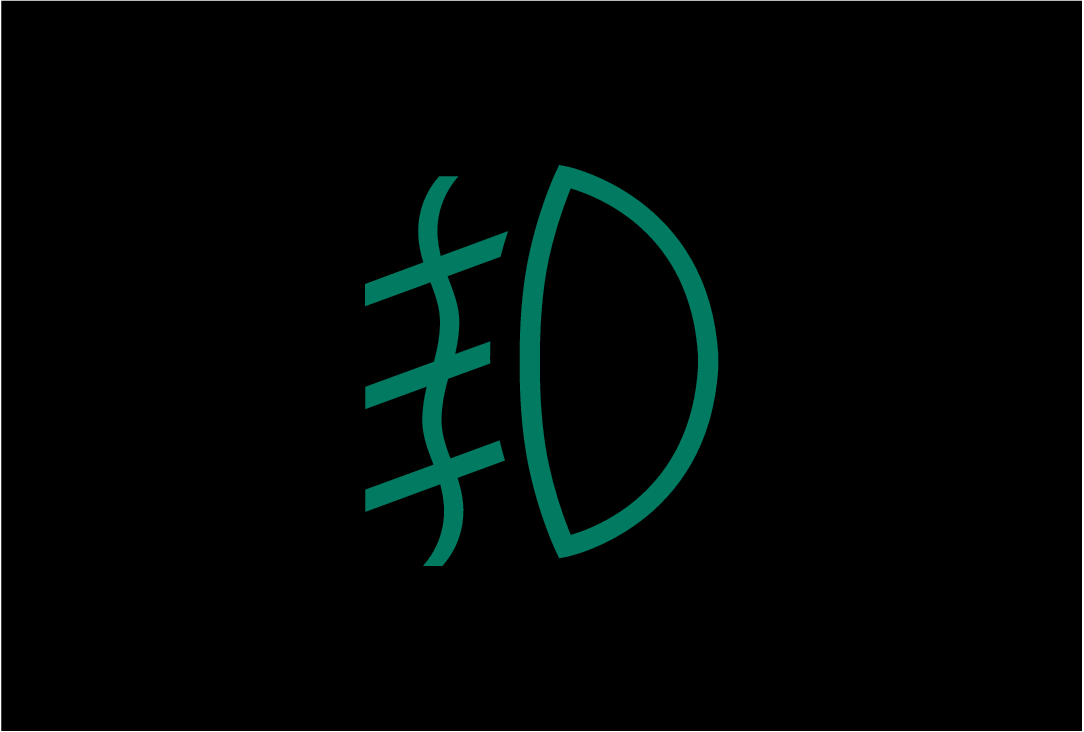
What does it mean if this lamp lights up on the dashboard?

Picture for question 45

Explanation

“Fog lights”

Driving Licence Book

Note that there is a similar question that is about the rear fog lights.

Question 46

Which age group has the best reaction times in traffic?

Explanation

“Younger drivers react significantly slower than experienced drivers. The age group with the best reaction time is experienced drivers between the ages of 45–54. […] The explanation is likely that the experienced driver is often more prepared to act.”

Driving Licence Book, 19th Edition, page 199

Remember that this applies in traffic, where you are not prepared at each given moment to react quickly. A person with a 2-second reaction time in traffic may have a reaction time of 0.7 seconds in a test where you have to push a button at the sound of a signal.

Question 47

Who are counted as road users?

Explanation

“Road user [...] Those travelling or otherwise sojourning on a road or in a vehicle on a road or in terrain as well as those travelling across terrain”

Road Traffic Definitions Act
Question 48

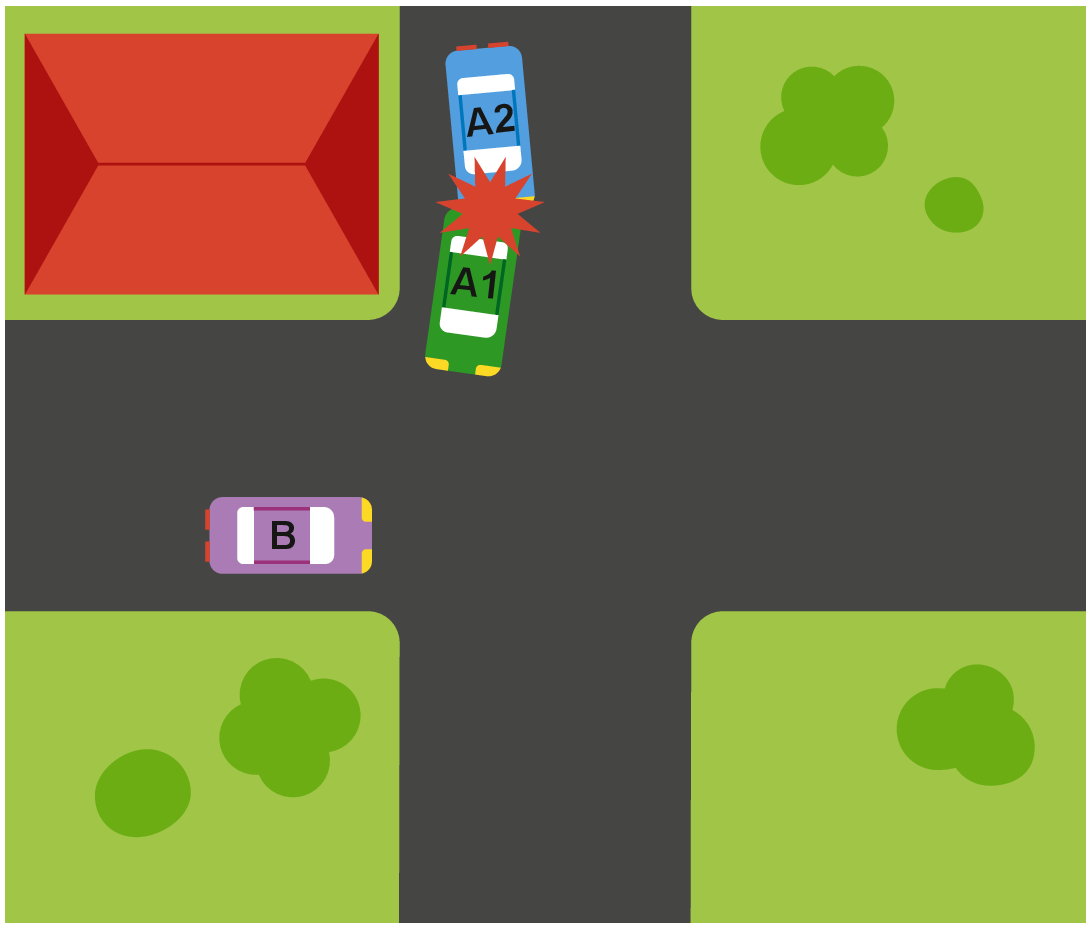
You are driving car B and rolling slowly out in the junction. A1 comes at high speed and is forced to break quickly, which results in A2 driving into A1 from behind. Which statement is true?

Picture for question 48

Explanation

“A road user who, regardless of blame, has been involved in a traffic accident shall remain on the scene.”

Swedish Road Traffic Ordinance

“Been involved in” = you have in some way been involved in or contributed to the accident happening. In this case, it is you who caused A1 to brake, which means that you “are involved in” the accident.

Note that you probably have not done anything wrong! The reasons why you must remain at the scene of the accident:

  • To help the injured.
  • To provide a witness statement.
Question 49

What type of diesel is sold in Sweden?

Explanation

“Environmental class 1 has been the predominant diesel fuel on the Swedish market since 1995: all diesel sold in regular petrol stations is environmental class 1.”

Swedish Transport Agency
Question 50

What does it usually mean if a person standing at a pedestrian crossing point is holding a white cane pointed outward?

Explanation

“Immediately before a visually impaired person walks out into the street, they stretch their cane outwards”

Du och jag i trafiken [You and me in traffic], 28th Edition, page 218
Question 51

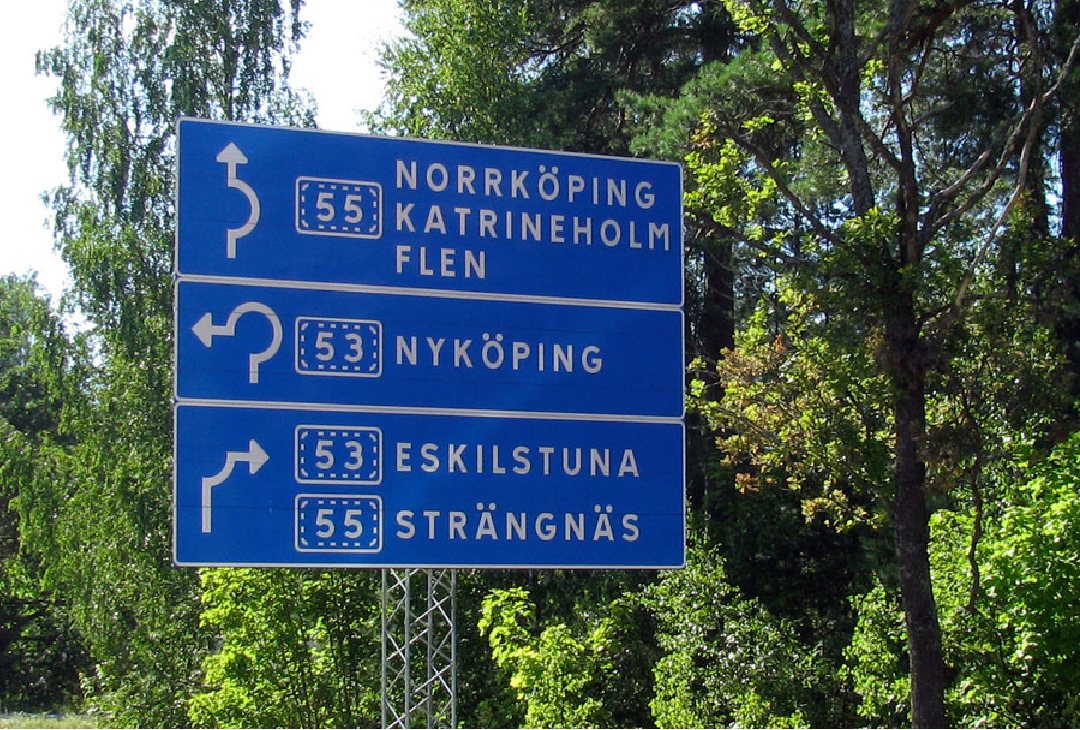
How can you drive to get to road 55?

Picture for question 51

Explanation

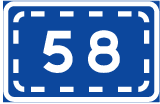
Road number (F14)
Road numberF14

“A road number is only given for roads in the number group 1-499. A sign with a dashed border indicates that the road is leading to the route with the number on the sign.”

The first options are wrong since the word only is used.

Question 52

What is declutching?

Explanation

“declutching […] (temporarily) break the connection between the driving shaft and the driven shaft of the engine: with ~d engine”

Nationalencyklopedin
Question 53

Which statement is true?

Explanation

Aggravated drunk driving: “The sanction is imprisonment for no more than two years. […] gross negligence manslaughter, the sanction can be up to six years in prison.” (Driving Licence Book, 19th Edition, page 209)

Question 54

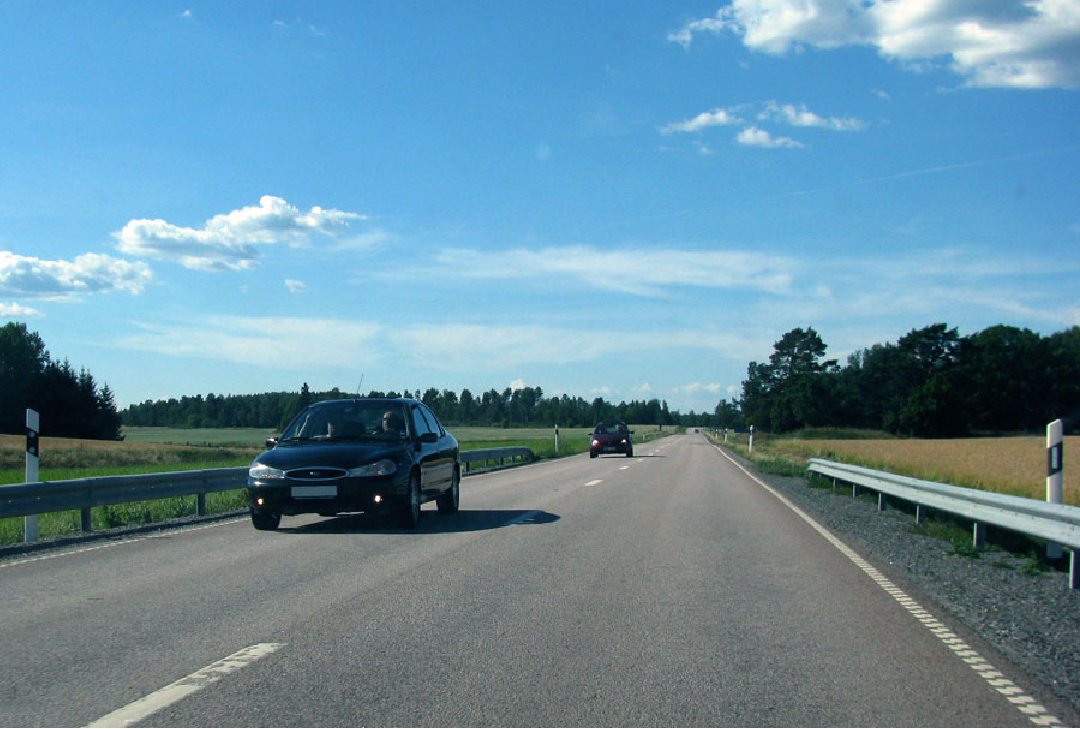
How should you position the car when you are driving on a country road void of traffic in the dark?

Picture for question 54

Explanation

In the dark it is better to drive closer to the middle of the road (keep left in the lane), since it is more difficult to see what is happening along the edges, for example, if an animal jumps out.

If you encounter an oncoming car, however, you should move a little to the right to reduce the risk of a head-on collision.
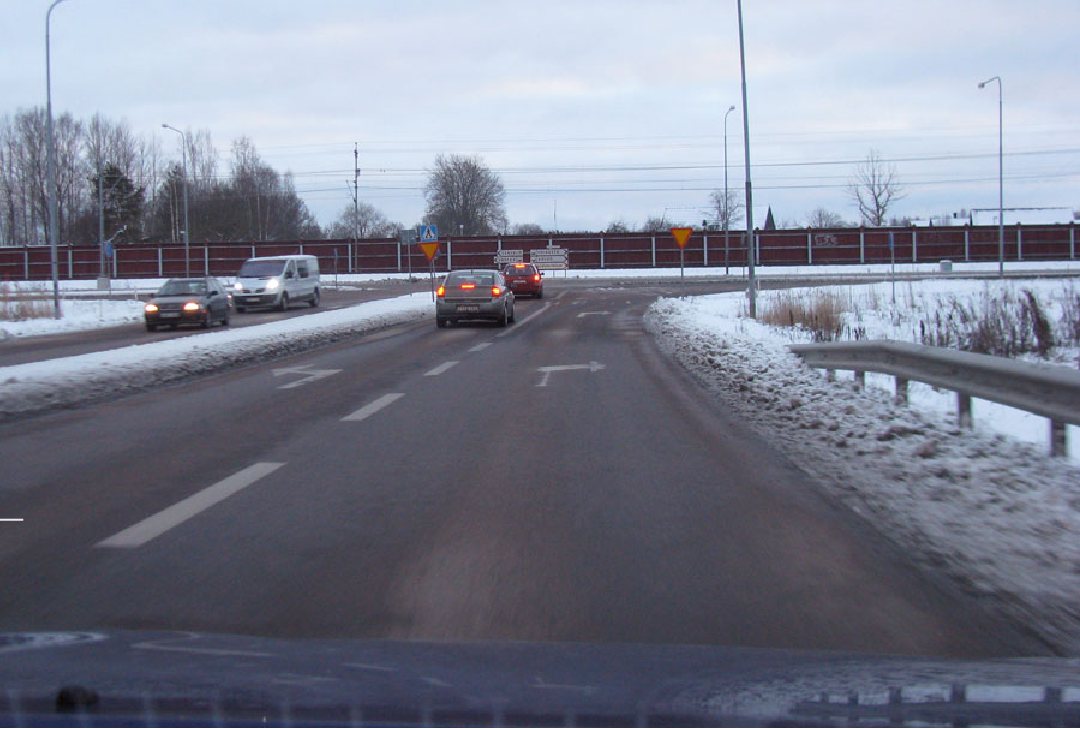
Illustration for question 54

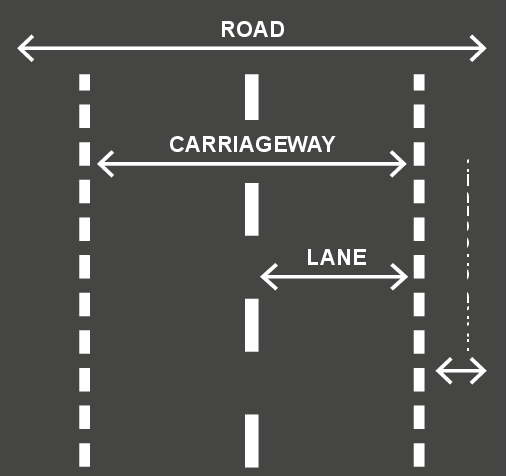
Note: Keeping left in the lane often more or less means the same position as driving close to the middle of the carriageway. See the definitions:

Illustration for question 54
Question 55

Which sign indicates bicycle crossing?

Picture for question 55

Explanation

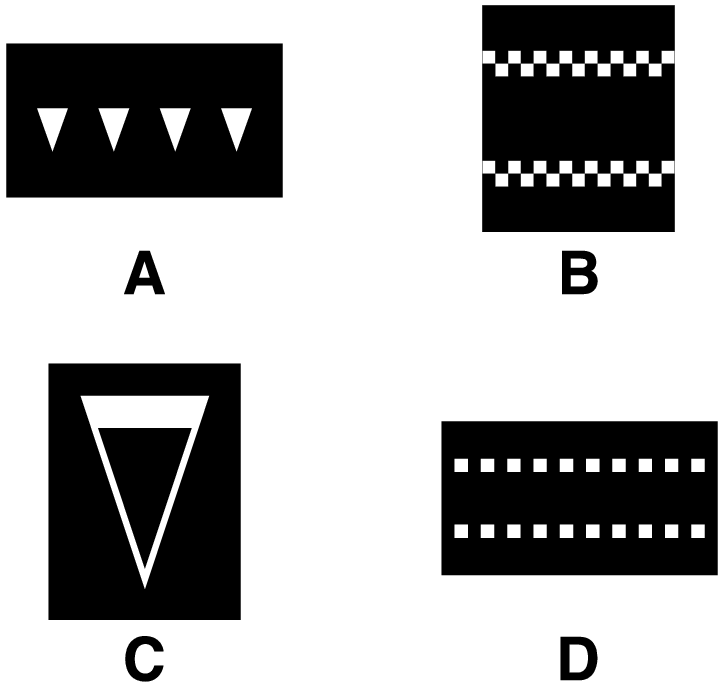
A: Give way line (M14)
AGive way lineM14

“This marking indicates the line that a vehicle should not pass when the driver is observing the obligation to give way.”

B: Speed bump (M17)
BSpeed bumpM17

“This marking indicates a speed bump, gutter or similar obstacle.”

C: Preparatory information regarding the obligation to give way or to stop (M18)
CPreparatory information regarding the obligation to give way or to stopM18

“This marking indicates that there is an obligation to give way or to stop further down the road.”

D: Bicycle passage or bicycle crossing (M16)
DBicycle passage or bicycle crossingM16
Question 56

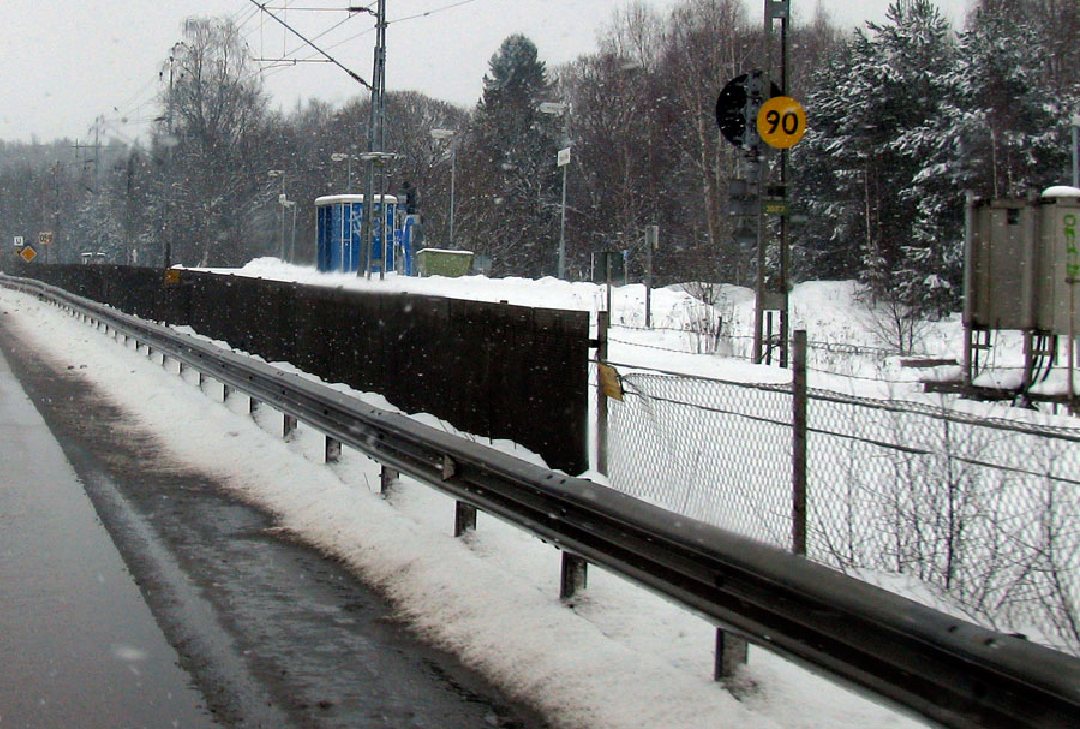
You are driving the car from which the picture is taken. What is the maximum permitted speed on this road?

Picture for question 56

Explanation

The sign is posted within the track area, and therefore only relates to railway traffic.

Question 57

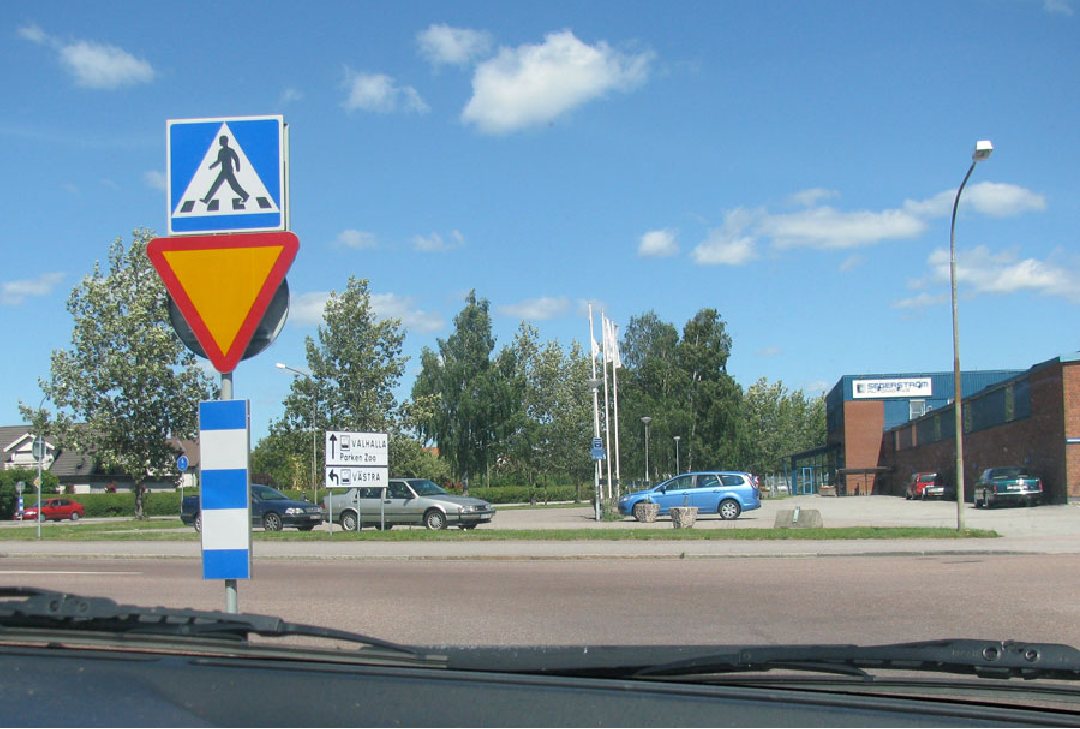
Do you always need to stop before driving out on the intersecting road in the situation in the picture?

Picture for question 57

Explanation

“A driver who is obliged to give way shall clearly show their intention to yield by slowing down or stopping in good time. The driver may continue driving only if there is no risk or obstruction involved, with regard to other road users’ position, the distance to them and their speed.”

Swedish Road Traffic Ordinance

You therefore do not need to stop if there are no other road users on the intersecting road that you would disrupt by driving out.

Question 58

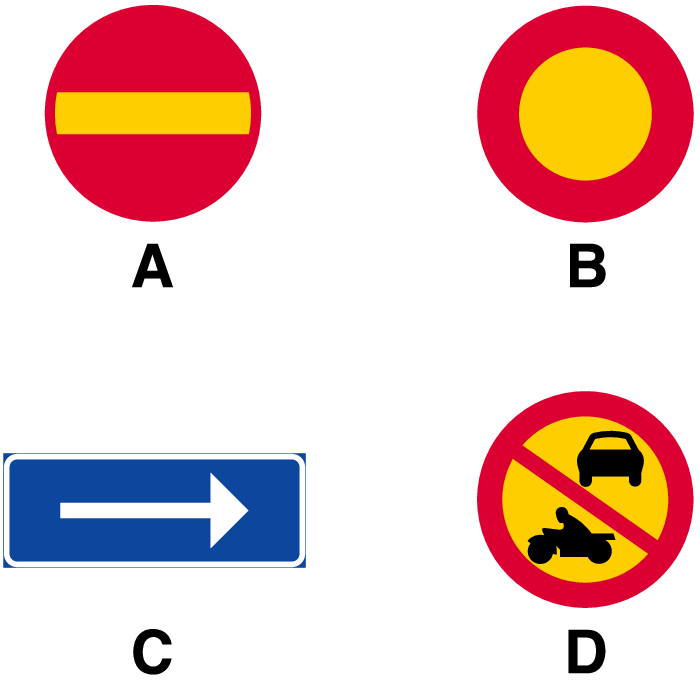
Which sign indicates no entry?

Picture for question 58

Explanation

A: No entry (C1)
ANo entryC1
B: No vehicles (C2)
BNo vehiclesC2

“The sign refers to traffic with vehicles in both directions.”

C: One-way traffic (E16)
COne-way trafficE16

“The sign indicates that vehicle traffic on the road is one-way in the direction of the arrow. An arrow pointing up indicates that the traffic is one-way in a forward direction.”

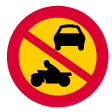
D: No motor vehicles other than class II mopeds (C3)
DNo motor vehicles other than class II mopedsC3

“If the prohibition also applies to class II mopeds, this is indicated on an additional panel.”

Question 59

What is infrasound in the context of traffic?

Explanation

“Road traffic produces [...] and inaudible sound, i.e. infrasound.”

Driving Licence Book, 19th Edition, page 228
Question 60

You are driving up a slope and right at the top you spot a tractor coming towards you. What should you pay particular attention to in this situation?

Explanation

The question specifies that you are going uphill. Is there any alternative where the slope means that you should pay particular attention to a certain aspect?

Review of the options:

  • The large rear wheels of the tractor increases the risk of loose chippings.
    – They would rather reduce the risk, as the tractor is driving at a low speed.
  • Vehicles behind the tractor may overtake it.
    – Drivers behind the tractor may feel stressed by the low speed, and they have limited visibility due to the slope. The low speed of the tractor combined with the limited visibility on the slope means that this alternative is well suited as something to be particularly attentive of.
  • The width of the tractor forces you out on the hard shoulder.
    – The slope has no impact on this, meaning that you do not have to pay particular attention.
  • The driver of the tractor is young and inexperienced when it comes to regular road traffic.
    – The driver may just as well be very experienced, so this is not a good alternative.
Question 61

You want to transport a box on the car’s roof. The car is 160 cm wide and the width of the box is 175 cm. Are you allowed drive the car with this load on a public road?

Explanation

“If a motor vehicle or a vehicle coupled to this has a load where either side protrudes more than 20 centimetres outside the vehicle, or if the vehicle’s width, including load, exceeds 260 centimetres, [...] the vehicle or a vehicle coupled to this may only be driven on a private road.”

Swedish Road Traffic Ordinance

The measurement is under 260 cm and the load may protrude up to 15 cm from the side (175- 160=15). The load is therefore within the parameters.

Question 62

What does this road sign mean?

Picture for question 62

Explanation

Emergency site (F33)
Emergency siteF33

“The sign indicates an emergency site during roadworks or similar. No other colour may be used.”

Question 63

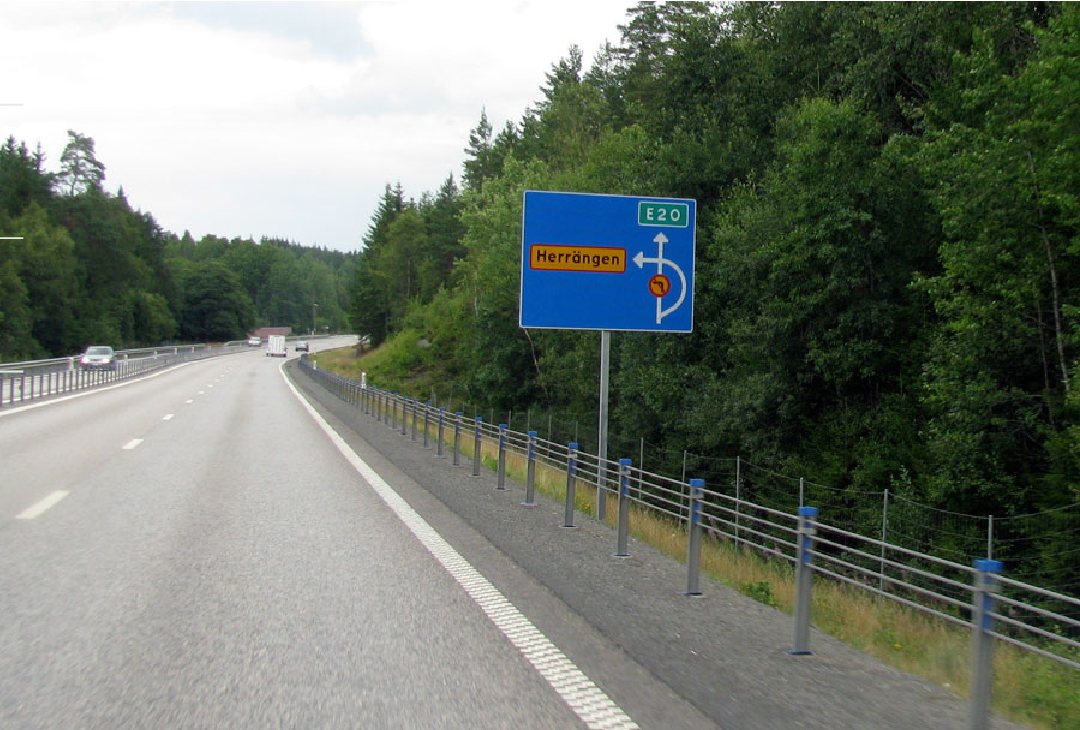
What type of turn needs to be made to be able to drive towards Herrängen?

Picture for question 63

Explanation

The Spanish turn is not mentioned in any law texts, but is a well-established term that is mentioned in both the Driving Licence Book (19th Edition, page 94) and Du och jag i trafiken [You and me in traffic] (28th Edition, pages 256). You should therefore be familiar with the term.

Question 64

How fast may you drive in a car towing a trailer without brakes whose total weight exceeds half of the car’s unladen weight?

Explanation

“Vehicles with unbraked trailers whose total weight [...] exceeds half of the towing vehicle’s unladen weight. [may drive at a maximum of] 40 [km/h]”

Swedish Transport Agency
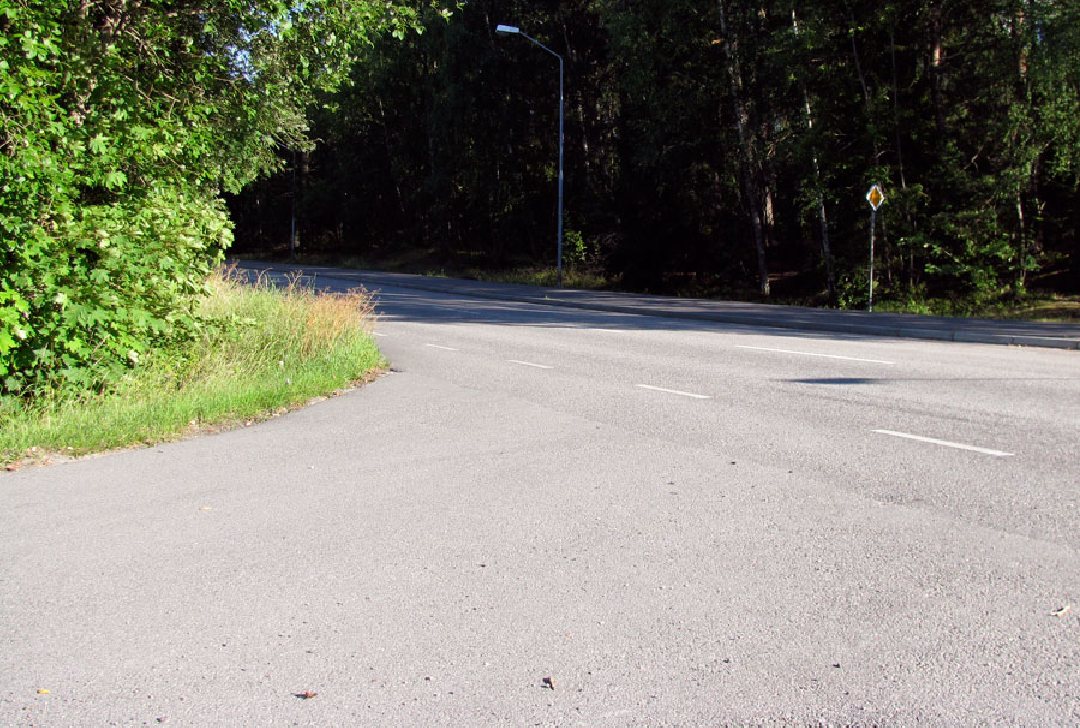
Question 65

The picture is taken from the driver’s side window of the car you are driving. What should you do if you want to turn right on the intersecting road?

Picture for question 65

Explanation

The road you want to turn out onto is a priority road (see the sign to the right of the picture). This means that the last option is wrong.

You cannot make a good assessment of the traffic situation from where you are positioned. You therefore need to drive a bit further forward.

Question 66

In which of the following situations does the right-hand rule not apply?

Explanation

“The right hand rule does not apply [...] in a roundabout”

Driving Licence Book, 19th Edition, page 41
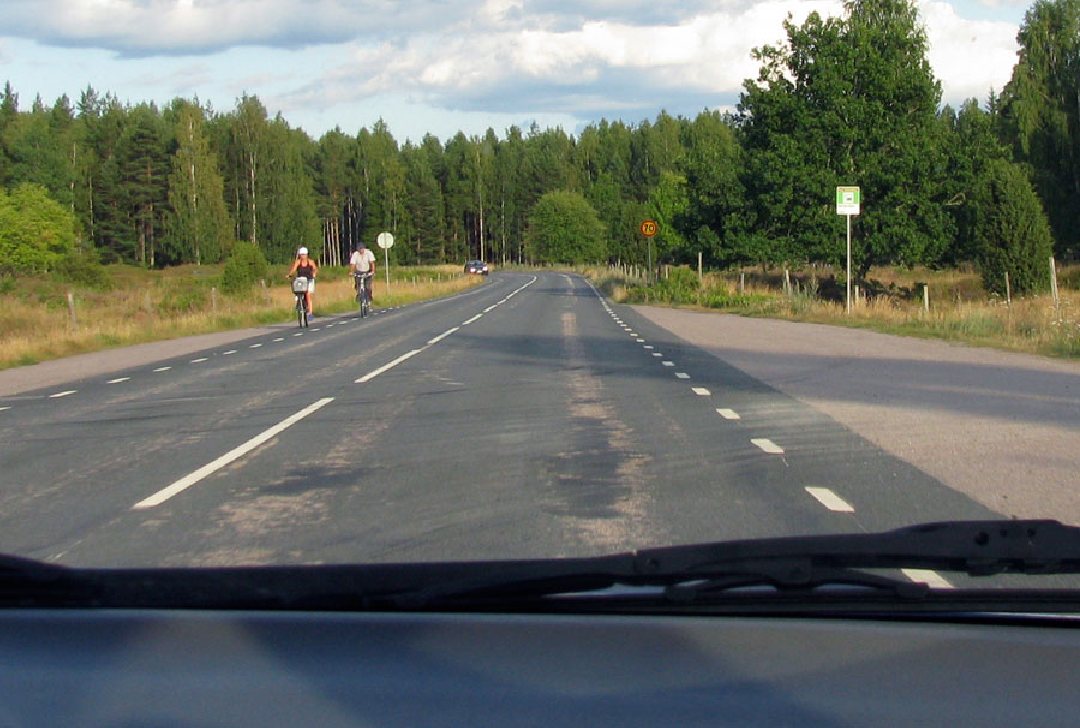
Question 67

You are driving the car from which the picture is taken. How should you act?

Picture for question 67

Explanation

The reasons why you should not drive extremely close to the right edge:

  • The cyclists are far to the left = there is no reason to increase the margins between you and the cyclists.
  • A hard shoulder starts just by the cyclists = increased safety margin.
  • The possibility for you to steer over to the right decreases significantly at the 70 sign = you must in that case carry out an abrupt and possibly dangerous manoeuvre.
  • The oncoming car is so far away that you will pass the cyclists before the oncoming car reaches them (can be seen by counting the number of centre lines from you to the cyclists and from the cyclists to the oncoming car, as well as by comparing the cyclists’ size to the car – the cyclists are significantly bigger = the car is far away).

If there is no reason to do something, it is safest and best to continue as normal.

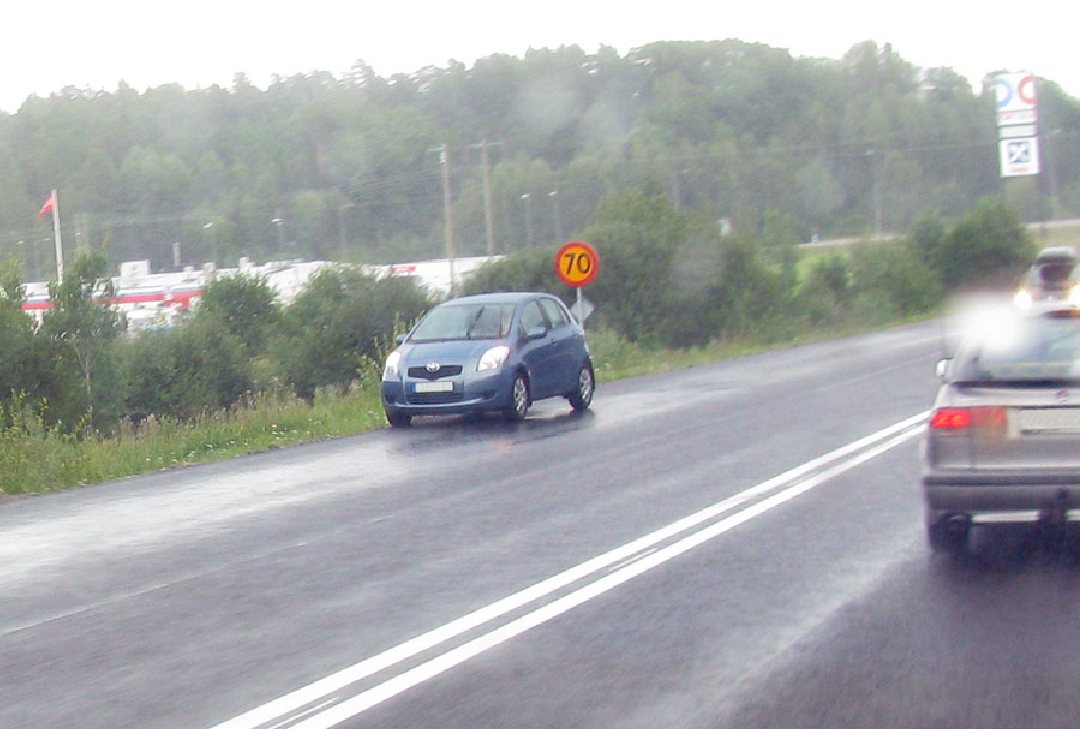
Question 68

The driver of the car in the centre of the picture has pulled over to the side of the road to answer their phone. Why is it prohibited here?

Picture for question 68

Explanation

Review of the options:

  • The weather means that this may present a traffic hazard
    – It is certainly raining, but visibility still seems to be good and it is not dark. The weather is therefore not a big enough problem for stopping to be classed as a traffic hazard.
  • The centre line is solid, which prevents the traffic behind from overtaking
    – It looks like there is a margin of at least two car widths to overtake on, so there is no problem with the margins. The fact that the line is solid does not automatically entail that overtaking is prohibited.
  • The road is a priority road
    – It can be observed that the road is a priority road by looking at the back of the sign under the 70 sign. The sign below the 70 sign could signal the end of the priority road, but by applying the exclusion method to the other options, you can assume that it is not an end sign (no option would be correct if it was an end sign).

Answering a mobile phone counts as parking, not stopping. See the Driving Licence Book (19th Edition, page 104): “The parking prohibition on the priority road means that you may not even stop and answer your phone”.

As parking is prohibited on priority roads (assume that it is a priority road, see the above point), it is prohibited to answer a mobile phone at this location.
Question 69

Which alternative is a characteristic of a mature driver?

Explanation

A mature driver listens to their passengers but makes their own decisions about what to do.
Listening to the passengers and adapting to their will can be both good and bad. It is good if the passengers are asking the driver to slow down because they have seen animals on the side of the road. It is bad if the passengers say that they are moving too slowly, pressuring the driver to make a dangerous overtaking.

Question 70

What is the total weight of the car if the driver weighs 75 kg, the maximum load is 500 kg and the unladen weight is 1,300 kg?

Explanation

Total weight = unladen weight + maximum load

The unladen weight is the car’s “weight when unloaded [...], including the driver” (Driving Licence Book, 19th Edition, page 246).

The driver’s weight of 75 kg has already been included in the unladen weight of 1,300 kg. That means that only the load has to be added to get the total weight: 1,300 kg + 500 kg = 1,800 kg.